 Trump administration offers mixed messages on limits to Ukraine’s Starshield access
  US Treasury proposes a rule to crack down on high-tech investments in China, other adversaries
  Calley Means, a key MAHA advocate, resigns as a top RFK Jr. adviser
  Spotify Tightens Family Plan Controls with QR Code Verification
  Use of Chief Minister C. Joseph Vijay’s deep fake videos to collect money: Rajasthan youth moves Madras High Court seeking bail
 BJP Organisational Reshuffle 2026: Smriti Irani, Vasundhara Raje and Ram Madhav Get Key Roles in Nitin Nabin’s New Team
**
BJP Organisational Reshuffle 2026: Smriti Irani, Vasundhara Raje and Ram Madhav Get Key Roles in Nitin Nabin's New Team - AI News Breaking
organisational reshuffle 2026 smriti:
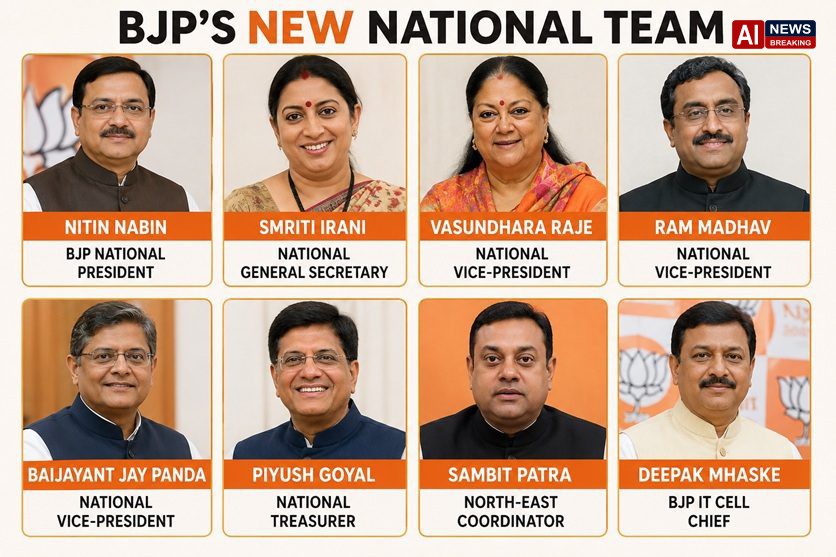
The Bharatiya Janata Party on Monday, August 17, announced a major restructuring of its national organisation under party president Nitin Nabin. The new team includes former Union minister Smriti Irani as a national general secretary, while former Rajasthan Chief Minister Vasundhara Raje, Ram Madhav and Baijayant Jay Panda have been appointed national vice-presidents.
The reshuffle also brings changes to the BJP’s treasury, communications and organisational machinery, with Piyush Goyal appointed national treasurer and Sambit Patra given responsibility as the party’s North-East coordinator. Amit Malviya has been replaced as head of the BJP’s IT cell, with Deepak Mhaske taking over the role.
Full Picture of the New Leadership Structure
The most prominent changes announced on August 17 include:
- Nitin Nabin — BJP national president.
- Smriti Irani — National general secretary.
- Vasundhara Raje — National vice-president.
- Ram Madhav — National vice-president.
- Baijayant Jay Panda — National vice-president.
- Piyush Goyal — National treasurer.
- Sambit Patra — North-East coordinator.
- Deepak Mhaske — BJP IT cell chief.
BJP Announces New National Team Under Nitin Nabin
New Delhi: The Bharatiya Janata Party has unveiled a sweeping organisational reshuffle, giving national prominence to several experienced leaders while introducing changes across its key organisational departments.
The appointments were announced on August 17 under BJP national president Nitin Nabin, marking his first major restructuring of the party’s central organisation since taking charge.
The new national team includes 13 national vice-presidents, eight national general secretaries and 16 national secretaries, alongside changes in several other important organisational positions.
The reshuffle has immediately attracted political attention because several prominent leaders who had occupied important positions in national politics have been given renewed organisational responsibilities.
Among the most prominent appointments is Smriti Irani’s return to a key BJP organisational position.
The former Union minister has been appointed a national general secretary.
Former Rajasthan Chief Minister Vasundhara Raje and BJP strategist Ram Madhav have been named national vice-presidents, while Odisha leader Baijayant Jay Panda has also been elevated to the vice-presidential team.
The changes suggest an effort to combine political experience, organisational reach and electoral strategy as the BJP prepares for the next phase of its political campaign.
Smriti Irani Returns to BJP’s National Organisation
One of the most closely watched appointments is that of Smriti Irani.
Irani has been appointed a national general secretary, bringing one of the BJP’s most recognisable political campaigners back into a prominent organisational role.
Her return is politically significant because of her previous experience in national elections, government and the BJP organisation.
Irani became one of the BJP’s most prominent national faces during the 2014 and 2019 general elections. Her 2019 victory in Amethi over Rahul Gandhi turned her into one of the party’s most high-profile campaigners.
Although she lost the Amethi Lok Sabha seat in 2024, her political profile within the BJP remained significant.
Her new assignment gives her an opportunity to operate at the national organisational level rather than being defined solely by electoral politics.
The appointment is also being viewed in the context of the BJP’s preparations for upcoming assembly elections, particularly the politically crucial contest in Uttar Pradesh.
Her communication skills, familiarity with national campaigning and experience in dealing with the Congress leadership could make her an important asset for the BJP’s electoral strategy.
Vasundhara Raje Gets Key National Role
Former Rajasthan Chief Minister Vasundhara Raje has also been appointed a national vice-president.
Raje is one of the BJP’s most experienced state-level leaders and has previously served as Rajasthan chief minister as well as a Union minister.
Her inclusion in the new national team gives the party another senior leader with extensive electoral and administrative experience.
Raje has maintained a substantial political presence in Rajasthan for decades.
Her return to a prominent national organisational position is therefore significant for both Rajasthan politics and the BJP’s broader leadership structure.
The appointment also indicates that the new BJP leadership is not relying exclusively on younger leaders.
Instead, the party appears to be retaining experienced political figures who can contribute to organisation-building, election strategy and coordination between the central leadership and state units.
Ram Madhav Returns to the National Leadership Structure
Ram Madhav has also been appointed a national vice-president.
Madhav has been associated with the BJP’s organisational and strategic work for many years and previously held important responsibilities within the party.
His experience in political strategy, organisational coordination and the BJP’s wider ideological ecosystem makes his return noteworthy.
His new assignment could be particularly important as the BJP seeks to strengthen its organisational network and prepare for multiple electoral contests.
The inclusion of Madhav alongside Raje and Jay Panda adds considerable political experience to the new vice-presidential team.
Baijayant Jay Panda Gets Vice-President Role
Odisha leader Baijayant Jay Panda has also been appointed a national vice-president.
Panda has held important responsibilities within the BJP and has been one of the party’s prominent leaders from Odisha.
His appointment strengthens the representation of eastern India within the party’s central organisational structure.
The BJP has been attempting to consolidate its political expansion across eastern and northeastern states, making experienced leaders from the region particularly important to the party’s organisational strategy.
Panda’s elevation therefore carries both organisational and geographical significance.
Piyush Goyal Appointed National Treasurer
Another important change is the appointment of Union minister Piyush Goyal as the BJP’s national treasurer.
The treasurer’s position is central to the party’s organisational functioning, particularly as the BJP manages a nationwide political network and prepares for multiple elections.
Goyal brings extensive experience in government, economics and political organisation to the role.
His appointment places a senior Cabinet-level political figure in charge of an important organisational function.
The move also demonstrates the importance being attached to financial and administrative management as the BJP prepares for future political campaigns.
Sambit Patra Gets North-East Responsibility
BJP national spokesperson Sambit Patra has been appointed the party’s North-East coordinator.
The assignment is strategically important because northeastern states have become an increasingly significant component of the BJP’s national political strategy.
The region has complex political dynamics, diverse ethnic identities and distinctive electoral alliances.
Patra’s new role is expected to involve coordination with the party’s state organisations and leadership across the northeastern states.
His appointment reflects the BJP’s continued emphasis on strengthening organisational coordination in the region.
Amit Malviya Replaced as BJP IT Cell Chief
One of the most consequential changes involves the BJP’s digital and information machinery.
Amit Malviya has been replaced as head of the party’s IT cell, with Deepak Mhaske taking over the position.
Malviya had become one of the BJP’s most recognisable digital strategists, particularly through the party’s social-media operations and rapid-response political communication.
His replacement therefore represents more than a routine organisational change.
The BJP’s digital infrastructure has played an increasingly important role in political campaigning, message amplification, opposition attacks and voter outreach.
The appointment of a new IT cell chief could indicate a broader effort to recalibrate the party’s digital strategy ahead of future electoral battles.
What the New Team Says About BJP Strategy
The composition of the new team suggests that Nitin Nabin is attempting to build an organisation that combines experienced political leaders with operational and communication specialists.
The BJP has not simply replaced old office-bearers with new faces.
Instead, the reshuffle includes several leaders with substantial political backgrounds.
Smriti Irani brings national campaign experience.
Vasundhara Raje brings extensive state-government and electoral experience.
Ram Madhav brings organisational and strategic experience.
Baijayant Panda brings experience from Odisha and national politics.
Piyush Goyal brings government and economic experience.
Sambit Patra brings communication and regional coordination experience.
Together, these appointments create a team with a broad range of political capabilities.
Ten Women Included in New BJP National Team
The BJP’s new organisational structure also includes significant representation of women.
According to reports, 10 women leaders have been included among the national office-bearers.
Smriti Irani and Vasundhara Raje are among the most prominent names.
The presence of women across the organisational structure allows the BJP to present its national team as broader and more representative of different sections of its political base.
The party has increasingly focused on women’s political participation and outreach as an important component of its electoral strategy.
The organisational reshuffle therefore has a representational dimension in addition to its strategic purpose.
Six Minority Leaders Also Included
The BJP has also highlighted representation from minority communities in the new national team.
Reports say six leaders from minority communities have been included among the national office-bearers.
Among those mentioned is Professor Tariq Mansoor.
The appointments give the party an opportunity to strengthen its outreach to communities that have traditionally had a more limited presence within the BJP’s organisational structure.
The move may become particularly important as the BJP seeks to broaden its social coalition in states where electoral contests are increasingly competitive.
Focus on the Next Electoral Cycle
The timing of the reshuffle is important.
The BJP is preparing for a series of major political contests, and organisational appointments made now are likely to influence campaign planning, candidate coordination and state-level strategy.
The party needs a national structure capable of quickly responding to political developments while maintaining coordination between its central and state organisations.
The new appointments therefore have implications beyond internal party administration.
They are likely to shape how the BJP approaches upcoming assembly elections and its longer-term preparations for the next Lok Sabha contest.
Uttar Pradesh Could Be a Major Focus
Smriti Irani’s appointment as national general secretary is particularly noteworthy in relation to Uttar Pradesh.
The state remains one of the most important electoral battlegrounds in Indian politics because of its size and its large representation in the Lok Sabha.
Irani has extensive experience campaigning in Uttar Pradesh and has previously been closely associated with the Amethi contest.
Her new national organisational role could give the BJP an additional senior leader with familiarity with the state’s political landscape.
The appointment does not by itself establish a specific electoral assignment for Irani, but her experience makes her potentially valuable in the party’s Uttar Pradesh strategy.
The Digital Battlefield Is Changing
The replacement of Amit Malviya as IT cell chief deserves particular attention because political communication has increasingly moved toward digital platforms.
Election campaigns are no longer limited to rallies, television interviews and newspaper advertisements.
Political parties now rely heavily on social media, short-form video, messaging platforms, digital advertising and rapid-response teams.
The BJP has built one of India’s most sophisticated political digital operations.
Changing its leadership at this level could signal a desire to adapt to changing digital consumption patterns.
The challenge for the new IT leadership will be to combine speed with credibility while managing the increasingly fragmented information environment surrounding Indian politics.
Nitin Nabin’s First Major Organisational Test
The reshuffle is also an important test for Nitin Nabin as BJP president.
A party president’s effectiveness is measured not only by public speeches or electoral campaigns but also by the ability to construct an organisation capable of implementing political decisions across states.
The new appointments provide Nabin with a leadership team of his choosing.
That gives him greater organisational control and creates clearer accountability for the party’s performance going forward.
The success of the reshuffle will ultimately be judged by how effectively the new team translates appointments into electoral organisation, booth-level mobilisation, candidate support and communication.
A Balance Between Experience and Renewal
One of the clearest features of the reshuffle is the balance between continuity and renewal.
The party has brought experienced leaders such as Raje and Madhav into senior positions while giving Irani a major organisational responsibility.
At the same time, changes have been made in areas such as digital communication and regional coordination.
This approach allows the BJP to retain institutional knowledge while attempting to modernise parts of its organisational machinery.
For a nationwide political party, that balance is critical.
Too much dependence on established leaders can slow organisational renewal.
Too rapid a generational shift can lead to the loss of experience.
The new team appears designed to avoid both extremes.
Why the BJP Reshuffle Matters
The BJP is not simply India’s largest political party; its organisational structure has become a major component of its electoral strength.
The party’s ability to coordinate campaigns across states, mobilise workers and communicate directly with voters has played an important role in its political expansion.
Consequently, changes in national office-bearers can influence political strategy well beyond the BJP headquarters.
The new appointments will affect how the party manages state units, communicates its political message, prepares election campaigns and responds to opposition strategies.
The reshuffle therefore deserves attention as an indicator of the BJP’s political priorities for the next several years.
The broader team includes 13 national vice-presidents, eight national general secretaries and 16 national secretaries.
The BJP’s August 17 organisational reshuffle represents a significant restructuring of the party’s national leadership under president Nitin Nabin.
The elevation of Smriti Irani to national general secretary is among the most prominent changes, while Vasundhara Raje, Ram Madhav and Baijayant Panda have been appointed national vice-presidents. Piyush Goyal has been given the treasurer’s role, Sambit Patra has received responsibility for coordination in the North-East and Deepak Mhaske has replaced Amit Malviya as head of the BJP IT cell.
The structure combines experienced politicians with organisational and communication specialists and includes 10 women and six leaders from minority communities.
More importantly, the reshuffle comes at a politically consequential moment. The BJP is preparing for future electoral contests and needs an organisation capable of managing increasingly competitive campaigns across multiple states.
For Nitin Nabin, the new team represents both an opportunity and a responsibility. The appointments give him a leadership structure with experienced figures and fresh organisational faces. The real test will now be whether this new team can convert those appointments into stronger grassroots organisation, more effective communication and electoral success.
Insight: The BJP’s latest organisational overhaul appears less like a routine change of office-bearers and more like an attempt to position the party for the next electoral cycle. The combination of Smriti Irani’s national campaigning profile, Vasundhara Raje’s administrative experience, Ram Madhav’s organisational background, Piyush Goyal’s institutional experience and a new digital leadership under Deepak Mhaske points toward a multi-layered strategy rather than a single political objective. The inclusion of 10 women and six minority leaders also suggests that representation and social outreach remain important components of the party’s organisational planning. The most consequential change may ultimately be in the BJP’s communication machinery: replacing a long-established digital strategist indicates that the party recognises that India’s political information ecosystem is changing rapidly. The success of Nitin Nabin’s new team will therefore depend not simply on who occupies each post, but on whether the organisation can integrate experienced leadership with faster grassroots mobilisation, more sophisticated digital communication and effective state-level election management.