Use of Chief Minister C. Joseph Vijay’s deep fake videos to collect money: Rajasthan youth moves Madras High Court seeking bail
 Florida officer took possession of man’s home after finding him dead 4 years ago, police say
 Jury weighs fate of US woman who says father forced her into Syria’s war zone when she was a teen
 France bans certain protests to restore public
Delhi’s Winter Season of Polluted Air Begins
**
Delhi’s Winter Season of Polluted Air Begins - AI News Breaking
delhis winter season polluted:
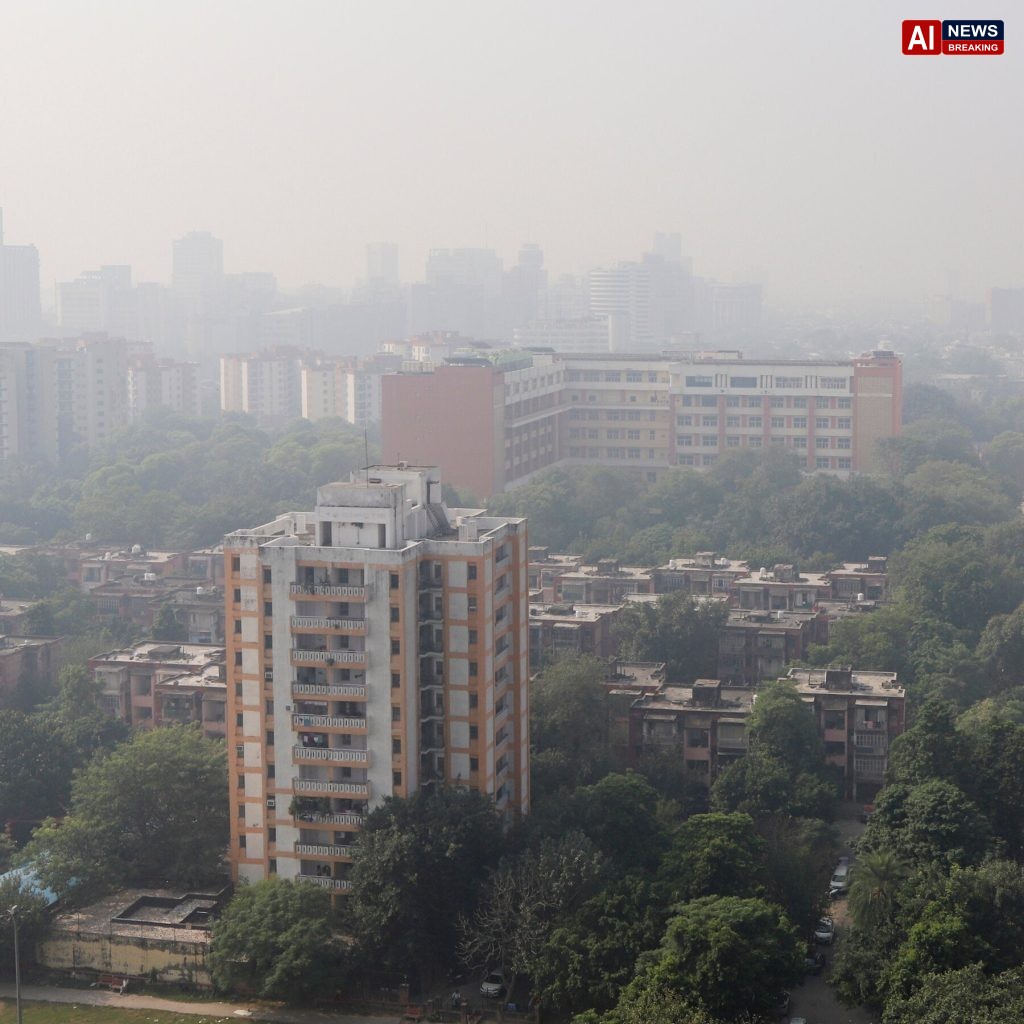
Delhi’s winter has once again become synonymous with a thick, choking haze that hangs over the city’s streets and rooftops, turning everyday commutes into health hazards. Recent measurements from the National Air Quality Index (AQI) show that the capital’s particulate matter (PM2.5) levels have surged to more than 250 micrograms per cubic metre, a figure that far exceeds the World Health Organization’s safe limit of 25. The deterioration has been swift; within a fortnight of the onset of colder temperatures, the AQI has leapt from “moderate” to “severe,” prompting alarm among residents, doctors and policymakers alike.The phenomenon is not new..
Every December, Delhi experiences a convergence of factors that combine to trap pollutants close to the ground. A temperature inversion—a meteorological condition in which a layer of warm air sits above cooler air near the surface—prevents the vertical mixing of the atmosphere, effectively sealing in emissions from traffic, construction, and household heating. At the same time, the region’s agricultural cycle intensifies, with farmers in the neighboring states of Punjab, Haryana and Uttar Pradesh burning crop residues to prepare fields for the next sowing season..
The smoke from these fires adds a substantial load of fine particles to the already polluted urban air.Government officials have acknowledged the gravity of the situation and pledged a series of interventions aimed at curbing the seasonal spike. The Ministry of Environment, Forest and Climate Change announced an accelerated rollout of the Graded Response Action Plan (GRAP), a set of escalating measures that include the temporary closure of schools, restrictions on construction activities, and a ban on the entry of diesel‑powered vehicles into the city’s core zones. In addition, the Delhi Pollution Control Committee (DPCC) has issued an emergency directive to halt the use of firecrackers and other sources of open burning within the municipal limits for the next two weeks.Air quality experts caution that while such emergency measures can provide short‑term relief, they are unlikely to reverse the entrenched sources of pollution that drive the winter haze..
“The problem is systemic,” says Dr. Ananya Singh, an atmospheric scientist at the Indian Institute of Technology Delhi. “We see a mix of vehicular emissions, industrial output, construction dust, and agricultural burning, all of which are amplified by meteorological conditions that are hard to change.” Dr..
Singh stresses that lasting improvement will require coordinated action across state boundaries, stricter enforcement of existing emission standards, and a shift toward cleaner energy for both households and industry.The health implications of the smog have already begun to manifest. Hospitals across the city report a sharp rise in admissions for respiratory ailments, particularly among children, the elderly and those with pre‑existing conditions such as asthma or chronic obstructive pulmonary disease. The All India Institute of Medical Sciences (AIIMS) has issued an advisory urging citizens to limit outdoor activities, wear N95‑type masks, and use air purifiers where possible..
A recent study by the Indian Council of Medical Research (ICMR) estimates that each day of severe pollution in Delhi could be responsible for up to 250 premature deaths, a figure that underscores the urgency of the crisis.Public sentiment is a mixture of frustration and resignation. In the bustling lanes of Chandni Chowk, vendors have set up makeshift tents to shield themselves from the smog, while commuters on the Delhi Metro have begun to wear masks as a routine accessory rather than an occasional precaution. Social media platforms are awash with images of the city’s iconic landmarks—such as the Lotus Temple and India Gate—appearing as ghostly silhouettes against a gray sky..
Hashtags like #DelhiHaze and #BreatheClean have trended, with citizens demanding more decisive action from the authorities.The central government’s response includes the deployment of aerial surveillance drones to monitor illegal crop‑burning activities in the neighboring states, a move intended to deter farmers from resorting to fire as a quick method of residue clearance. The Ministry of Agriculture has also pledged to provide subsidies for mechanised alternatives, such as the use of the “Happy Seeder” equipment, which can plant seeds directly into standing stubble, thereby reducing the need for burning. However, critics point out that the adoption rate of such technology remains low, partly due to the high cost for smallholder farmers and a lack of adequate extension services.Industry stakeholders have voiced concerns about the economic impact of the GRAP’s more stringent restrictions..
Representatives from the Confederation of Indian Industry (CII) argue that halting construction and limiting diesel vehicle movement could impede the city’s growth trajectory, especially as Delhi prepares for the upcoming fiscal year’s infrastructure projects. Nonetheless, the CII has signalled willingness to collaborate on greener alternatives, including the promotion of electric vehicles (EVs) and the retrofitting of older diesel engines with particulate filters. The state’s transport department has announced an accelerated rollout of EV charging stations, aiming to double the number of public chargers by the end of the year.In the longer term, experts suggest that Delhi must embrace a multi‑pronged strategy that goes beyond seasonal fixes..
Urban planners are calling for the expansion of green corridors and the development of ‘smart’ traffic management systems that can dynamically regulate vehicle flow based on real‑time pollution data. Moreover, the city’s energy consumption profile needs to shift away from coal‑dependent power plants toward renewable sources such as solar and wind, which would reduce the baseline emissions that contribute to the winter smog. The National Clean Air Programme (NCAP), launched in 2019, sets a target of a 20‑percent reduction in PM2.5 levels by 2024, but progress reports indicate that the capital is still trailing behind its own milestones.As Delhi braces for another winter of hazy skies, the confluence of immediate government actions, public health advisories and long‑term structural reforms will determine whether the city can break the recurring cycle of polluted air..
For now, residents are left to navigate a landscape where the simple act of stepping outside carries a measurable risk to health, and where the promise of cleaner air remains a goal that requires sustained commitment across multiple sectors of society..
Updated: October 21, 2026
Summary: Delhi’s winter smog has surged to hazardous levels, with PM2.5 readings topping 250 µg/m³, prompting emergency bans on construction, diesel vehicles and firecrackers, while hospitals report a spike in respiratory cases. Experts warn that lasting relief will require coordinated state‑wide action, stricter enforcement and a shift to cleaner energy and transport, beyond short‑term measures.
The smog crisis reveals that Delhi’s seasonal panic‑mode policies are merely band‑aid on a structural ailment—inter‑state agricultural practices, entrenched diesel reliance and inadequate urban planning—making any fleeting drop in AQI a deceptive lull rather than progress. Without a coordinated, financially viable shift toward clean energy and enforceable cross‑border emission controls, each winter will continue to exact a hidden toll on public health and economic vitality, eroding trust in governance.