Trump administration offers mixed messages on limits to Ukraine’s Starshield access
 US Treasury proposes a rule to crack down on high-tech investments in China, other adversaries
 Calley Means, a key MAHA advocate, resigns as a top RFK Jr. adviser
 Spotify Tightens Family Plan Controls with QR Code Verification
 Use of Chief Minister C. Joseph Vijay’s deep fake videos to collect money: Rajasthan youth moves Madras High Court seeking bail
DOJ says it’s investigating whether White House TV pool’s coverage halt violated antitrust law
**
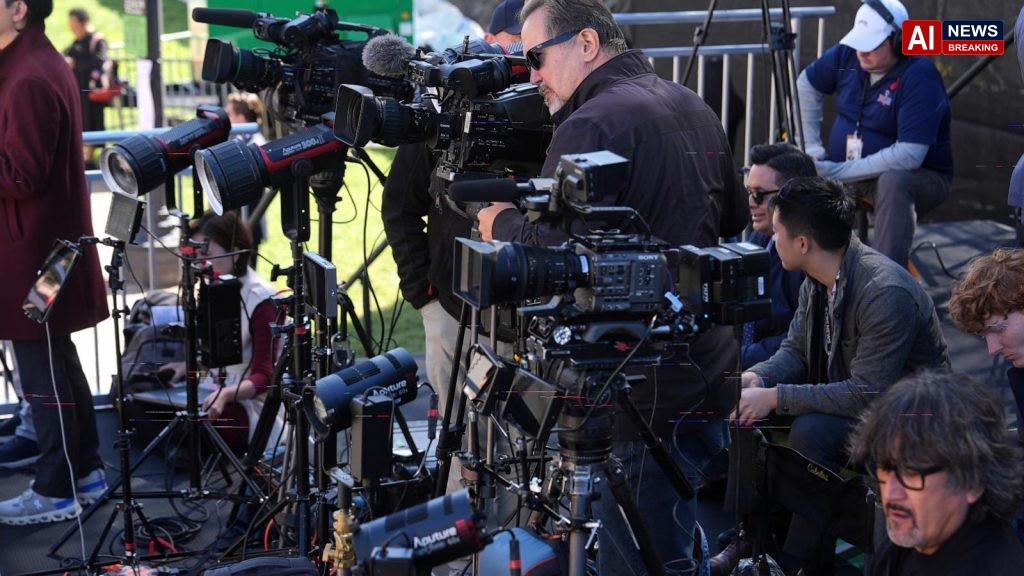
DOJ says it's investigating whether White House TV pool's coverage halt violated antitrust law - AI News Breaking
says investigating whether white:
The United States Department of Justice has opened a formal inquiry into the White House television press pool’s decision to suspend live coverage of President Donald Trump’s activities last month, assessing whether the move may have breached federal antitrust statutes. The probe, announced in a statement by the DOJ’s Antitrust Division on Wednesday, will examine whether the pool’s actions constituted an unlawful restraint of trade by limiting competition among broadcasters for access to the president’s public appearances. Officials declined to disclose the specific legal framework under review, but indicated that the investigation will focus on whether the pool’s conduct unreasonably restrained competition in the market for presidential news coverage.The White House television pool, a longstanding arrangement that rotates among major network news organizations to provide live video of the president’s daily schedule, has traditionally been praised for its efficiency and for ensuring that a single, consistent feed reaches the nation..
However, critics argue that the pool’s exclusive control over live presidential footage can create a de‑facto monopoly, especially when the pool decides to withhold or delay coverage. In early June, the pool announced that it would pause all live broadcasts of Trump’s public events for a period of two weeks, citing “logistical challenges” and “security concerns” following a series of heightened protests at the White House. The decision immediately sparked accusations of political bias and raised questions about the pool’s authority to limit access to a public official’s activities.Legal scholars note that antitrust law applies not only to traditional commercial markets but also to any arrangement that could diminish competition or consumer choice..
“If a group of broadcasters collectively decides to restrict the flow of information that the public has a right to receive, that could be viewed as a concerted effort to limit competition,” said Professor Emily Harrington of Georgetown Law, who specializes in media regulation. “The DOJ’s involvement suggests that officials see a plausible argument that the pool’s actions may have had anticompetitive effects, especially if the decision was coordinated among the participating networks rather than a unilateral operational choice.” Harrington added that the investigation will likely assess whether the pool’s governance structure complies with the Sherman Act, which prohibits agreements that unreasonably restrain trade.The Department of Justice’s inquiry follows a series of complaints filed by smaller broadcasters and independent media outlets that were denied live feeds during the two‑week blackout. These outlets contend that the pool’s decision disadvantaged them financially and reduced their ability to compete for viewership against the major networks that participate in the pool..
“Our audience expects timely coverage of the president’s engagements,” said Karen Liu, senior producer at a regional public television station in the Midwest. “When the pool shuts down, we are forced to rely on delayed clips or secondary sources, which erodes our credibility and impacts our advertising revenue.” Liu’s station, along with several others, lodged formal complaints with the Federal Communications Commission, prompting the DOJ to consider whether the pool’s conduct might violate antitrust principles governing market access.White House officials have defended the pool’s decision as a necessary measure to ensure the safety of both the president and the journalists covering him. A spokesperson for the Office of the Press ary said that “the security environment surrounding the president’s movements has been unprecedentedly volatile, and the temporary suspension of live coverage was a prudent response to protect all parties involved.” The statement also emphasized that the pool remains committed to resuming normal operations once the situation stabilizes, and that the decision was made after consultation with the Service and senior White House staff.In response to the DOJ’s announcement, the head of the television press pool, a senior producer at a major network, expressed confidence that the investigation would find the pool’s actions lawful..
“The pool operates under a charter that has been reviewed and approved by the White House for decades,” the producer said in a brief interview. “Our decision was based solely on legitimate security concerns, not on any desire to suppress competition or influence public perception.” The producer declined to comment on the specifics of the DOJ’s inquiry, citing the ongoing nature of the investigation.The investigation will likely involve a detailed review of the pool’s internal communications, contractual agreements among participating networks, and the decision‑making process that led to the coverage halt. Antitrust officials may also examine whether the pool’s governance model—whereby the participating broadcasters collectively elect a rotating chair to oversee operations—could be interpreted as a cartel-like arrangement if it is used to coordinate market‑wide restrictions..
“We are looking at the totality of circumstances,” a DOJ attorney, who requested anonymity, explained. “That includes the intent behind the decision, the effect on competition, and the degree to which the pool’s actions were coordinated.”Industry analysts caution that the outcome of the DOJ’s probe could have far‑reaching implications for how presidential coverage is managed in the future. A report by the Media Insight Center earlier this year warned that the concentration of broadcast rights in a single pool could become a target for regulatory scrutiny if it is perceived to limit competition or to be used as a political lever..
“Should the DOJ find that the pool’s conduct violated antitrust law, we could see a restructuring of the system, perhaps moving toward a more open, multi‑source model for distributing live presidential footage,” said Michael Ortega, senior analyst at the think‑tank. “That would fundamentally change the relationship between the White House and the media.”The investigation arrives at a time of heightened tension between the Trump administration and the news media, with the president repeatedly accusing mainstream outlets of bias and “fake news.” Critics of the pool argue that the exclusive arrangement amplifies these concerns, as it concentrates control over the president’s image in the hands of a few large broadcasters. Conversely, supporters contend that the pool’s centralized approach ensures consistent, high‑quality coverage and reduces the logistical burden on the Service, which would otherwise have to accommodate dozens of separate crews..
The DOJ’s review may force a reevaluation of that balance between security, efficiency and market competition.Legal experts note that the DOJ’s antitrust division has previously pursued cases involving media conglomerates and content distribution agreements, but rarely has it targeted a government‑linked news pool. “This is an unusual intersection of public policy, national security, and competition law,” observed Professor Harrington. “The agency will need to tread carefully to avoid the appearance of politicizing antitrust enforcement while still upholding the principles that protect competitive markets.” The investigation’s findings could also set a precedent for how other government‑run information services, such as the Federal Emergency Management Agency’s public alerts, are scrutinized under antitrust law.As the probe proceeds, both the White House and the participating broadcasters have pledged full cooperation with federal authorities..
Updated: October 11, 2026
The DOJ has launched an antitrust probe into the White House TV press pool after it halted live coverage of President Trump’s events, examining whether the suspension unlawfully restrained competition among broadcasters. Smaller outlets claim the blackout hurt their revenues and viewership, while the pool cites security concerns, raising questions about the balance between safety, market access and media monopolies.
If the DOJ deems the pool’s blackout an illegal market choke, it could shatter the long‑standing monopoly on presidential footage, forcing networks to compete on speed and depth rather than exclusive access. That shift would empower regional outlets, but also test how far security concerns can justify