 A replica Oval Office near the White House just got a new Trump makeover. Gold flourishes abound
  Process disenfranchising millions, turning them to second class citizens is arbitrary, says Justice Bhuyan
  Iran’s Top Security Official Warns of Dire Economic Crisis
  After Mangaluru bades farewell to Southern Railway, forum recalls decades’ long association of coastal city with the Zone
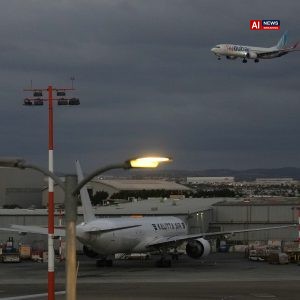
 FlyDubai cockpit attack exposes security lapses on Tel Aviv flight
**

FlyDubai cockpit attack exposes security lapses on Tel Aviv flight - AI News Breaking
A Flydubai flight that departed from Dubai International Airport on 26 May 2024 was forced to make an emergency landing in Tel Aviv after a passenger attempted to breach the cockpit. The incident, which unfolded just minutes after take‑off, has reignited scrutiny of airline security protocols and raised questions about the adequacy of measures designed to prevent unauthorized access to the flight deck on short‑haul routes.The aircraft, a Boeing 737‑800 registered A6‑FDE, was operating Flight FZ 972 from Dubai to Tel Aviv with 154 passengers and six crew members on board. Approximately ten minutes into the flight, flight attendants reported a disturbance in the cabin..
According to the airline’s statement, a male passenger, identified as a 32‑year‑old Saudi national, attempted to open the cockpit door, prompting the flight crew to initiate an immediate return to Israel. The aircraft landed safely at Ben‑Gurion Airport, where the passenger was taken into police custody.Flydubai’s chief operating officer, Peter C. Dhanani, told reporters that the crew acted “in accordance with standard operating procedures” and that the flight was brought to a safe landing without injury..
“The safety of our passengers and crew is our top priority,” he said. “We are cooperating fully with the authorities in both the United Arab Emirates and Israel to ascertain the full chain of events.” The airline has launched an internal investigation, and the International Air Transport Association (IATA) has been notified.Israeli security officials, speaking on condition of anonymity, indicated that the individual’s motives remain unclear. Early speculation suggested a possible political or personal grievance, but no definitive claim of terrorist intent has been confirmed..
The passenger was reportedly cooperative with investigators, and no weapons were found on board. Nevertheless, the incident has prompted the Israeli Civil Aviation Authority (ICAA) to review the security arrangements for incoming flights from the Gulf region, especially those operating under the open‑skies agreement signed in 2020.The attack comes at a time when global aviation regulators are reassessing cockpit security standards that were dramatically tightened after the September 2001 hijackings. In the immediate aftermath of those events, the International Civil Aviation Organization (ICAO) mandated reinforced cockpit doors and strict procedural safeguards..
While most major carriers have complied, variations in implementation persist, particularly among low‑cost and regional airlines that operate high‑frequency, short‑haul routes with limited crew resources.A review of Flydubai’s safety record shows no prior incidents of cockpit intrusion. However, the airline’s rapid expansion—its fleet has grown from 45 to 113 aircraft since 2015—has placed pressure on training and security oversight. Aviation analyst Priya Menon of FlightGlobal noted that “the speed of growth can sometimes outpace the institutional controls that keep safety margins robust.” Menon added that airlines operating in the Middle East have been “particularly vulnerable” to lapses because of the high volume of short‑distance flights that often rely on a single cabin crew member to monitor the cabin while the pilots attend to flight duties.In response, Flydubai announced it would conduct a comprehensive audit of its cabin crew procedures, with a focus on the enforcement of the “no‑fly‑zone” around the cockpit door..
The airline also intends to introduce additional training modules that simulate attempted breaches, a practice that has become more common in the industry following similar incidents on other carriers. The European Union Aviation Safety Agency (EASA) has previously recommended that airlines incorporate “active threat detection” drills into routine training, a guideline that Flydubai says it will adopt.The incident has also revived debate about the effectiveness of current cockpit door designs. While modern reinforced doors are engineered to withstand force, they rely heavily on the vigilance of cabin crew to prevent unauthorized approach..
Critics argue that the reliance on human monitoring creates a vulnerability that can be exploited, especially on flights where crew numbers are stretched thin. Some experts advocate for technological solutions, such as biometric access controls and automatic lockdown mechanisms that can be activated remotely from the cockpit.The Israeli government, for its part, has pledged to work closely with Gulf carriers to tighten security at Ben‑Gurion Airport. Minister of Transport Miri Regev announced a series of measures, including increased random screening of passengers on flights arriving from the United Arab Emirates and Qatar, as well as the deployment of additional air marshals on high‑risk routes..
“We will not tolerate any compromise to the safety of our airspace,” Regev said in a statement. “Our cooperation with regional partners must be matched by rigorous security standards on both sides.”International aviation bodies are watching the development closely. The ICAO convened an emergency session of its Safety Oversight Working Group on 30 May, inviting representatives from Flydubai, the UAE General Civil Aviation Authority, and the ICAA to discuss “enhanced cockpit security protocols for short‑haul operations.” The group is expected to issue a set of recommendations within the next three months, potentially influencing global standards for airline cockpit protection.The Tel Aviv incident underscores the delicate balance between efficient air travel and uncompromising safety..
While the swift action of the crew prevented a potentially dangerous escalation, the episode has gaps that regulators and airlines must address. As passenger numbers continue to rebound post‑pandemic, and as regional air traffic grows, the aviation sector faces renewed pressure to ensure that the lessons of the past translate into concrete, enforceable safeguards for the future..
Updated: October 4, 2026
A Flydubai Boeing 737‑800 returning to Tel Aviv after a passenger tried to force open the cockpit door landed safely, with the man taken into police custody. The breach has sparked renewed scrutiny of cockpit security on short‑haul flights and prompted Flydubai and regulators to vow tighter procedures and training.
Insight: The episode exposes a systemic blind spot: rapid network growth and lean crew rosters are eroding the human gatekeeping that reinforced cockpit doors depend on, prompting regulators to consider tech‑driven safeguards. If unchecked, such procedural drift could force a costly overhaul of global short‑haul security standards, reshaping the cost calculus for low‑cost carriers.