Spotify Tightens Family Plan Controls with QR Code Verification
 Use of Chief Minister C. Joseph Vijay’s deep fake videos to collect money: Rajasthan youth moves Madras High Court seeking bail
 Florida officer took possession of man’s home after finding him dead 4 years ago, police say
 Jury weighs fate of US woman who says father forced her into Syria’s war zone when she was a teen
French students protest nationwide over school staffing and infrastructure
**
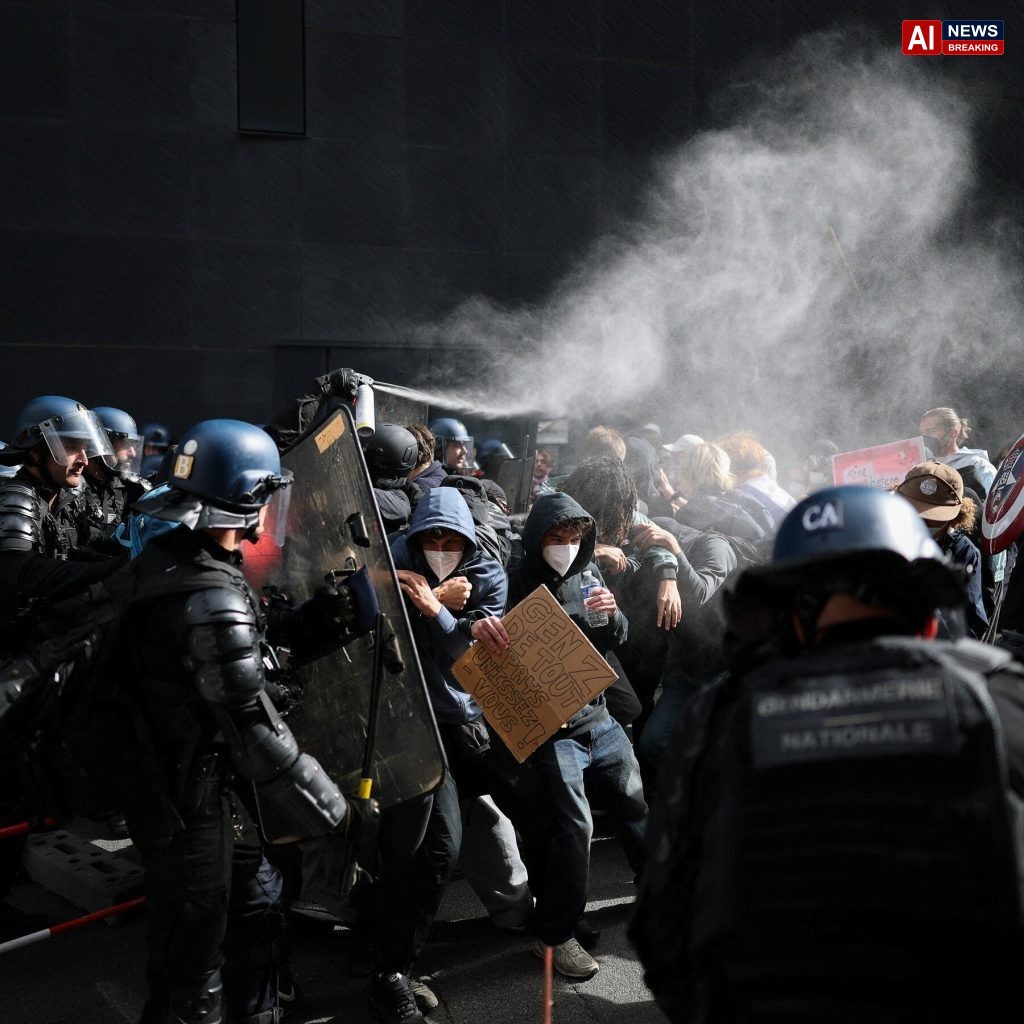
French Students Take to the Streets as Government Seeks Way Out of Crisis - AI News Breaking
For three weeks the streets of Lyon, Bordeaux and Paris have echoed with chants that have grown louder and more organised with each passing day. The unrest began as a series of small, local demonstrations over the state of primary schools in the south‑western city of Bordeaux, but quickly spread across the country as students took to the sidewalks in the thousands, demanding urgent reforms to a system that many now consider broken.The grievances are not limited to a single issue. In Bordeaux, students confronted a school that had been abandoned for months, its windows boarded up and its roof leaking..
They marched to the regional council headquarters, carrying placards that read “Our children deserve better.” In Lyon, a similar protest erupted when a secondary school found itself without a full-time teacher for an entire semester. The absence of staff had left students to rely on a single part‑time teacher, who in turn was struggling to cover the curriculum. Students in Paris marched to the Ministry of Education, demanding an immediate audit of school staffing across the nation.The protests are led largely by students aged sixteen to eighteen, but they have attracted a growing number of adult supporters..
Parents have joined the demonstrations, wearing black armbands and chanting slogans about the future of their children. Teachers, too, have walked the streets in solidarity. In Marseille, a group of ten teachers marched with students, demanding that the Ministry honour contracts that were signed but never fulfilled..
The movement’s unity is a to the fragmented protests that have characterized earlier years, when student movements were often divided along regional or ideological lines.The government has yet to respond decisively. In a statement released last Monday, Minister of Education Jean-Baptiste Leclerc said the Ministry was “working on a comprehensive plan” to address the deficiencies, but the lack of concrete details has only intensified the frustration of demonstrators. In the days that followed, Leclerc met with representatives from several unions, but the meeting ended without an agreement..
The Ministry’s lack of transparency has become a point of contention, with critics arguing that the government has been more interested in delaying action than in delivering solutions.Meanwhile, the French National Assembly has taken up the issue in a heated debate. Deputy Marie Dubois, who represents the Loire-Atlantique constituency, accused the Ministry of ignoring the voices of those in rural areas, where schools are often the only public institution left in the town. “We are not going to stand by while our children are left in dilapidated buildings, while our teachers are unpaid, and while the state’s priorities are set by a distant bureaucracy,” she said, prompting a chorus of agreement from fellow MPs..
The opposition party, led by Jean-Pierre Moreau, demanded that a full inquiry be launched into the funding of education and the hiring practices of the Ministry.In the midst of the protests, student leaders have set up a temporary headquarters in the Marais district of Paris, a former school that has been repurposed as a community centre. There, they coordinate with civil society organisations to lobby for policy changes and to keep the protest momentum alive. Their leader, Amélie Gauthier, a 17‑year‑old high‑school senior, has spoken in a video that has gone viral on social media..
“We are not asking for special treatment. We simply want what has always been promised: a safe learning environment, competent teachers, and a system that does not let our future slip through the cracks.” Her words resonated with millions, and her hashtag #NosÉcolesNotreFutur has become a rallying cry across the nation.The scale of the protests has not remained static. After a series of clashes in which demonstrators blocked a major motorway in Lyon, police deployed tear gas and rubber bullets to restore order..
The incident sparked a new wave of anger, and students from Marseille and Strasbourg joined the demonstration in Paris. The protest in Paris on Sunday saw an estimated 100,000 participants, making it one of the largest student mobilisations since the student movement of 1968. The demonstrators staged a sit‑in at the Ministry’s building, refusing to leave until they were given a platform to present their demands directly to the Minister..
The Ministry’s spokesperson, Claire Renault, declined to comment on the sit‑in, stating that the government was “focusing on ensuring public safety and maintaining normal civic functions.”The broader impact of the protests has been felt in the French economy. The Paris Stock Exchange recorded a dip on Monday after several large firms announced they would delay their investment plans in the education sector. “The uncertainty around educational policy has had a ripple effect on the market,” said a financial analyst at BNP Paribas..
The French tourism board warned that the protests could affect tourist flow, particularly in regions with a high density of student populations. In response, the Ministry issued a statement urging calm and insisting that the protests were peaceful. However, the statement was criticised by student representatives who said it was an attempt to deflect attention from the lack of real solutions.The protests have also forced a reckoning with the role of technology in education..
Many students have highlighted the stark inequalities between schools that have access to modern digital learning tools and those that do not. In a town in the centre of France, a primary school had to rely on outdated computers that had not been updated in five years. “If we are to prepare our children for the digital age, we need to provide them with the necessary tools,” said Amélie..
The Ministry has announced it will look into the deployment of digital equipment in schools, but the delay has caused many students to remain critical of the government’s commitment to the cause.Amid the protests, the French government has attempted to diffuse the situation by launching a series of public consultations. The Ministry of Education set up a 48‑hour online portal for parents, teachers and students to submit their concerns. The portal received more than 20,000 submissions in a week, covering topics from school infrastructure, teacher salaries, curriculum updates, to the integration of technology..
In a statement, Minister Leclerc said the consultation process would be used to “shape a robust and lasting strategy for educational reform.” However, the government has yet to publish a draft plan, leaving the demonstrators uncertain about the next steps.International observers have taken notice of the situation. The European Union’s Commissioner for Education and Culture, Lucia Rossi, released a statement saying that the protests underscored the need for a “re‑evaluation of the European approach to education.” She also pledged to arrange a meeting with the French Minister of Education to discuss possible EU initiatives that could support the reform efforts. The European Council has scheduled a session to discuss the issue next month, but many of the student groups fear that the bureaucratic process will be too.
Updated: October 8, 2026
The nationwide student marches signal that France’s education crisis is now a public security issue, not just a bureaucratic one, forcing the government to reckon with the moral weight of neglected schools.
If Paris can’t deliver tangible fixes, the protest narrative may shift from policy demands to a broader critique of state accountability, potentially resh