Trump administration offers mixed messages on limits to Ukraine’s Starshield access
 US Treasury proposes a rule to crack down on high-tech investments in China, other adversaries
 Calley Means, a key MAHA advocate, resigns as a top RFK Jr. adviser
 Spotify Tightens Family Plan Controls with QR Code Verification
 Use of Chief Minister C. Joseph Vijay’s deep fake videos to collect money: Rajasthan youth moves Madras High Court seeking bail
Government school teacher in Villupuram fosters scientific temper among rural students
**
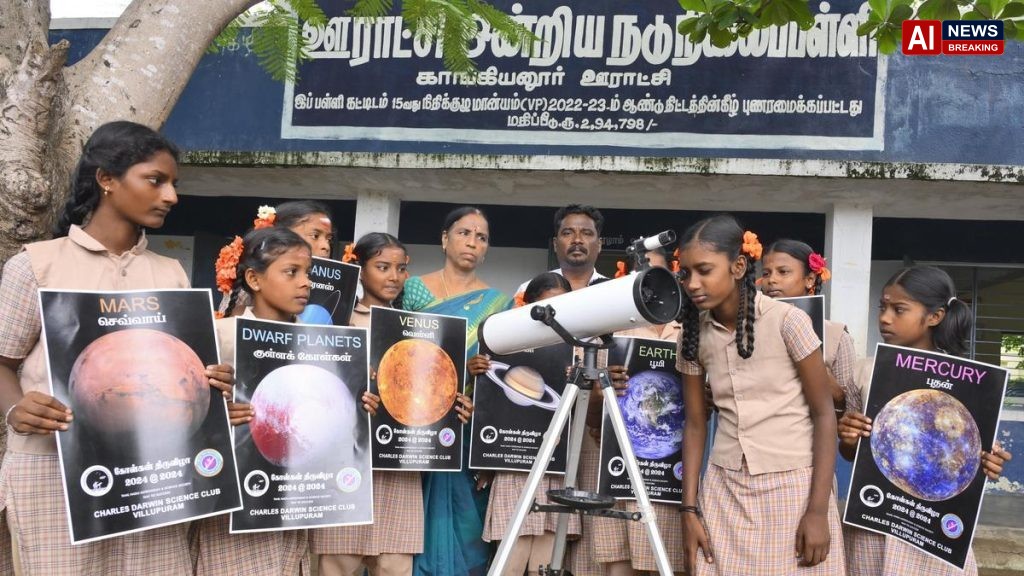
Government school teacher in Villupuram fosters scientific temper among rural students - AI News Breaking
government school teacher villupuram:
In the quiet village of Kangeyanur, nestled within the agricultural heartland of Villupuram district, a small middle school has become an unlikely laboratory for curiosity and innovation. The school, officially known as Kangeyanur Panchayat Union Middle School, has long relied on limited resources, yet its science teacher, Maria Joseph, has turned those constraints into a fertile ground for nurturing scientific inquiry among rural students.Maria Joseph, now in her mid-forties, joined the teaching staff in 2004, a period when educational reforms in Tamil Nadu were increasingly emphasising practical science education. “When I first arrived, the science laboratory was essentially a dusty room with a single gas burner and a few glassware items,” she recalls..
“We did not have the modern equipment that many urban schools boast. But I believed that the core of scientific learning lies in observation and experimentation, not in expensive gadgets.” Her conviction has guided her career for almost twenty years, as she has patiently built a culture of inquiry from the ground up.The school’s students, many of whom come from families engaged in farming and small trades, are introduced to basic scientific principles through hands‑on projects that use local materials. For instance, to demonstrate the principles of buoyancy and density, students create floating boats from bamboo and rice husks..
In another exercise, they grow small vegetable gardens to observe the effects of soil pH on plant growth, using inexpensive test strips and local clay pots. These projects, while simple, have proven effective in stimulating discussion and problem‑solving, allowing students to link classroom theories to their everyday surroundings.Maria’s approach extends beyond the classroom. She routinely organizes “Science Saturdays,” community evenings where students and their parents gather to watch live demonstrations of basic physics experiments, such as pendulum motion and the generation of static electricity using a simple Leyden jar..
These sessions have become a popular event in the village, drawing attention from local leaders and encouraging greater parental engagement with the school’s educational agenda. The community’s involvement has, in turn, increased support for the school, leading to donations of spare batteries, LED lights, and even a refurbished old computer that is now part of the school’s digital learning initiative.One of Maria’s most ambitious projects involved the development of a low‑cost rainwater harvesting system to illustrate the water cycle and resource management. Using discarded plastic bottles, local cement, and sand, students constructed a prototype that captures and filters rainwater for irrigation..
The project not only taught them about environmental science but also provided a practical solution for the village’s water scarcity issues. The success of the prototype has prompted discussions with the district education office about replicating the model in nearby schools.Student outcomes reflect the impact of Maria’s methods. The school’s science examination pass rates have risen from 68% in 2005 to an impressive 92% in 2023, with several students achieving top scores in state-level competitive exams..
One such student, 14‑year‑old Anitha R., has expressed a keen interest in pursuing a career in environmental engineering. “My teacher showed me how we could use simple tools to solve real problems,” she says. “That made science feel relevant to my life.”Maria’s efforts have not gone unnoticed by educational authorities..
In 2019, she was awarded the Tamil Nadu State Education Award for Innovation in Science Teaching, recognising her for “integrating local resources into science curricula and fostering community participation.” The award, presented by the Chief Minister, highlighted her work as a model for rural science education across the state. However, Maria remains focused on the day‑to‑day challenges of teaching in a resource‑constrained setting, and she often returns to the school to conduct refresher training for newer teachers.Beyond curriculum, Maria has championed a culture of safety in science practices. Recognising the potential hazards associated with chemical experiments, she has introduced a simple yet effective safety protocol that includes the use of goggles, gloves, and proper ventilation..
She also encourages students to document their procedures and observations in a laboratory notebook, a practice that builds scientific literacy and critical thinking. “When students record their experiments, they learn to analyse outcomes rather than merely replicate results,” she explains.The school’s progress has also attracted external partnerships. A recent collaboration with a non‑profit organisation focused on STEM education has led to the provision of a portable microscope and a set of biology kits..
These tools have expanded the scope of biology lessons, allowing students to examine plant tissues and microscopic organisms from their own soil samples. The partnership has also facilitated a summer camp for talented students, providing mentorship from university researchers and exposure to advanced scientific concepts.Looking ahead, Maria plans to introduce a community science project that examines local biodiversity, encouraging students to catalogue species and study ecological interactions. She hopes that this initiative will not only deepen scientific understanding but also foster stewardship of the village’s natural environment..
The school’s principal, Ms. Selvi, supports these ambitions, noting that “the school has become a beacon of hope for our children, demonstrating that with ingenuity and dedication, we can transform limited resources into limitless learning opportunities.”As the school approaches its twentieth anniversary, the collective efforts of Maria Joseph and her students serve as a testament to the transformative power of science education in rural India. Their story underscores that passion, perseverance, and community engagement can overcome infrastructural limitations, creating a learning environment where curiosity thrives and futures are reimagined..
Updated: October 20, 2026
Rural classrooms that lean on ingenuity rather than infrastructure can outpace urban peers, proving that curiosity is the most scalable resource.
If policymakers institutionalise community‑driven labs as Maria has, India’s next generation of innovators will emerge from the very villages that once had only dusty benches.