
 Brazil votes to decide between Lula and Bolsonaro
  Woman APEPDCL engineer found dead on road near Rajam; family says it was no accident
  Tamil Nadu minister reviews Villupuram monsoon preparedness.
 India-Singapore Trade Set for Fresh Momentum as Leaders Push Investment, Digital and Technology Cooperation
India and Singapore are set to deepen their economic partnership as senior leaders push for stronger cooperation in trade, investment, AI, semiconductors, digital technology and advanced manufacturing. Bilateral trade reached $36.1 billion in FY2025-26, while Indian exports to Singapore surged more than 100% in the first quarter of FY2026-27.
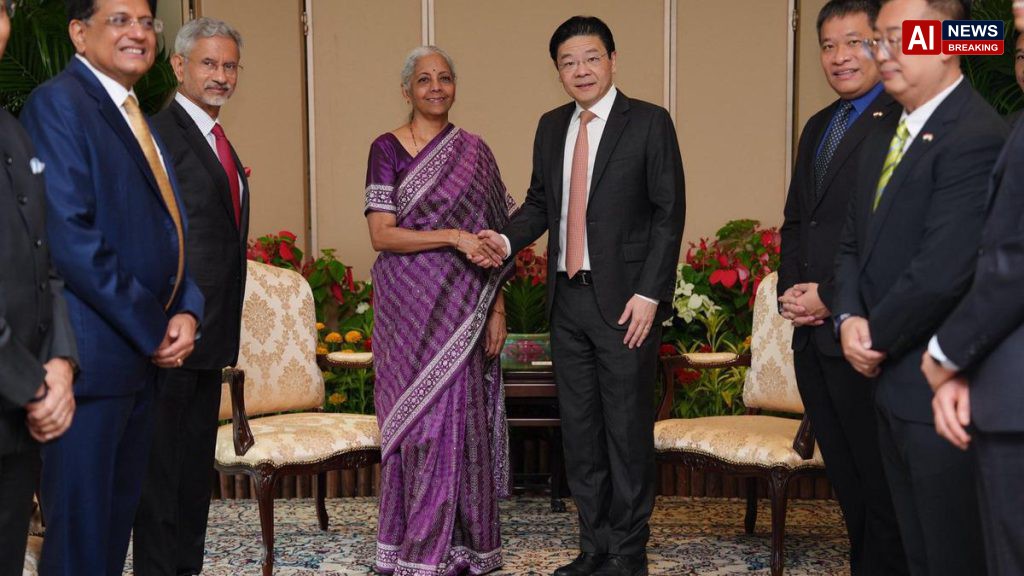
India-Singapore Trade Set for Fresh Momentum as Leaders Push Investment, Digital and Technology Cooperation - AI News Breaking
indiasingapore trade fresh momentum:
Singapore/New Delhi, August 20, 2026: India and Singapore are looking to give fresh momentum to their economic relationship as senior leaders from both countries hold high-level discussions on trade, investment, digitalisation, technology, skills and emerging industries.
Singapore Prime Minister Lawrence Wong met a high-level Indian ministerial delegation led by Finance Minister Nirmala Sitharaman on Thursday, with External Affairs Minister S. Jaishankar, Commerce and Industry Minister Piyush Goyal and Minister of State for Electronics and IT and Commerce and Industry Jitin Prasada also participating in the engagement. The discussions focused on strengthening the two countries’ Comprehensive Strategic Partnership and expanding cooperation across several economic sectors.
The talks come as India and Singapore conduct the fourth India-Singapore Ministerial Roundtable (ISMR), the principal ministerial mechanism for advancing their Comprehensive Strategic Partnership. The latest engagement is expected to provide a roadmap for expanding bilateral trade and investment while creating opportunities in technology-intensive and future-oriented sectors.
Key Points
- India-Singapore bilateral trade reached $36.1 billion in FY2025-26, up from $6.7 billion in FY2004-05.
- Indian exports to Singapore jumped 101.2% to $6.52 billion in April-June 2026.
- Nirmala Sitharaman-led Indian ministers met Singapore PM Lawrence Wong on August 20 to discuss deeper economic cooperation.
- Around 70 Indian business leaders are participating in B2B and government-to-business engagements in Singapore.
- AI, semiconductors, digitalisation, fintech, advanced manufacturing, skills and agri-food exports are emerging as key areas for future cooperation.
India-Singapore trade reaches $36.1 billion
India’s economic relationship with Singapore has expanded significantly over the past two decades.
According to India’s Commerce Ministry data cited in the report, bilateral trade increased from $6.7 billion in 2004-05 to $36.1 billion in 2025-26 following the implementation of the Comprehensive Economic Cooperation Agreement (CECA).
Singapore has also remained India’s largest trading partner within ASEAN, giving the city-state an important role in India’s broader Southeast Asian economic strategy.
The sharp increase in trade reflects the transformation of the relationship from a conventional goods-trade partnership into a much broader economic relationship covering services, finance, technology and investment.
India’s exports to Singapore have also been growing strongly. Commerce Ministry data showed that Indian exports to Singapore increased 101.2% to $6.52 billion during April-June 2026, compared with $3.24 billion in the corresponding period a year earlier.
The figures indicate that bilateral commercial activity is gaining momentum even before the latest high-level talks produce any new initiatives.
Singapore remains a major investor in India
Investment is another major pillar of the India-Singapore relationship.
Singapore has emerged as one of India’s most important sources of foreign direct investment, with the Bihar News Post report citing approximately $19.8 billion in Singaporean FDI during 2025-26.
Cumulative FDI from Singapore between April 2000 and March 2026 was reported at around $194.68 billion, underlining the importance of Singaporean capital to India’s economy.
The investment relationship extends across sectors including services, computer software and hardware, telecommunications, trading and pharmaceuticals.
This means Singapore’s role in India’s economy goes well beyond being a destination for Indian exports. It is also an important source of capital, technology, financial expertise and international business connections.
Fourth India-Singapore Ministerial Roundtable
The fourth ISMR is taking place on August 20 as part of a broader high-level Indian delegation visit to Singapore.
The Indian Commerce Ministry said Piyush Goyal is visiting Singapore from August 19 to 21, accompanied by a business delegation of around 70 senior Indian business leaders.
The delegation includes representatives from technology, software and artificial intelligence, manufacturing and engineering, infrastructure, sustainability, financial services, fintech, healthcare, food and agriculture, logistics, maritime trade and professional services.
The business delegation is holding business-to-business and government-to-business engagements aimed at expanding partnerships, investment, market access, technology cooperation and talent development.
The government-to-business engagement adds a commercial dimension to the ministerial talks and could help convert diplomatic discussions into specific investment and business opportunities.
Digital economy becomes a major focus
One of the most important changes in the India-Singapore relationship is the increasing importance of the digital economy.
The two countries have already developed cooperation in digital public infrastructure and financial technology.
The linkage between India’s UPI and Singapore’s PayNow has become an important example of cross-border digital payment cooperation.
The latest discussions are expected to take this relationship further, with digitalisation, artificial intelligence, cybersecurity and digital public infrastructure among the areas receiving attention.
For India, Singapore offers expertise, investment and access to one of Asia’s most advanced digital and financial ecosystems.
For Singapore, India’s huge digital market and expanding technology sector offer opportunities for investment and collaboration.
Artificial intelligence and cybersecurity
Artificial intelligence is emerging as another important area of bilateral cooperation.
As both countries develop policies around AI adoption and governance, cooperation could extend beyond commercial applications into areas such as responsible AI, digital governance, cybersecurity and skills development.
India’s rapidly expanding AI ecosystem and Singapore’s position as a major technology and financial hub provide complementary strengths.
The two countries can potentially collaborate on AI-enabled public services, enterprise technology, cybersecurity infrastructure and workforce training.
The focus on AI also reflects a wider shift in the bilateral relationship toward high-value technology rather than traditional trade alone.
Semiconductor cooperation gains importance
The semiconductor sector is another area where India and Singapore could deepen cooperation.
India is seeking to build domestic semiconductor manufacturing and electronics supply chains as part of its strategy to reduce dependence on concentrated global production networks.
Singapore has significant expertise in advanced manufacturing, electronics and semiconductor-related industries.
Greater cooperation could involve investment, supply-chain partnerships, technology, training and skill development.
The two countries’ interests are particularly aligned as global companies seek to diversify manufacturing and supply chains across Asia.
India’s large domestic market and manufacturing ambitions, combined with Singapore’s established industrial and financial ecosystem, could create opportunities for companies operating across the semiconductor value chain.
Advanced manufacturing and supply chains
Advanced manufacturing is expected to become another important pillar of India-Singapore economic cooperation.
Global supply chains are undergoing major changes because of geopolitical tensions, trade restrictions and companies’ efforts to diversify production.
India wants to increase its role in global manufacturing, while Singapore is already an established regional hub for high-value production, logistics and financial services.
Cooperation between the two countries could therefore help Indian and Singaporean companies develop new supply-chain partnerships.
The focus could include electronics, engineering, industrial technology and other high-value manufacturing sectors.
70-member business delegation seeks new opportunities
The presence of a roughly 70-member Indian business delegation highlights the commercial importance attached to the visit.
According to the Commerce Ministry, companies from technology, software and AI, manufacturing, infrastructure, financial services, healthcare, agriculture, logistics and professional services are participating.
The delegation is expected to explore partnerships with Singaporean companies and institutions.
Its agenda includes investment, market access, technology collaboration and talent development.
Such business-level engagement is important because government agreements alone do not automatically translate into higher trade. Private-sector partnerships and investment decisions ultimately determine whether bilateral economic opportunities are realised.
Indian agricultural exports get a push
Agriculture and food products are also receiving attention during the visit.
The Indian delegation is working to increase the presence of Indian agricultural and processed food products in Singapore’s retail market.
The Commerce Ministry said the APEDA-FairPrice initiative is being used to promote Indian agri-food exports in Singapore.
This could create new opportunities for Indian farmers, food-processing companies and exporters.
Greater access to Singapore’s retail market could also provide Indian agricultural producers with a pathway into the wider Southeast Asian consumer market.
Products with strong export potential include processed foods, agricultural commodities and other value-added food products.
Why Singapore matters to India’s ASEAN strategy
Singapore occupies a strategically important position in India’s economic engagement with Southeast Asia.
It is a major financial centre, shipping and logistics hub and gateway to ASEAN markets.
For Indian companies seeking to expand across Southeast Asia, Singapore can serve as a regional base for investment, finance, technology and distribution.
India, meanwhile, provides Singaporean companies with access to one of the world’s largest and fastest-growing consumer and technology markets.
This complementary relationship gives the bilateral partnership significance beyond the value of direct India-Singapore trade.
Trade growth already showing strong momentum
The latest trade figures suggest that the relationship is already expanding.
India’s exports to Singapore more than doubled during the first quarter of FY2026-27, rising to $6.52 billion from $3.24 billion a year earlier.
Exports to the broader ASEAN region also rose 61.6% to $14.61 billion during April-June 2026.
These figures come at a time when India is seeking to diversify export destinations and strengthen its trade relationships with major Asian economies.
Singapore’s position as an ASEAN financial and commercial hub makes it particularly important to that strategy.
From trade to technology partnership
The direction of the relationship is increasingly clear.
India and Singapore are moving from a partnership primarily focused on trade and investment toward one that also encompasses AI, semiconductors, digital infrastructure, fintech, advanced manufacturing and cybersecurity.
This shift reflects the changing nature of global commerce.
Technology, data, digital payments and resilient supply chains are becoming as important to international economic relationships as traditional tariffs and merchandise trade.
For both countries, deeper cooperation in these sectors could help attract investment and create higher-value economic opportunities.
Skills and talent development
Another important area under discussion is skills development.
Emerging sectors such as AI, semiconductors, advanced manufacturing and fintech require specialised talent.
Singapore has extensive experience in technical training and workforce development, while India has a large pool of engineers, technology professionals and young workers.
Greater cooperation in training, education and skills development could help address the talent requirements of expanding industries.
The Indian business delegation’s programme includes interactions with Centres of Excellence and visits to skilling institutions in Singapore, according to the Commerce Ministry.
Comprehensive Strategic Partnership enters a new phase
The latest ministerial engagement is taking place under the broader India-Singapore Comprehensive Strategic Partnership.
The two governments are reviewing progress under the partnership’s existing roadmap while identifying new areas for cooperation.
The meeting between Lawrence Wong and the Indian ministers focused on economic cooperation, digitalisation, connectivity, skills development and sustainability.
This indicates that the relationship is increasingly being viewed as a multi-sector strategic partnership rather than simply a bilateral trade relationship.
What it means for Indian businesses
For Indian businesses, stronger economic engagement with Singapore could provide several advantages.
Companies could gain access to Singapore’s sophisticated financial ecosystem, regional supply chains, technology networks and ASEAN markets.
For startups and technology companies, Singapore can provide an important base for international expansion.
For manufacturers, deeper cooperation could open opportunities for investment and integration into regional supply chains.
For agricultural exporters, initiatives involving Singapore’s retail sector could improve market access.
The potential benefits will depend on how effectively the agreements and discussions translate into actual commercial activity.
A stronger role for Singapore in India’s global trade strategy
India is currently pursuing a broader strategy of expanding trade relationships and diversifying export markets.
Singapore fits naturally into this strategy because of its geographical location, financial infrastructure and role within ASEAN.
The country’s importance is also reinforced by the scale of investment already flowing from Singapore into India.
As India seeks to attract global capital and strengthen its position in international supply chains, Singapore can serve as both an investor and a gateway to Southeast Asian markets.
Challenges remain
Despite the positive outlook, higher trade and investment will not happen automatically.
Businesses still face issues involving regulatory compliance, standards, market access, logistics and rules of origin.
India’s experience with free-trade agreements has shown that signing an agreement does not necessarily guarantee high utilisation by exporters.
Experts have argued that companies need easier compliance procedures and greater awareness of preferential trade benefits to fully exploit trade agreements.
The next phase of India-Singapore cooperation will therefore need to focus not only on announcing partnerships but also on implementation.
The road ahead
The current discussions could establish the foundation for a new phase in India-Singapore economic relations.
Bilateral trade has already reached $36.1 billion, while Singapore remains a major source of foreign investment into India.
At the same time, India’s exports to Singapore have recorded exceptional growth in the first quarter of FY2026-27.
The next opportunity lies in moving beyond traditional trade and expanding cooperation in sectors that will shape the global economy over the coming decade.
Semiconductors, artificial intelligence, digital infrastructure, fintech, advanced manufacturing, healthcare, logistics and sustainable technologies are likely to play an increasingly important role.
The presence of senior ministers and a large Indian business delegation in Singapore demonstrates the political and commercial importance attached to that transition.
Bottom Line
India and Singapore are entering a potentially important new phase of economic cooperation. With bilateral trade already at $36.1 billion and Singapore continuing to play a major role as an investor and ASEAN gateway, both sides are now looking to build a deeper partnership around technology, investment and resilient supply chains.
The latest ministerial talks, backed by a 70-member Indian business delegation, could help convert the strong political relationship into new commercial opportunities.
The next phase of India-Singapore trade is likely to be defined not just by the movement of goods, but by investment, technology, digital infrastructure, semiconductors, AI, advanced manufacturing and access to wider Asian markets.