Use of Chief Minister C. Joseph Vijay’s deep fake videos to collect money: Rajasthan youth moves Madras High Court seeking bail
 Florida officer took possession of man’s home after finding him dead 4 years ago, police say
 Jury weighs fate of US woman who says father forced her into Syria’s war zone when she was a teen
 France bans certain protests to restore public
India urges binding global pact to prevent an arms race in space
**
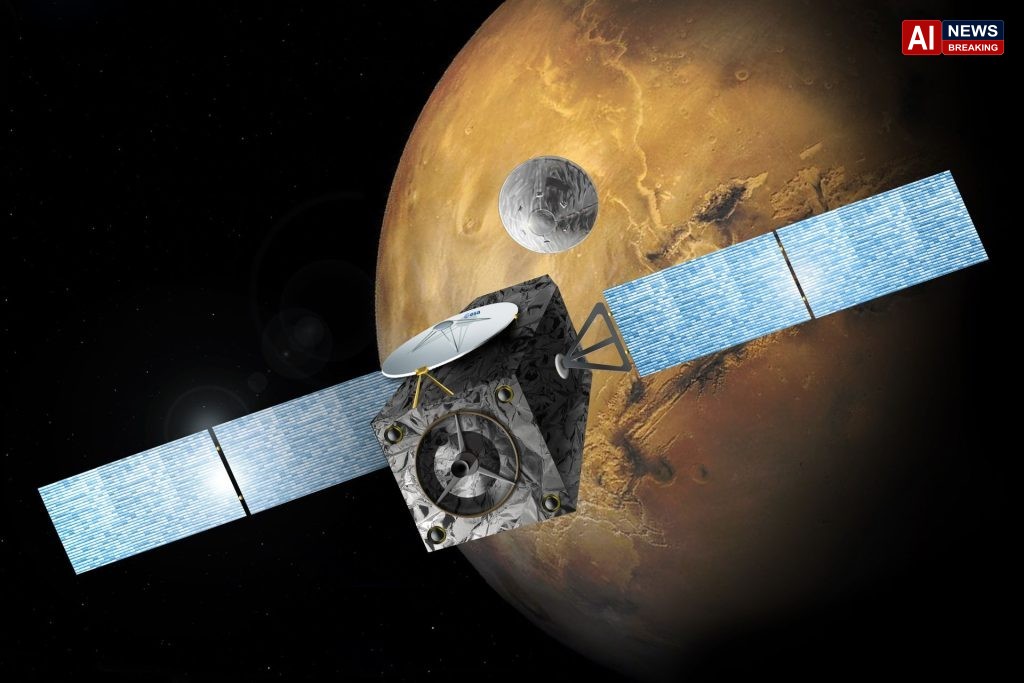
On this day in space! Oct. 19, 2016: Europe's ExoMars orbiter and Schiaparelli lander arrive at Mars - AI News Breaking
India has called for a legally binding international treaty to curb a burgeoning arms race in outer space, warning that unchecked militarisation could destabilise global security and jeopardise the peaceful use of the final frontier. Speaking at a high‑level United Nations forum in New York, the Indian delegation underscored the need for comprehensive rules that would prohibit the deployment of weapons on celestial bodies, ban the placement of autonomous weapon systems in orbit, and establish transparent verification mechanisms. The appeal arrives as major space‑faring nations accelerate the development of anti‑satellite (ASAT) capabilities, hypersonic glide vehicles and dual‑use technologies that blur the line between civilian and military applications.In recent years, the strategic importance of space has risen sharply..
Satellite constellations now underpin critical infrastructure, including communications, navigation, banking, weather forecasting and disaster response. Consequently, the vulnerability of these assets has become a focal point for defence planners worldwide. The United States, Russia and China have all demonstrated the ability to destroy or disable satellites, with notable tests in 2007, 2008 and 2021 respectively..
India itself conducted a successful ASAT test in 2019, asserting its right to protect its own space assets but also acknowledging the broader implications of such actions for international stability.New Delhi’s proposal seeks to move beyond the existing, largely voluntary framework embodied in the Outer Space Treaty of 1967, which prohibits the placement of nuclear weapons or any other weapons of mass destruction in orbit, on the Moon or other celestial bodies. While the treaty remains the cornerstone of space law, it does not address the proliferation of conventional weapons, nor does it provide robust verification or enforcement mechanisms. India’s stance is that without a binding agreement, the risk of a cascade of counter‑measures—each nation seeking to protect its own satellites—could spiral into an uncontrolled arms race, with potentially catastrophic consequences for the space environment.The call for a new pact has found resonance among several mid‑size space powers, which fear that the current trajectory may marginalise their interests..
Countries such as Brazil, South Africa and the United Arab Emirates have expressed concern that the dominance of a few militarily capable states could limit access to space for scientific and commercial ventures. In a joint statement issued after the UN meeting, these nations welcomed India’s initiative and urged the international community to pursue a balanced approach that safeguards both security and the equitable development of space technologies.However, the proposal also encounters resistance from the United States and Russia, both of which have historically viewed space as a domain of strategic competition. Washington has emphasised the importance of maintaining freedom of operation in orbit, arguing that any restrictions could hinder its ability to defend critical assets and respond to threats..
Moscow, while supportive of broader arms‑control efforts, has cautioned that overly stringent limitations could undermine its national security objectives, especially given its reliance on satellite communications for command and control. These positions highlight the diplomatic tightrope that any future treaty would need to navigate, balancing deterrence with the prevention of escalation.Technical experts stress that any effective agreement must address not only the deployment of kinetic weapons but also emerging threats such as directed‑energy systems, cyber‑infrastructure attacks and the weaponisation of lunar or Martian surfaces. The rapid miniaturisation of satellite technology, coupled with the rise of commercial mega‑constellations, complicates the verification of compliance..
Satellite owners may find it difficult to distinguish between benign manoeuvres and hostile posturing, raising the spectre of misinterpretation and inadvertent conflict. To mitigate these risks, India proposes the creation of an international monitoring body equipped with the authority to conduct on‑orbit inspections and share data on satellite trajectories and activities in real time.Civil society organisations have welcomed the Indian initiative as a step toward greater accountability. The Secure World Foundation, an NGO specialising in space security, noted that a binding treaty could provide the legal scaffolding needed to develop confidence‑building measures, such as transparent notifications of launches and maneuvers..
It also argued that the environmental impact of weapon tests—particularly the generation of debris that threatens the long‑term sustainability of the orbital environment—must be incorporated into any regulatory framework. The growing problem of space junk, already responsible for thousands of tracked fragments, could be exacerbated by kinetic engagements, creating a self‑reinforcing hazard for all users.Economic implications are also central to the debate. The commercial space sector, projected to generate over $1 trillion in revenue by 2030, relies on a stable and predictable operating environment..
Investors have expressed unease about the potential for conflict to disrupt services, increase insurance premiums and deter the launch of new constellations. By establishing clear norms, a binding treaty could reduce uncertainty, encouraging further private investment and fostering innovation. India, which has ambitious plans for its own satellite navigation system, communication networks and a nascent crewed space programme, stands to benefit from a framework that protects its burgeoning industry while promoting international cooperation.Negotiations are expected to unfold over several years, with the United Nations Committee on the Peaceful Uses of Outer Space (COPUOS) likely to serve as the primary forum..
India has pledged to lead a working group that will draft the text, drawing on expertise from legal scholars, scientists and defence analysts. The working group will also engage with the private sector to ensure that the treaty’s provisions are technologically feasible and do not stifle legitimate commercial activities. While the path ahead is fraught with geopolitical sensitivities, the Indian delegation remains optimistic that a consensus can be reached, citing the shared interest of all nations in preserving space as a domain of peace and cooperation.As the world watches the diplomatic process unfold, the broader message is clear: the militarisation of space is no longer a theoretical concern but a pressing reality that demands collective action..
India’s advocacy for a binding global pact reflects both its rising stature in international affairs and its recognition that the security of the planet increasingly depends on the stability of the space environment. Whether the proposed treaty will materialise into a robust legal instrument or remain a aspirational statement will hinge on the willingness of major powers to compromise, the capacity of the international community to enforce compliance, and the ability of all stakeholders to envision a future where space serves humanity rather than becoming a new arena for conflict..
Updated: October 21, 2026
India’s push for a legally binding space‑arms control treaty signals a shift from reactive deterrence to proactive stewardship, forcing great powers to reconcile strategic sovereignty with global stability. If the pact succeeds, it could transform the commercial space economy into a risk‑managed arena; if it falters, the same weapons‑fueled uncertainty that threatens Earth’s infrastructure will only grow louder in orbit.