Europe warns of Russia’s hybrid attacks but struggles to counter them
  Former chief election commissioner calls SIR scheme illegal.
  A Corruption Scandal Is Reshaping Brazil’s Presidential Election
  US citizen injured in Illinois after ICE agents mistook him for fugitive, tried to arrest him
  At 10 years old, Smithsonian’s Black museum is undaunted amid pressure from Trump administration
 India-US Ties in Focus: JD Vance Calls PM Modi After US Senate Passes 100 Tariff Bill
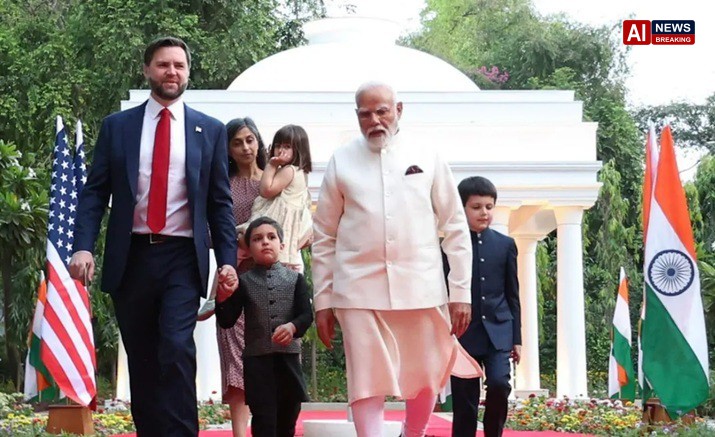
India-US Ties in Focus: JD Vance Calls PM Modi After US Senate Passes 100 Tariff Bill - AI News Breaking
indiaus ties focus vance:
US Vice President JD Vance spoke with Prime Minister Narendra Modi as India-US relations came into focus following the US Senate’s passage of legislation proposing a 100% tariff on countries continuing certain Russian oil transactions.
The two leaders discussed strengthening cooperation in trade, defence and emerging technologies, while also exchanging views on key international developments.
JD Vance Calls PM Modi as India-US Relations Face New Trade Challenges
US Vice President JD Vance held a phone conversation with Prime Minister Narendra Modi on Saturday, with the two leaders reaffirming their commitment to strengthening the India-US strategic partnership.
The conversation comes at a particularly important moment for bilateral relations, as Washington considers stronger economic measures linked to countries that continue to engage in certain transactions involving Russian oil.
According to the details shared about the conversation, Vance and Modi discussed ways to further expand cooperation between India and the United States across several strategic areas, including trade, defence and emerging technologies. The leaders also exchanged views on international developments and issues of common interest.
The timing of the call is significant because it follows the US Senate’s approval of legislation that proposes a 100% tariff on imports from countries continuing specified Russian oil-related transactions. While the measure is part of a broader US effort to increase economic pressure connected to Russia, its potential implications for major trading partners have added another layer of complexity to Washington’s relations with countries such as India.
Vance and Modi Discuss Strengthening Strategic Partnership
The conversation between Vance and Modi underlined the importance both countries attach to their expanding strategic relationship.
India and the US have increasingly broadened their partnership beyond traditional diplomatic and security cooperation. Trade, defence technology, semiconductors, artificial intelligence, critical minerals, telecommunications and other advanced technologies have become increasingly important components of the relationship.
The latest conversation indicates that both sides remain interested in deepening cooperation despite disagreements that may emerge over individual economic or geopolitical issues.
For Washington, India is an increasingly important strategic partner in the Indo-Pacific and in efforts to build resilient supply chains for critical technologies. For New Delhi, closer cooperation with the US can support investment, technology transfer, defence modernisation and India’s broader ambitions to strengthen its position in global manufacturing and technology.
The discussion on emerging technologies is particularly important. Artificial intelligence, advanced computing, semiconductor manufacturing and other next-generation technologies are rapidly becoming areas of strategic competition among major powers.
India and the US have already identified technology cooperation as an important pillar of their bilateral relationship. Continued engagement at the leadership level could help both countries explore new opportunities in these areas.
US Senate Tariff Bill Adds New Pressure
The phone call took place against the backdrop of the US Senate’s passage of legislation proposing a 100% tariff on countries that continue certain transactions involving Russian oil.
The proposed tariff represents a significant escalation in the use of economic pressure related to Russia. If ultimately enacted and implemented in its proposed form, such a measure could have consequences for countries that maintain commercial relationships involving Russian energy supplies.
India has remained an important buyer of Russian crude oil since the disruption of global energy markets following Russia’s invasion of Ukraine.
New Delhi has repeatedly maintained that its energy decisions are guided by national interests, energy security and market considerations. Russian crude became particularly important for Indian refiners after Western sanctions and restrictions altered global oil flows.
For India, the issue is therefore not simply about foreign policy. It is also directly connected to energy security, inflation, refinery economics and the availability of affordable crude.
A major tariff imposed on Indian exports to the US could potentially affect Indian businesses operating in sectors that depend heavily on access to the American market.
This makes diplomatic engagement especially important.
Why the Vance-Modi Conversation Matters
The conversation between Vance and Modi can be viewed as an attempt to keep broader strategic cooperation moving forward while the two countries navigate complicated economic and geopolitical questions.
India and the US have built a relationship that encompasses a wide range of shared interests. Defence cooperation, Indo-Pacific security, counterterrorism, technology, space, trade and supply-chain diversification are all important elements of the partnership.
At the same time, the two countries do not always have identical positions on international issues.
India has historically maintained strategic autonomy and has sought to preserve relationships with multiple major powers. Russia remains an important defence and energy partner, while the United States has become an increasingly important economic and strategic partner.
This balancing act has become more difficult as geopolitical tensions between Washington and Moscow have intensified.
The latest US Senate action therefore puts additional pressure on countries maintaining economic engagement with Russia.
However, the Vance-Modi conversation suggests that Washington and New Delhi continue to see substantial value in their broader relationship.
Trade Remains a Major Issue
Trade is likely to remain one of the most sensitive areas of India-US relations.
The United States is one of India’s most important trading partners, and American consumers and companies have extensive economic links with India.
Indian exporters across sectors such as pharmaceuticals, textiles, engineering goods, information technology and other services have significant exposure to the US market.
At the same time, American companies see India as one of the world’s most promising large consumer and investment markets.
The two countries have therefore repeatedly sought to expand bilateral trade while resolving disagreements involving tariffs, market access, intellectual property, agricultural products and regulatory barriers.
Any new tariff measures could complicate these efforts.
For India, the challenge will be to protect its export interests while maintaining access to energy supplies and preserving its broader foreign-policy objectives.
For the United States, policymakers must balance pressure on Russia with the strategic importance of partnerships with countries such as India.
Defence Cooperation Remains a Key Pillar
Defence was another important area highlighted in the Vance-Modi discussion.
India and the United States have significantly expanded defence cooperation over the past two decades.
The relationship has evolved from limited military engagement to a much broader partnership involving defence exercises, logistics cooperation, intelligence sharing and procurement of advanced military platforms.
The two countries increasingly view defence technology cooperation as an important component of their strategic relationship.
India is also seeking to strengthen domestic defence manufacturing under its broader goal of reducing dependence on imports.
Greater cooperation with US defence companies could potentially support India’s efforts to develop advanced manufacturing capabilities while providing American companies with access to India’s large defence market.
The strategic importance of the Indo-Pacific provides another major incentive for cooperation.
India occupies a critical geographic position along major maritime routes, while the United States has significant strategic interests in maintaining stability and freedom of navigation across the region.
Emerging Technologies Could Become the Next Major Growth Area
Technology cooperation is likely to become increasingly important in the India-US relationship.
Artificial intelligence, semiconductors, quantum computing, telecommunications, cybersecurity and advanced manufacturing are emerging as strategic industries.
Both countries have strong technology ecosystems, although their strengths are different.
The United States remains home to many of the world’s largest technology companies and advanced research institutions, while India has a massive pool of engineering talent, a rapidly growing digital economy and a large technology-services industry.
Combining these strengths could create significant opportunities.
AI is particularly important because it is becoming a strategic asset for economies and governments.
The development of advanced AI systems requires computing infrastructure, semiconductors, data centres, energy and highly skilled workers. Cooperation across these areas could become an important part of future India-US economic relations.
The reference to emerging technologies in the Vance-Modi conversation therefore carries significance beyond the immediate diplomatic exchange.
Russia Remains a Complicated Issue for India
The Russian oil issue represents one of the most difficult points in the India-US relationship.
India has maintained that it must protect the interests of its population and economy while dealing with a volatile global energy market.
Russian crude has offered Indian refiners access to competitively priced supplies, particularly after international sanctions changed the traditional pattern of global energy trade.
The United States, meanwhile, has sought to use economic measures to increase pressure on Moscow.
The disagreement is therefore rooted in different strategic priorities.
Washington’s priority is to increase economic pressure on Russia.
New Delhi’s priority is to maintain affordable and reliable energy supplies while pursuing an independent foreign policy.
Neither position automatically eliminates the possibility of cooperation in other areas.
That is why high-level communication remains important.
The Bigger Geopolitical Picture
The Vance-Modi conversation also needs to be viewed within the broader transformation of global geopolitics.
The world economy is increasingly being shaped by strategic competition among major powers.
Energy security, semiconductor supply chains, artificial intelligence, defence technology and critical minerals are becoming intertwined with national security.
Countries are increasingly attempting to reduce excessive dependence on a single supplier or market.
India has positioned itself as an important alternative manufacturing and technology hub, while the United States is seeking to strengthen partnerships with countries that can contribute to resilient global supply chains.
This creates substantial strategic space for deeper India-US cooperation.
At the same time, India’s continued engagement with Russia means that Washington will likely continue to face difficult policy choices regarding how much economic pressure it can impose without damaging its relationship with New Delhi.
What the Tariff Debate Could Mean for India
A 100% tariff would represent a substantial increase in trade costs if applied broadly.
The economic consequences would depend on the final scope of the legislation, how it is implemented and which countries and products are ultimately covered.
For Indian exporters, the possibility of higher tariffs creates uncertainty.
Companies that depend heavily on the US market could face higher costs, reduced competitiveness or pressure to shift production and supply-chain strategies.
Indian policymakers could respond through negotiations, diversification of export markets or efforts to increase domestic value addition.
The situation could also encourage Indian companies to expand their presence in markets outside the United States.
However, the sheer size and purchasing power of the American market means that diversification cannot completely eliminate the importance of US trade.
A Test for India-US Diplomacy
The latest conversation between Vance and Modi illustrates the complexity of modern India-US relations.
The partnership is too important to be defined by a single disagreement, but individual disputes can still influence the broader relationship.
Trade disagreements, energy policy and Russia-related sanctions represent areas where Indian and American priorities can diverge.
Defence, technology, Indo-Pacific security and supply-chain cooperation, meanwhile, provide strong incentives for continued partnership.
The challenge for diplomats on both sides will be to compartmentalise disagreements while expanding cooperation in areas where interests overlap.
This approach has increasingly characterised India-US relations.
Both countries recognise that they have substantial strategic interests in working together, even when their approaches to individual international issues differ.
What Comes Next
The next phase of India-US engagement will likely depend heavily on negotiations over trade and economic policy.
The proposed tariff legislation could become a major issue if it moves through the remaining legislative and implementation stages.
India will closely monitor the final language of the measure and its potential impact on Indian exports.
At the same time, Washington will have to consider how its Russia policy affects relationships with countries that remain important to its broader strategic objectives.
For Modi’s government, the priority will likely be to protect India’s energy security and export interests while keeping the wider strategic partnership with Washington on track.
For the United States, maintaining close cooperation with India could be particularly important as geopolitical competition intensifies across the Indo-Pacific and the global technology sector.
The Vance-Modi conversation therefore sends an important diplomatic signal: despite pressure surrounding trade and Russia-related energy transactions, both sides continue to recognise the strategic value of their relationship.