 Indian Stock Market Crash: Sensex Plunges 1,124 Points, Nifty Ends Below 22,800 as Oil Surge and Iran-US Tensions Trigger Sell-Off
  Possible Foiled Terror Attack at U.S. Air Base in U.K. Raises Questions Over Security
  People with Down syndrome and other disabilities find rhythm in Indiana dance program
  Tamil Nadu CM Vijay declares open renovated Gandhi Memorial Museum in Madurai
  Trump Asked Xi Jinping If China Wanted to Buy US Weapons, Ambassador Reveals
 Indian Stock Market Crash: Sensex Plunges 1,124 Points, Nifty Ends Below 22,800 as Oil Surge and Iran-US Tensions Trigger Sell-Off
Indian stocks witnessed a major Monday sell-off as the Sensex plunged 1,124 points and Nifty fell below 22,800. Rising crude oil prices, Iran-US tensions, FII selling, higher bond yields and rupee concerns triggered broad-based market losses.
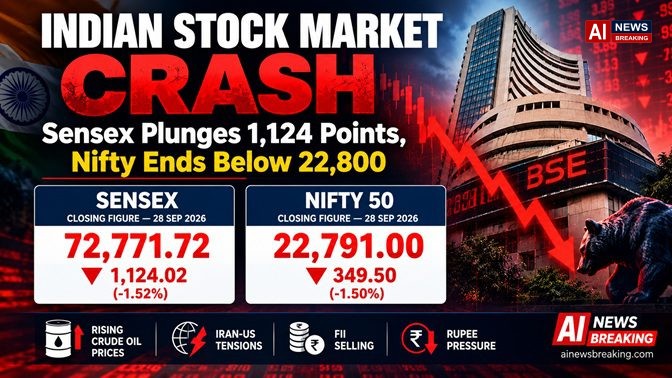
The Indian stock market suffered a sharp sell-off on Monday, September 28, as investors reacted to renewed geopolitical uncertainty, a jump in crude oil prices and continued foreign institutional selling. The benchmark Sensex plunged 1,124 points, while the Nifty 50 fell more than 350 points and finished the session around the 22,800 level.
The decline marked a significant reversal in market sentiment after Indian equities had attempted to stabilise during the previous session. The sell-off was not limited to a handful of stocks. Instead, weakness spread across banking, financial services, real estate, automobiles, metals, FMCG and other major sectors. The market’s breadth also deteriorated sharply, highlighting the widespread nature of the selling pressure.
The immediate trigger for the latest risk-off move was the renewed rise in crude oil prices amid heightened tensions involving the United States, Iran and the Strait of Hormuz. Brent crude futures climbed around 2% to approximately $106.5 a barrel during Monday’s trading, reviving concerns over inflation, India’s import bill and corporate profit margins.
Key Points
- Sensex crashes 1,124 points as broad-based selling hits Indian equities.
- Nifty 50 falls more than 350 points and ends around the 22,800 zone.
- Brent crude rises above $106 a barrel, increasing India’s inflation and import-bill concerns.
- Iran-US tensions weigh on investor sentiment after uncertainty surrounding the Strait of Hormuz.
- Foreign institutional investors continue selling Indian equities, adding pressure to domestic benchmarks.
- All major sectoral indices close in the red, with PSU banks among the biggest losers.
- India VIX rises sharply, reflecting increased market volatility and investor caution.
Sensex Suffers Major Monday Fall
The BSE Sensex came under intense selling pressure throughout Monday’s session. By the close, the index had fallen by 1,124 points, finishing below the 72,800 mark, according to market reports.
The scale of the decline reflected a sharp deterioration in risk appetite. Nearly every major component of the benchmark index ended lower. Among the notable decliners were Larsen & Toubro, Power Grid, Adani Ports, HDFC Bank, Hindustan Unilever, Reliance Industries and State Bank of India.
L&T and Power Grid fell close to 3%, while several large-cap stocks declined more than 2%. Infosys was the notable exception among the Sensex constituents, managing to finish marginally higher even as the broader market remained under heavy pressure.
The magnitude of the fall also demonstrated how quickly geopolitical developments can affect Indian equities when they coincide with movements in global commodities, currencies and bond markets.
Nifty 50 Falls Below the 22,800 Zone
The Nifty 50 also witnessed aggressive selling and lost more than 350 points during the session. Market data showed the index around 22,834, down more than 1.3%, during the late afternoon trading period, while other reports placed the closing level around the 22,800 zone.
The fall pushed the Nifty decisively lower after the index had struggled to sustain recovery attempts in recent sessions.
The 23,000 level had already emerged as an important psychological area for traders. The latest decline below that region has increased attention on lower technical support zones, although short-term technical levels can change rapidly during periods of elevated volatility.
The important point for investors is that Monday’s decline was not driven by a single domestic corporate development. It was a broad macro-driven risk-off move involving oil prices, geopolitical uncertainty, capital flows and currency concerns.
Why Did the Indian Stock Market Crash Today?
Several factors combined to create the sharp Monday sell-off.
1. Crude Oil Prices Rebound Above $106
The biggest immediate concern for Indian markets was the renewed increase in crude oil prices.
Brent crude futures rose around 2% to approximately $106.5 per barrel during Monday’s trading.
For India, higher crude prices are particularly important because the country is heavily dependent on imported oil.
When international crude prices rise sharply, India’s import bill can increase. If the increase persists, it can put pressure on inflation, the current account and the Indian rupee.
Higher input costs can also affect corporate profitability.
Companies that consume large amounts of energy or petroleum-linked raw materials may experience margin pressure if they are unable to fully pass higher costs on to customers.
For airlines, transportation companies, chemicals manufacturers, paints companies and several other industries, the relationship between crude prices and profitability can therefore become an important market consideration.
The impact is not necessarily immediate or uniform across companies. However, a rapid and sustained rise in oil prices can influence broader expectations about India’s economic outlook.
That explains why oil prices have become one of the most closely watched indicators for Indian equity investors during the current geopolitical uncertainty.
2. Iran-US Tensions Increase Geopolitical Risk
The second major factor was the continuing uncertainty surrounding the conflict involving Iran, the United States and Israel.
The market reaction intensified after US President Donald Trump rejected an Iranian proposal connected with reopening the Strait of Hormuz and ending the fighting, according to reports cited by market publications.
The Strait of Hormuz is particularly important for global energy markets because it is a major route for oil shipments.
Any prolonged uncertainty surrounding the waterway can therefore create a risk premium in crude oil prices.
For financial markets, the concern is not simply the immediate price of oil. Investors also have to consider what sustained energy inflation could mean for central-bank policy, economic growth and corporate earnings.
That combination creates a difficult environment for risk assets.
India is particularly sensitive to such developments because of its dependence on imported energy.
If crude remains elevated for an extended period, investors may reassess assumptions surrounding India’s inflation trajectory and the operating environment for businesses.
3. Foreign Institutional Selling Adds Pressure
Foreign institutional investor activity was another important factor behind the market decline.
Foreign investors had already been selling Indian equities, and Moneycontrol reported that FIIs sold equities worth approximately Rs 3,696 crore on September 25, marking their second consecutive session of selling.
Large foreign flows can have a significant short-term effect on Indian benchmark indices.
When global investors reduce exposure to emerging markets, large-cap stocks often experience selling pressure because they are highly liquid and easier to transact in significant volumes.
The effect can then spread through the broader market.
Monday’s session provided an example of that dynamic, with selling extending well beyond a small group of large-cap companies.
4. Higher Bond Yields Add to Equity Market Pressure
Another concern for investors has been the movement in bond yields.
Higher global bond yields can affect equity valuations because they increase the relative attractiveness of fixed-income assets while raising the discount rate used to value future corporate earnings.
Indian equities had already experienced a difficult period in September as concerns about crude oil, inflation, interest rates and global risk conditions increased.
A combination of higher oil prices and elevated bond yields can therefore create pressure on both earnings expectations and equity valuations.
The relationship is particularly important for high-growth companies whose valuations depend heavily on earnings expected several years into the future.
5. Rupee Weakness Raises Additional Concerns
Currency movements were another element watched by investors.
A weaker rupee can increase the domestic cost of imported commodities, particularly crude oil.
That creates an additional channel through which higher international oil prices can affect the Indian economy.
For oil-importing economies, a simultaneous rise in crude and depreciation in the domestic currency can amplify the impact of energy prices.
At the corporate level, the effect can differ.
Export-oriented companies may benefit from a weaker rupee because overseas revenue translates into more rupees. Import-heavy businesses, however, can face higher costs.
The overall market impact therefore depends on the direction and speed of currency movements as well as individual company exposure.
6. Broad-Based Selling Across Sectors
Monday’s decline was notable because virtually every major sector participated in the sell-off.
According to market data, all sectoral indices ended in negative territory.
The Nifty PSU Bank index fell more than 3%, while real estate, automobiles, financial services, FMCG, metals and private banks also recorded substantial declines.
This broad-based selling is important because it indicates that the market was responding to a macroeconomic risk rather than an isolated sector-specific problem.
When only one sector falls, investors can often interpret the movement as a sector rotation.
When almost every major sector declines simultaneously, it generally reflects a wider reduction in risk appetite.
The Monday session therefore represented a broader reassessment of risk across Indian equities.
7. Market Volatility Surges
The India VIX, commonly used as a measure of expected market volatility, also increased sharply during the session.
The index rose around 12% and moved close to 14, according to market reports.
A rise in volatility indicates that investors are pricing in greater uncertainty.
It does not by itself determine the future direction of the stock market.
However, when volatility rises at the same time as benchmark indices fall sharply, it generally indicates that traders are becoming more cautious about near-term market conditions.
Higher volatility can also result in wider intraday price movements and faster changes in investor positioning.
Market Breadth Turns Deeply Negative
The breadth of Monday’s market was another important feature.
On the NSE, 2,716 stocks declined while only 869 advanced, with 91 stocks unchanged, according to market data reported by Economic Times.
That means the weakness was widespread across listed companies.
Small-cap and mid-cap stocks also suffered, with the Nifty Smallcap 100 and Nifty Midcap 100 indices falling close to 2%.
This is significant because smaller companies generally have greater sensitivity to liquidity conditions and changes in investor risk appetite.
When investors become defensive, they may reduce exposure to higher-beta and less-liquid stocks first.
The resulting selling can cause broader market indices to decline even more rapidly than the large-cap benchmarks.
Banking Stocks Come Under Pressure
Banking stocks were among the major casualties of the Monday sell-off.
The Nifty PSU Bank index fell more than 3%, while private banking stocks also declined.
Banks are particularly sensitive to changes in economic expectations, interest rates, bond yields and market liquidity.
A sustained rise in oil prices could potentially affect inflation and economic growth, creating an uncertain environment for credit demand and asset quality.
At the same time, higher yields can influence banks’ treasury portfolios and funding conditions.
However, the one-day market decline should not automatically be interpreted as evidence of deterioration in bank fundamentals.
The stock market often prices macroeconomic risks before their effects appear in company financial statements.
IT Stocks Face a Different Set of Risks
Indian IT companies have also remained under observation during the recent market volatility.
Higher US interest-rate expectations can affect technology valuations, while concerns over global economic growth can influence expectations for corporate technology spending.
Earlier in September, Indian IT stocks had come under pressure amid concerns surrounding demand and earnings. Reuters reported that IT stocks were among the factors weighing on Indian markets during the September 22 session.
The current market environment therefore presents multiple simultaneous challenges for technology companies: global demand expectations, currency movements, US economic conditions and valuation sensitivity.
Realty and Auto Stocks Also Decline
Real estate stocks were another major area of weakness, with the Nifty Realty index falling more than 2%.
Auto and financial indices also declined.
The selling across these sectors demonstrates how investors were moving away from cyclical exposure amid heightened uncertainty.
Real estate companies are particularly sensitive to interest rates, borrowing costs, liquidity and consumer confidence.
Automobile companies, meanwhile, are affected by commodity prices, financing conditions, demand and consumer sentiment.
The simultaneous weakness across these industries reinforced the broader risk-off character of Monday’s trading session.
Around Rs 8 Lakh Crore Market Capitalisation Erased
The scale of the sell-off was also visible in India’s total market capitalisation.
According to Economic Times, nearly Rs 8 lakh crore was wiped out from the combined market capitalisation of BSE-listed companies during the sharp decline, bringing the total to around Rs 474 lakh crore.
Such a large one-day change illustrates how quickly market value can move when investors simultaneously reassess geopolitical, commodity and macroeconomic risks.
It is important, however, to distinguish between a fall in market capitalisation and an actual loss of economic output.
Market capitalisation reflects the price investors are currently willing to pay for listed equity.
It can therefore move substantially without an equivalent immediate change in the underlying physical assets or operations of the companies.
The Strait of Hormuz Factor
The Strait of Hormuz has become one of the most important variables for financial markets amid the current geopolitical situation.
Any disruption or uncertainty around energy shipments through the region can influence global oil prices.
For India, the significance is especially high because imported crude is a critical component of the country’s energy system.
If oil prices remain elevated for a prolonged period, several economic consequences could emerge.
The first is a larger import bill.
The second is potential pressure on inflation.
The third is possible pressure on the rupee.
The fourth is the risk of reduced corporate margins.
The fifth is the possibility that monetary policy could remain restrictive for longer than investors expect.
These factors are interconnected rather than independent.
That is why developments in the Middle East can quickly translate into movements on Dalal Street.
Why Oil Matters So Much to India
India’s exposure to international crude prices is one of the reasons oil has such a powerful influence on domestic financial markets.
When crude rises, the immediate impact is visible through energy-related costs.
But the indirect effects can be even broader.
Higher transportation costs can increase the price of goods.
Manufacturers may face increased production expenses.
Logistics companies may see higher fuel bills.
Airlines can face higher operating costs.
Chemical and manufacturing companies can experience pressure on petroleum-derived inputs.
Consumers may ultimately face higher prices if companies pass increased costs through the supply chain.
Therefore, the market’s concern is not merely that Brent crude has crossed a particular price threshold.
The bigger question is whether elevated prices will persist long enough to influence inflation and economic growth.
What Happened to Investor Sentiment?
Investor sentiment had already been fragile following several sessions of volatility.
Indian markets had experienced a difficult September, with crude prices, foreign capital flows, global interest rates and geopolitical developments repeatedly influencing trading.
The latest sell-off came after the Sensex and Nifty had shown signs of attempting to stabilise.
That made Monday’s decline particularly significant from a sentiment perspective.
Instead of continuing the recovery, the market experienced another large-scale risk-off move.
The result was aggressive selling across large-cap and broader-market stocks.
Nifty Support Levels Come Into Focus
The sharp fall has once again shifted attention toward technical support levels on the Nifty.
Technical analysts had previously identified the 22,900–22,870 area as an important support zone, with a sustained break potentially opening the way toward lower levels.
However, technical levels should be treated as reference points rather than guaranteed turning points.
Market conditions can change rapidly when the primary driver is geopolitical risk.
For that reason, traders are likely to monitor crude oil, global markets, foreign fund flows, the rupee and developments involving the US and Iran alongside conventional technical indicators.
What Investors Will Watch Next
The direction of Indian equities in the near term is likely to remain closely connected to developments in crude oil and geopolitical tensions.
Investors will particularly watch whether Brent crude remains above the $100 level or begins to retreat.
A sustained decline in oil prices could reduce some of the immediate pressure on India’s inflation and external balance concerns.
On the other hand, another sharp increase could intensify concerns about economic growth and corporate margins.
Foreign institutional flows will also remain important.
If foreign selling continues, it could keep pressure on large-cap stocks.
Conversely, stabilisation in global risk appetite and reduced selling could help domestic equities find some support.
Global Markets Remain an Important Signal
Indian equities do not trade in isolation.
Global markets have become increasingly interconnected, and movements in US Treasury yields, the dollar, crude oil and Asian equities can influence domestic trading.
Recent Indian market sessions have demonstrated this relationship.
Reuters reported earlier in September that Indian shares were affected by movements in oil prices, foreign capital flows and global economic expectations.
Consequently, traders will likely monitor overnight movements in Wall Street and Asian markets before assessing the next session on Dalal Street.
GIFT Nifty and the Opening Signal
Ahead of Monday’s trading session, GIFT Nifty had already indicated a weaker opening.
Moneycontrol reported that renewed crude strength and US-Iran tensions were expected to weigh on Indian indices.
The subsequent sell-off demonstrated how quickly negative overnight cues can translate into domestic equity pressure when investors are already cautious.
However, pre-market indicators do not determine the final outcome of a trading session.
Domestic institutional activity, short covering, global developments and late-session news can all change market direction.
What Does the Market Crash Mean for the Indian Economy?
A sharp stock-market decline should not automatically be interpreted as a collapse in the Indian economy.
Equity markets are forward-looking.
Investors constantly adjust valuations based on expectations about future earnings, interest rates, inflation and risk.
Monday’s sell-off primarily reflected a rapid repricing of risk.
Nevertheless, if the underlying triggers persist, the effects can eventually move beyond financial markets.
Persistently high oil prices could affect inflation and the current account.
A weaker currency could increase the rupee cost of imports.
Higher interest-rate expectations could influence borrowing costs.
Lower equity valuations could affect corporate fundraising and investor wealth.
The economic impact therefore depends heavily on how long the current combination of geopolitical and commodity-market pressures lasts.
Large-Cap Stocks Bear the Initial Pressure
The Sensex decline was driven by several heavyweight stocks.
L&T, Power Grid, Adani Ports, HDFC Bank, Hindustan Unilever, Reliance Industries and SBI were among the stocks registering significant declines.
Large-cap stocks tend to have a major influence on benchmark indices because of their high index weights.
Consequently, heavy selling in a handful of major companies can pull the headline indices down sharply.
But Monday’s session went beyond that phenomenon.
The weakness in mid-cap and small-cap indices confirmed that investors were reducing risk across a much wider portion of the market.
Why Investors Should Watch Corporate Margins
One of the most important questions arising from higher crude prices concerns corporate margins.
Businesses do not all respond to oil-price increases in the same way.
Some companies can pass higher costs to customers.
Others operate in competitive markets where raising prices could reduce demand.
Some companies have hedging arrangements.
Others are more directly exposed to spot commodity prices.
Therefore, the impact of $100-plus crude oil on earnings will vary considerably across sectors.
The broader market concern arises when investors begin to believe that elevated input costs could affect earnings across multiple industries simultaneously.
The Role of Inflation Expectations
Oil is closely connected to inflation expectations.
If crude prices remain high, investors may begin to reassess future inflation.
Higher inflation can influence expectations surrounding monetary policy.
That matters for equity markets because interest rates influence borrowing costs, consumer demand, corporate investment and valuation multiples.
The interaction between oil and interest rates is therefore one of the most important macroeconomic relationships currently facing Indian investors.
Monday’s Sell-Off in Perspective
The September 28 decline should also be viewed in the context of the market’s recent volatility.
Just days earlier, Indian equities had experienced another major decline.
Moneycontrol reported on September 24 that the Sensex and Nifty had suffered their worst session in 10 weeks, with both falling more than 1.5% as US Treasury yields climbed and crude oil moved above $100 a barrel.
That history shows that Monday’s decline did not occur in isolation.
Instead, it followed a period in which investors had already been dealing with elevated uncertainty.
The market therefore entered Monday’s session with a relatively fragile risk environment.
What Could Stabilise the Market?
Several developments could potentially reduce volatility.
A sustained decline in crude oil prices would remove one major source of pressure.
Progress in diplomatic discussions involving the US and Iran could reduce geopolitical risk premiums.
Stabilisation in global bond yields could also support equity valuations.
A reduction in foreign selling would remove another source of supply pressure.
At the domestic level, stronger corporate earnings expectations and stable economic indicators could provide additional support.
None of these factors can be assumed in advance.
They will depend on actual developments in financial and geopolitical markets.
What Could Keep Pressure on Indian Equities?
The opposite scenario could keep volatility elevated.
A further escalation of US-Iran tensions could push oil prices higher.
Any serious disruption involving the Strait of Hormuz could increase concerns about global energy supply.
Continued foreign institutional selling could add to equity-market pressure.
Further increases in global bond yields could make risk assets less attractive.
A sustained decline in the rupee could amplify India’s imported inflation risk.
The combination of these factors would remain important for market participants.
Market Volatility Is Likely to Remain High
Monday’s rise in India VIX suggests that traders are pricing in increased uncertainty.
Volatility is particularly relevant for derivatives traders because large intraday moves can increase both potential gains and losses.
For long-term investors, however, one-day market movements provide limited information about the underlying value of a diversified portfolio.
The more important question is whether the factors driving the sell-off are temporary or persistent.
If geopolitical tensions ease and crude prices decline, some of the pressure could fade.
If energy prices remain elevated and global risk aversion increases, the market could remain volatile.
The Bigger Picture for Investors
The September 28 market crash highlights the growing importance of global macroeconomic factors for Indian equities.
Domestic corporate earnings remain important, but they are being influenced by international developments.
Oil prices affect inflation.
Global bond yields affect valuations.
The dollar affects the rupee.
Geopolitical tensions affect energy markets.
Foreign capital flows affect liquidity.
Together, these factors can produce significant moves in Indian benchmarks even when there is no major negative development inside an individual company.
That is why investors are likely to continue watching global developments alongside domestic economic data.
Conclusion
The Indian stock market’s Monday collapse was the result of several pressures converging at the same time.
The Sensex plunged 1,124 points, while the Nifty 50 dropped more than 350 points and moved around the 22,800 level. The decline was broad-based, with banking, financial services, real estate, automobiles, metals and other major sectors ending lower.
The immediate catalyst was renewed geopolitical uncertainty involving Iran and the United States, which contributed to a rebound in crude oil prices. Brent crude climbed around 2% toward $106.5 per barrel, reviving concerns about India’s import bill, inflation and corporate margins.
Foreign institutional selling added another layer of pressure, while higher bond yields, currency concerns and elevated volatility further weakened investor sentiment.
For the Indian market, the next phase will depend heavily on whether these pressures persist.
Crude oil movements, developments around the Strait of Hormuz, US-Iran relations, foreign fund flows, global bond yields and the rupee will remain key variables.
Monday’s sell-off therefore serves as a reminder that Indian equities remain highly sensitive to global energy and financial conditions. The immediate market reaction has been severe, but the longer-term implications will depend on how persistent the underlying geopolitical and economic pressures become.
AI News Breaking Market Desk
The September 28 sell-off illustrates how quickly a geopolitical shock can move through global energy markets and into Indian equities. The important transmission mechanism is not simply the headline risk surrounding Iran-US tensions; it is the combination of crude oil, inflation expectations, currency movements, interest-rate expectations and foreign capital flows. For India, sustained oil prices above $100 a barrel would deserve close attention because imported energy costs can influence the trade balance, inflation and corporate margins. At the same time, a single-day decline of more than 1,000 Sensex points should not by itself be treated as evidence that India’s underlying economic fundamentals have deteriorated by the same magnitude. The more meaningful signal will be whether elevated oil prices, persistent FII selling and higher global yields continue for several sessions or begin to reverse. Investors will therefore be watching the interaction between geopolitical developments and market fundamentals rather than any single index movement. This analysis is informational and does not constitute investment advice.