 France deploys patrol fleet to curb Channel migrant crossings
  From a Nepal in Pain, a Young Leader Makes a Case for Climate Reparations
  Ukraine transfers two North Korean POWs to South Korea.
  Australia probes AI‑driven breach of My Health Record portal
  Engineering student’s ‘suicide’ turns out to be murder two arrested
 India’s Silent Climate Threat: Why 56 Himalayan Glacial Lakes Could Become the Next Major Disaster
** India’s Himalayan region is home to 2,485 glacial lakes, with 56 deemed “very high risk” of catastrophic flooding due to climate change. Rising temperatures and expanding human activity are transforming these lakes into potential disaster zones, threatening downstream communities, infrastructure, and entire river valleys.
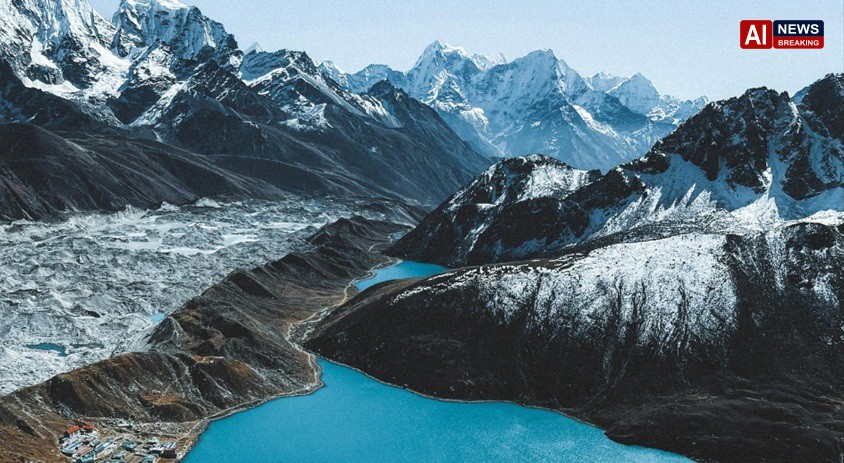
India's Silent Climate Threat: Why 56 Himalayan Glacial Lakes Could Become the Next Major Disaster - AI News Breaking
indias silent climate threat:
India is currently monitoring 2,485 glacial lakes spread across the Himalayan region, with 56 now classified as “very high risk” due to their potential to trigger catastrophic Glacial Lake Outburst Floods (GLOFs). The revelation is more than just a scientific update—it is a warning about the growing consequences of climate change, rising temperatures, and expanding human activity in one of the world’s most fragile mountain ecosystems.
From Ladakh to Arunachal Pradesh, these lakes sit silently at high altitudes, storing millions of cubic meters of water behind unstable walls of ice and debris. Experts warn that a single breach could devastate downstream communities, highways, dams, military infrastructure, and entire river valleys within hours.
The Himalayas Are Changing Faster Than India Realizes
The Himalayas have long been described as the “Third Pole” because they contain the largest reserves of ice outside the Arctic and Antarctica. They feed major rivers including the Ganga, Brahmaputra, Indus, and Teesta—water sources that sustain nearly a billion people across South Asia.
However, the mountains are changing.
Over the past few decades, glaciers have been retreating at unprecedented rates. As glaciers melt, they leave behind depressions that fill with water, creating glacial lakes. While many remain stable, some continue expanding year after year until the pressure becomes too great.
Scientists have repeatedly warned that climate change is transforming these lakes from geological features into potential disaster zones. Recent studies indicate that Himalayan glacial lakes have expanded significantly over recent decades, with several river basins showing accelerated growth.
India’s latest assessment suggests that this is no longer a future concern.
It is happening now.
2,485 Lakes Under Watch, 56 in the Danger Zone
The Ministry of Jal Shakti informed Parliament this week that the Central Water Commission (CWC) is monitoring 2,485 glacial lakes larger than 10 hectares across India’s Himalayan river basins using satellite-based remote sensing technologies.
Among these:
- 2,485 lakes are under regular monitoring.
- 189 were scientifically assessed as high-risk.
- 56 have been classified as “very high risk.”
- Monitoring is conducted annually between June and October.
- Multiple agencies, including NDMA and scientific institutions, are involved.
While the government has not publicly disclosed the complete list of all 56 lakes for security and safety reasons, experts believe many are located across:
- Sikkim
- Himachal Pradesh
- Uttarakhand
- Arunachal Pradesh
- Jammu & Kashmir
- Ladakh
These regions have already witnessed several climate-linked disasters over the last decade.
What Exactly Is a Glacial Lake Outburst Flood?
A Glacial Lake Outburst Flood—or GLOF—is one of nature’s most destructive events.
Imagine an enormous reservoir of icy water sitting 15,000 to 18,000 feet above sea level. Instead of being held back by concrete, the water is often restrained by loose rocks, mud, and glacial ice.
When that barrier collapses, the result can be catastrophic.
Within minutes, millions of liters of water rush downhill at tremendous speeds, carrying:
- Massive boulders
- Trees
- Ice blocks
- Mud
- Debris
- Entire sections of mountains
The resulting flood behaves more like a moving wall than a river.
Communities downstream often have little warning.
In many cases, the destruction unfolds at night.
Scientists describe GLOFs as “high-impact, low-warning” disasters because they provide minimal time for evacuation once initiated.
India Has Already Seen the Warning Signs
India does not need to imagine what a glacial lake disaster looks like.
The country has already experienced several.
Kedarnath, 2013
Cloudbursts and glacial processes contributed to one of India’s deadliest mountain disasters. Thousands died, and entire settlements were destroyed.
Chamoli, 2021
A devastating flood in Uttarakhand killed dozens and highlighted the vulnerability of hydropower infrastructure in Himalayan regions.
Sikkim, 2023
Perhaps the clearest warning came when South Lhonak Lake burst in Sikkim.
The flood destroyed bridges, roads, military installations, and the Teesta-III hydropower project. More than 100 people lost their lives or went missing. Scientists later noted that the lake had expanded dramatically over several decades before the disaster.
Each event carried the same message:
The Himalayas are becoming increasingly unpredictable.
Why Climate Change Is Accelerating the Threat
The numbers tell an uncomfortable story.
The Himalayan region is warming faster than many other parts of the world. Rising temperatures are causing glaciers to shrink, which creates larger and deeper lakes.
Climate scientists point to several accelerating factors:
- Rising average temperatures.
- Erratic monsoon patterns.
- Extreme rainfall events.
- Reduced snowfall.
- Increased glacier retreat.
- Earthquakes destabilizing mountain slopes.
- Human activity near fragile ecosystems.
A warming atmosphere means more melting.
More melting means larger lakes.
Larger lakes mean greater pressure on fragile natural barriers.
And greater pressure means a higher probability of failure.
Experts increasingly view GLOFs not merely as natural disasters, but as climate disasters.
The Strategic Dimension Nobody Talks About
There is another reason this story matters.
Many of these lakes lie near India’s sensitive border regions.
The Himalayas are home to:
- Strategic military bases.
- Border roads.
- Hydropower projects.
- Telecommunications infrastructure.
- Pilgrimage routes.
- Tourism hubs.
A single glacial flood could disrupt:
- National highways.
- Border logistics.
- Electricity generation.
- Water supplies.
- Local economies.
The Sikkim disaster demonstrated how vulnerable infrastructure can be when extreme climate events intersect with development projects.
For India, glacial lakes are not merely an environmental issue.
They are becoming a national security issue.
Technology Is Becoming India’s First Line of Defense
The good news is that India is not relying solely on field surveys.
Modern monitoring efforts increasingly depend on:
- Satellite imagery.
- Remote sensing.
- Artificial intelligence.
- GIS mapping.
- Climate modeling.
- Automated warning systems.
Scientists are now experimenting with machine learning systems capable of identifying changes in lake size and predicting future risks. New AI-based models are being developed specifically to improve Glacial Lake Outburst Flood forecasting.
The government has also expanded efforts to deploy early warning systems across vulnerable Himalayan zones.
However, experts caution that technology alone cannot eliminate risk.
If communities receive warnings only minutes before a flood arrives, the benefits remain limited.
The Human Cost Behind the Statistics
Numbers often conceal human stories.
Behind every “high-risk lake” are people living downstream.
There are:
- Farmers.
- Shopkeepers.
- Students.
- Pilgrims.
- Soldiers.
- Tour operators.
- Shepherd communities.
Many residents in remote Himalayan villages are unaware that they live below potentially unstable glacial lakes.
Some communities have no evacuation routes.
Others lack reliable communication networks.
For them, climate change is not an abstract debate.
It is a question of survival.
Development Versus Sustainability
India faces a difficult balancing act.
The Himalayan region is witnessing rapid development:
- Hydropower expansion.
- Tunnel construction.
- New highways.
- Tourism growth.
- Strategic infrastructure projects.
Development is necessary.
But experts increasingly argue that climate risk assessments must become mandatory before approving major projects in ecologically sensitive zones.
The Himalayas are young mountains in geological terms.
They are unstable.
Adding climate pressure to geological instability creates a dangerous combination.
Future development, scientists argue, must be designed around the mountains—not against them.
A Warning From the Mountains
The government’s announcement about monitoring 2,485 glacial lakes may appear technical at first glance.
It is not.
It is one of the clearest indicators yet that climate change is reshaping India’s geography in real time.
The 56 “very high risk” lakes are more than dots on a satellite map.
They represent a future India must prepare for.
History shows that disasters rarely arrive without warning.
The warning signs are already visible:
- Retreating glaciers.
- Expanding lakes.
- Increasing floods.
- Unpredictable weather.
- Fragile infrastructure.
The Himalayas have always been India’s natural shield.
Today, they are also becoming one of its greatest climate challenges.
And the question is no longer whether another glacial lake will burst.
It is whether India will be ready when it does.
Key Facts at a Glance
| Category | Data |
|---|---|
| Total Glacial Lakes Monitored | 2,485 |
| High-Risk Lakes Assessed | 189 |
| Very High-Risk Lakes | 56 |
| Monitoring Period | June–October |
| Main Risk | Glacial Lake Outburst Floods (GLOFs) |
| Key Regions | Sikkim, Uttarakhand, Ladakh, Himachal, Arunachal, J&K |
| Monitoring Agencies | CWC, NDMA, Scientific Institutions |
India’s glacial lake monitoring program is emerging as one of the country’s most important climate resilience initiatives. The next decade will likely determine whether the Himalayas remain a dependable source of water and stability or become an increasingly unpredictable frontier of climate risk. With artificial intelligence, satellite monitoring, and early warning systems improving rapidly, India has an opportunity to become a global leader in mountain disaster preparedness—but only if scientific warnings are translated into policy decisions before the next flood arrives.