 Australia probes AI‑driven breach of My Health Record portal
  Engineering student’s ‘suicide’ turns out to be murder; two arrested
  Canada’s Capital Bids Good Riddance to Trump Avenue as Tensions With U.S. Rise
  Pentagon investigates after China obtains parts from F-35 stealth fighter jet
 Invasive spotted lanternfly reaches Canada after spreading across 18 US states
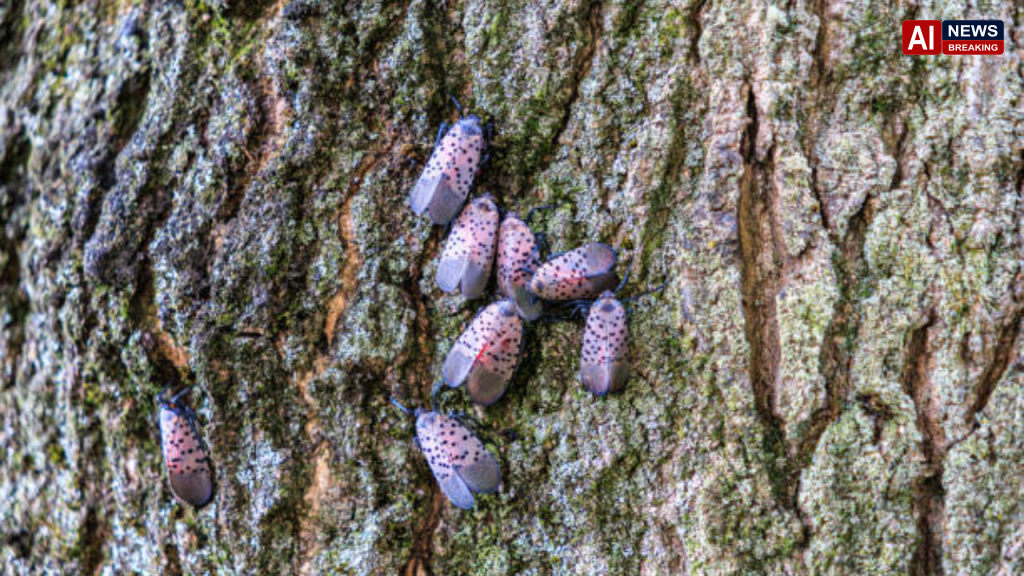
Invasive spotted lanternfly reaches Canada after spreading across 18 US states A first‑ever sighting of the spotted lanternfly (Lycorma delicatula) has been confirmed in Windsor, Ontario, marking a new chapter in the pest’s rapid expansion across North America. Authorities announced the detection on Tuesday, citing surveillance teams that spotted the insect on a maple tree near the Canadian‑US border. The arrival comes after the species has already established in 18 US states, causing widespread damage to fruit, hardwood and cereal crops..
Canadian officials have immediately imposed movement restrictions on plant material and equipment entering the region to curb further spread. The outbreak in Windsor follows a pattern of east‑west migration that began in the early 2000s in China, where the insect originated. The lanternfly, named for the bright yellow spots on its wings, feeds on sap from a variety of plants, with a particular affinity for grapevines, apple trees and eucalyptus..
Its voracious appetite can reduce crop yields by up to 30 percent and severely damage forest trees, raising alarms among farmers and foresters alike. In the United States, the species has cost the agriculture sector billions of dollars in control and mitigation efforts. Windsor’s authorities have enacted strict quarantine measures to prevent the spread of the insect across the border and into neighbouring communities..
All agricultural imports, including ornamental plants, must undergo mandatory inspection before entering Canada. Vehicle and equipment traveling across the border are subject to decontamination protocols, and workers in the horticulture industry are required to report any sightings immediately. The Ontario Ministry of Agriculture, Food and Rural Affairs has deployed mobile surveillance units to monitor the surrounding Windsor–Essex County area for additional infestations..
“Early detection and rapid response are our best defence against an invasive species of this calibre,” said Dr. Elena Morales, provincial chief entomologist. “We are coordinating closely with U.S..
counterparts to share data on the spread patterns and effective control methods. Our goal is to contain the lanternfly before it establishes a stable population in Canada.” Dr. Morales also emphasized the need for public vigilance, urging residents to report any sightings on the provincial government’s online portal..
Surveillance teams are conducting systematic inspections of high‑risk crops and hardwood forests within a 50‑kilometre radius of the Windsor detection site. Field researchers are using baited traps and visual surveys to gauge the insect’s prevalence. Preliminary assessments indicate that the infestation is currently confined to a small number of trees, but the potential for rapid expansion remains high due to the species’ high reproductive rate and the abundance of suitable host plants in the region..
Scientists are also testing the efficacy of various insecticides and biological controls in a controlled environment to determine the best strategies for Canadian ecosystems. The spotted lanternfly’s presence threatens several key agricultural industries that operate in Ontario. Apple and maple syrup producers are particularly concerned, as the insect can sap the vigor of their crops, reducing both yield and quality..
In addition, the lumber industry faces the risk of long‑term damage to hardwood forests, which could affect both timber supply and wildlife habitats. Experts estimate that if the lanternfly were to establish itself across Canada’s extensive forested areas, the cumulative economic impact could reach tens of billions of dollars over the next decade. Local farmers in Windsor’s agricultural district have already begun implementing preventative measures..
“We’re installing traps around our orchards and applying insecticidal dust to vulnerable trees,” said Michael O’Connor, a veteran apple grower. “It’s an added cost, but the alternative would be losing our crop to this pest.” Many growers are also considering planting resistant rootstocks and diversifying crops to reduce their vulnerability. The Ontario government is offering subsidies to support these mitigation efforts, along with guidance on best practices for containment..
Forestry officials are conducting a risk assessment for the Greater Toronto Area’s green spaces, including the iconic Toronto Islands and the Royal Botanical Gardens. These locations contain a mix of native hardwoods and ornamental species that could serve as reservoirs for the lanternfly. “We’re setting up a network of volunteer citizen scientists to monitor the area,” said Laura Chen, director of the Ontario Forest Management Office..
“Their observations will help us track any spread beyond the initial detection site and enable rapid response.” Public education campaigns are underway to raise awareness about the spotted lanternfly’s identifying features and the importance of reporting. The provincial government has distributed fact sheets and videos across social media platforms, schools, and community centres. A dedicated hotline allows residents to report suspected sightings and receive guidance on how to confirm the insect’s presence..
“The public’s role is critical,” noted Dr. “The more eyes on the ground, the faster we can react.” In addition to containment, researchers are studying the lanternfly’s potential impact on Canada’s natural ecosystems. The insect’s feeding habits could disrupt native plant communities, altering habitat structure and food webs..
Ecologists from the University of Toronto are collaborating with entomologists to model the long‑term ecological consequences. “We need to understand not just the economic losses but also how the lanternfly could reshape our forests,” said Professor Alan Wright, who leads the project. “This knowledge will inform both management strategies and conservation policies.” International cooperation remains a cornerstone of the response..
The United States Department of Agriculture has pledged to share real‑time data on the lanternfly’s movements and share proven control tactics. Cross‑border workshops are scheduled to train Canadian officials in advanced monitoring techniques and pest management. “This is a shared threat that transcends our borders,” said U.S..
Deputy ary of Agriculture, Susan Davis. “By working together, we increase our resilience and protect our shared natural resources.” As the situation unfolds, the Canadian government stresses that the current.
This development highlights evolving dynamics and may have broader implications in the near term.