 Australia probes AI‑driven breach of My Health Record portal
  Engineering student’s ‘suicide’ turns out to be murder; two arrested
  Canada’s Capital Bids Good Riddance to Trump Avenue as Tensions With U.S. Rise
  Pentagon investigates after China obtains parts from F-35 stealth fighter jet
 Jordan’s King Abdullah Likely to Focus on Palestinians at U.N. General Assembly
**
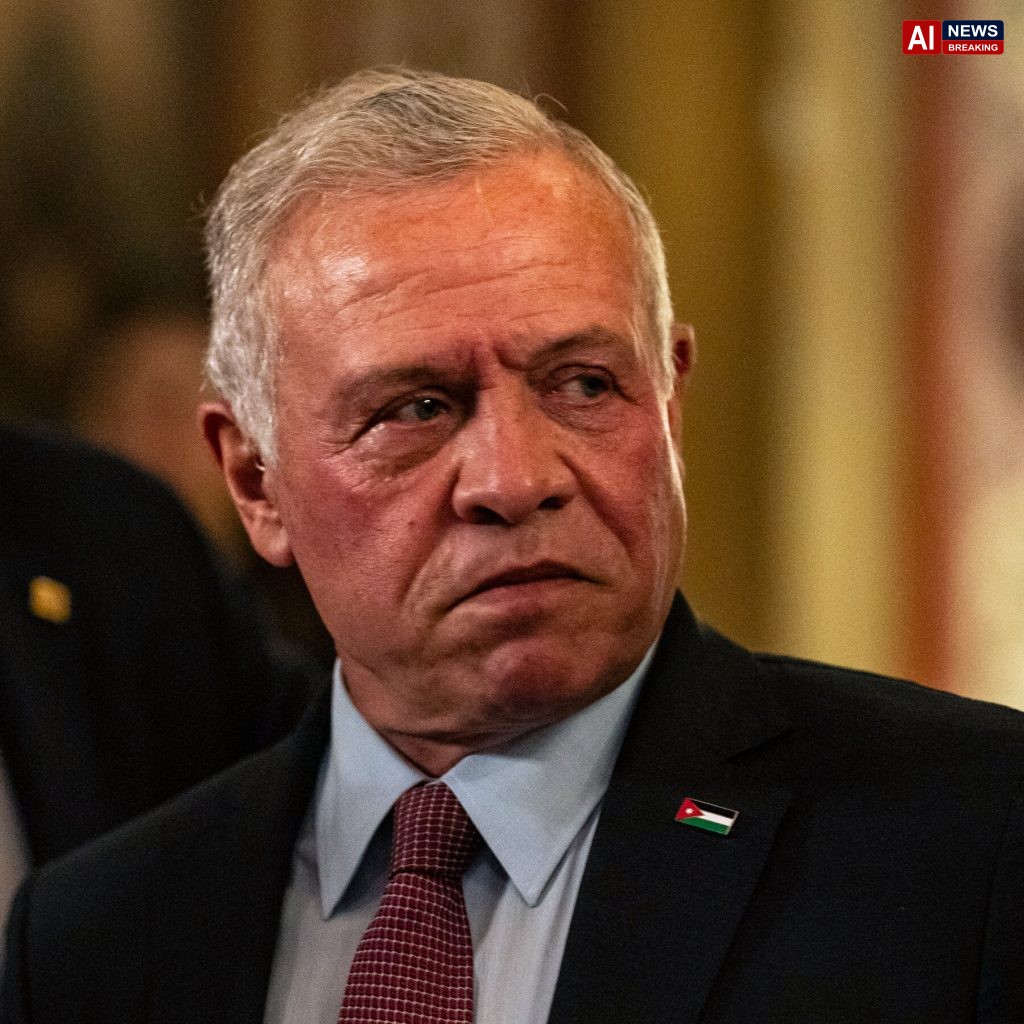
Jordan’s King Abdullah Likely to Focus on Palestinians at U.N. General Assembly - AI News Breaking
jordans king abdullah likely:
Jordan’s King Abdullah II is expected to centre his address to the United Nations General Assembly on the plight of the Palestinian people, with particular emphasis on the ongoing expansion of Israeli settlements in the occupied West Bank. The monarch, who has long positioned Jordan as a key regional actor in the Israeli‑Palestinian conflict, is likely to use the global forum to reaffirm his country’s commitment to a two‑state solution and to call for renewed international pressure on Israel to halt what he and many of his allies describe as illegal settlement activity. Analysts say the speech will also highlight Jordan’s own demographic and security concerns stemming from the conflict, underscoring how the issue reverberates beyond the borders of the occupied territories.Since the 1994 peace treaty that formally ended a state of war between Amman and Jerusalem, Jordan has maintained a delicate diplomatic balance, preserving a peace agreement while simultaneously voicing strong criticism of settlement expansion..
The king’s upcoming remarks are expected to echo this duality, stressing the importance of Israel’s compliance with United Nations Security Council resolutions, notably Resolution 242 and the more recent 2023 resolution calling for an end to settlement construction. By invoking these instruments, Abdullah aims to frame the settlement question not merely as a bilateral dispute but as a breach of widely accepted international law.The timing of the speech coincides with a broader wave of diplomatic activity surrounding the conflict. In recent months, several European capitals have renewed calls for a halt to settlement growth, while the United States, under its current administration, has signalled a willingness to revisit its longstanding policy of labeling settlements as “illegitimate but not illegal.” Jordan’s intervention at the UN is likely to be calibrated to complement these shifts, presenting a unified Arab stance that seeks to leverage any openings in Western policy to advance a negotiated settlement..
The king’s words may also reference recent United Nations reports documenting the impact of settlement expansion on Palestinian communities, including restrictions on movement, loss of agricultural land, and heightened tensions.Jordan’s internal dynamics add another layer of complexity to the king’s forthcoming address. The country hosts the largest number of Palestinian refugees of any Arab state, a demographic reality that shapes its domestic politics and economic planning. The king has repeatedly warned that unchecked settlement activity could trigger further displacement of Palestinians, potentially spilling over into Jordanian territory and exacerbating social and economic pressures..
By highlighting these concerns at the General Assembly, Abdullah seeks to draw attention to the humanitarian dimensions of the conflict, positioning Jordan as both a custodian of Palestinian rights and a nation directly affected by regional instability.Human rights organisations have documented a steady increase in settlement outposts over the past year, a trend that Jordan’s government has repeatedly condemned. In its latest statements, the Jordanian Ministry of Foreign Affairs has cited United Nations Office for the Coordination of Humanitarian Affairs data indicating that settlement construction has risen by approximately 15 percent since the start of 2024. The king’s anticipated remarks are expected to reference these figures, framing the settlement issue as a tangible obstacle to peace rather than a purely political abstraction..
By grounding his speech in empirical evidence, Abdullah aims to bolster the credibility of Jordan’s position and to counter narratives that portray settlement expansion as a minor or reversible phenomenon.The speech will also likely address the broader geopolitical context, including the role of Iran, the ongoing war in Gaza, and the shifting alliances within the Arab League. While Jordan has historically maintained a cautious approach to Iranian influence, the king may underscore the need for a unified Arab response to any actions that could destabilise the West Bank, including potential attempts by Tehran to exploit the situation for its own strategic aims. At the same time, Abdullah is expected to call for the reopening of diplomatic channels with Israel, emphasising that constructive engagement, rather than isolation, is essential for any lasting resolution.International reactions to Jordan’s anticipated stance have been mixed..
The United States, which continues to be Israel’s principal ally, has expressed openness to “new ideas” that could revive peace talks, yet it has refrained from outright condemnation of settlement activities. European Union officials, meanwhile, have reiterated their commitment to a two‑state solution and have warned that further settlement growth could trigger sanctions or trade repercussions. The king’s address may serve as a catalyst for renewed diplomatic dialogue, potentially prompting the UN Security Council to consider a more robust resolution or to convene a special session on the West Bank issue.In addition to political arguments, Abdullah is likely to invoke humanitarian concerns, citing the deteriorating living conditions in the occupied territories..
Recent UNRWA reports have highlighted shortages of water, electricity, and medical supplies in Gaza and the West Bank, conditions that are exacerbated by the expansion of settlements and the associated security measures. By integrating these humanitarian dimensions into his speech, the king seeks to appeal to a broader audience of UN member states, many of which have domestic constituencies sympathetic to the Palestinian cause.The monarch’s address will also reflect Jordan’s long‑standing role as the custodian of Jerusalem’s Islamic holy sites. While the king has historically avoided overtly religious rhetoric in diplomatic settings, his speech may subtly underscore the significance of East Jerusalem for Muslims worldwide, reinforcing the argument that settlement activity in that area threatens not only political stability but also the religious heritage of the city..
This nuance could resonate with a segment of the international community that frames the conflict in terms of cultural and religious preservation.As the General Assembly convenes, the world will be watching how Jordan’s king navigates the intricate web of regional politics, international law, and humanitarian imperatives. His speech is poised to reaffirm Amman’s commitment to a negotiated, two‑state solution while urging the global community to take concrete steps to curb settlement expansion. Whether the address will translate into tangible policy shifts remains to be seen, but it is likely to reinforce Jordan’s position as a pivotal voice for the Palestinians on the world stage, reminding the United Nations that the resolution of the conflict remains a cornerstone of regional peace and stability..
Updated: September 22, 2026
Jordan’s King Abdullah II will use his UN General Assembly address to denounce the surge in Israeli settlements, link the issue to Jordan’s own demographic and security concerns, and press for a renewed push toward a two‑state solution. He will back his appeal with recent UN data and frame settlement expansion as a breach of international law that threatens both Palestinian livelihoods and regional stability.
Insight: Jordan’s UN plea could pressure Western capitals into tightening settlement‑related sanctions, nudging the peace process from rhetorical support toward enforceable action.
At the same time, the king’s emphasis on refugee spillover underscores that unchecked expansion threatens Jordan’s own stability, turning a regional dispute into a direct security dilemma for the kingdom.