Trump administration offers mixed messages on limits to Ukraine’s Starshield access
 US Treasury proposes a rule to crack down on high-tech investments in China, other adversaries
 Calley Means, a key MAHA advocate, resigns as a top RFK Jr. adviser
 Spotify Tightens Family Plan Controls with QR Code Verification
 Use of Chief Minister C. Joseph Vijay’s deep fake videos to collect money: Rajasthan youth moves Madras High Court seeking bail
Kochi synagogue arson case: What happened, and history of over 800-year-old structure
**
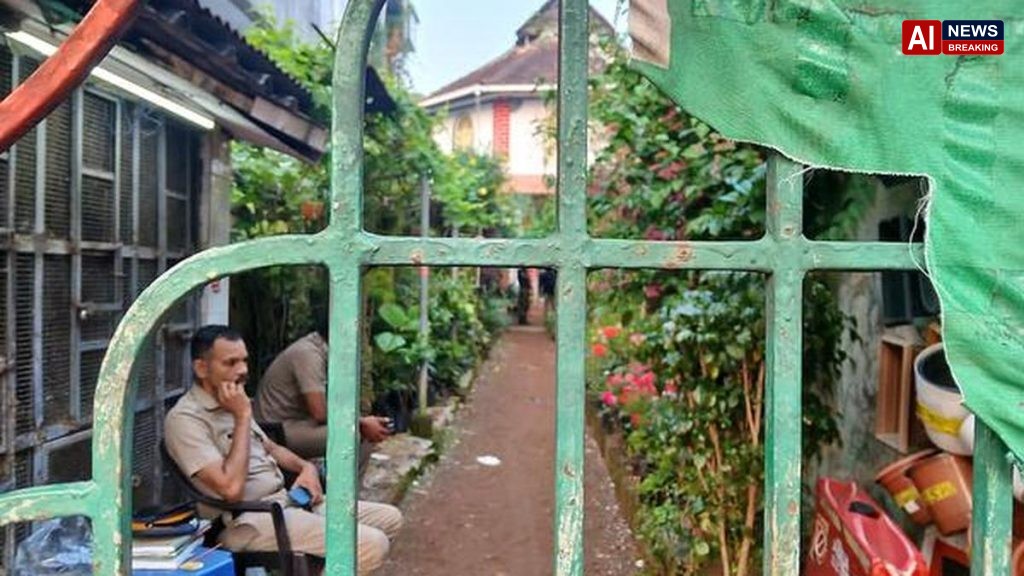
Kochi synagogue arson case: What happened, and history of over 800-year-old structure - AI News Breaking
A blaze was deliberately ignited at Blossom Nursery, the small commercial complex that fronts the Kadavumbhagam Synagogue in Ernakulam, at about 2.40 a.m. Fire‑fighters arrived within minutes, but the flames had already consumed a large portion of the nursery’s roofing and interior fittings. The blaze was contained after three hours, leaving the historic synagogue’s façade largely intact but its surrounding garden charred and several ancient stone columns cracked..
Initial police reports, released on the same day, describe the incident as an act of arson, noting the presence of accelerants and the absence of any accidental cause. The investigation, now being led by the Kerala Police’s Special Crimes Branch, has so far identified three suspects, all residents of nearby neighborhoods, who were taken into custody for questioning. Their alleged motive remains unclear, though authorities have not ruled out religious hatred, personal vendetta, or a staged protest against a proposed commercial development plan for the area.The Kadavumbhagam Synagogue, more commonly known as the Ernakulam Synagogue, is one of the oldest surviving Jewish houses of worship in India, dating back to the early 12th century..
The structure was built by the Malabari Jewish community, a group that migrated to the Malabar coast from the Middle East and later from the Iberian Peninsula after the expulsion from Spain and Portugal. Historical records, including a 1130 CE copper‑plate grant issued by the Chera king, mention a “house of worship for the children of Israel” in the region, widely believed to refer to the Kadavumbhagam edifice. The building’s original architecture blended local Kerala timber techniques with Sephardic design elements, featuring a sloping tiled roof, intricate wooden beams, and a modestly sized prayer hall oriented towards Jerusalem.Over the centuries the synagogue has endured a series of transformations, each reflecting the shifting fortunes of Kerala’s Jewish populace..
In the 16th century, Portuguese colonial authorities imposed heavy taxes on non‑Christian communities, prompting the community to reinforce the synagogue’s outer walls with laterite stone and add a protective courtyard. The 19th century saw a wave of migration to the newly established Cochin Jewish quarter, prompting the congregation to expand the prayer hall and install a mikveh, a ritual bath, in accordance with Orthodox practice. By the early 20th century, the building had become a cultural hub for the dwindling Jewish community, hosting Hebrew language classes, kosher butchery, and the annual Passover seder that drew participants from across the Indian subcontinent.The partition of India and the creation of Israel in 1948 accelerated the exodus of Kerala’s Jews, many of whom emigrated to Israel under the Law of Return..
By the 1970s, only a handful of families remained in Ernakulam, and the Kadavumbhagam Synagogue fell into disuse. In 1990 the Kerala State Department of Archaeology declared the site a protected monument, initiating a restoration programme funded by the Indian government, the World Monuments Fund, and private donors from the global Jewish diaspora. The restoration, completed in 1998, replaced rotted timber, reinstated the original lime‑plaster façade, and installed a discreet fire‑safety system, though the system was later found to be inadequately maintained.The synagogue’s significance extends beyond its religious function; it stands as a tangible reminder of Kerala’s long history of religious pluralism and maritime trade..
Scholars such as Dr Anil Mohan of the University of Kerala point out that the Kadavumbhagam edifice, together with the nearby Paradesi Synagogue in Mattancherry, illustrates how Jewish merchants integrated into the local economy, engaging in spice trade with Arab, Chinese, and European partners. The synagogue’s archives, housed in a climate‑controlled vault within the structure, contain Hebrew manuscripts, Portuguese‑era trade ledgers, and a rare 17th‑century prayer book printed in Cochin, making it a valuable resource for historians of both Indian and Jewish heritage.In the weeks following the arson, local residents gathered in front of the synagogue to express solidarity, lighting candles and reciting prayers in Hebrew, Malayalam, and English. Community leaders, including the head of the Kerala Jewish Heritage Foundation, urged the government to step up security measures for protected sites, citing previous incidents of vandalism at heritage monuments across the state..
The Ministry of Culture responded by dispatching a rapid‑response team of conservators to assess any structural damage to the synagogue itself. Their preliminary report, released on 15 October, confirmed that the main prayer hall remained structurally sound, but noted minor cracks in the stone lintels that could, if left unattended, compromise the building’s integrity over time.Legal experts anticipate that the case will test India’s laws on hate crimes and the protection of cultural property. The Prevention of Damage to Public and Private Property Act, amended in 2022, imposes stringent penalties for crimes motivated by religious animus, while the Ancient Monuments and Archaeological Sites and Remains (AMASR) Act provides for the preservation of historic structures..
Prosecutors are expected to invoke both statutes, seeking a maximum sentence of ten years’ imprisonment for each suspect, should the investigation confirm that the fire was set with intent to damage a protected heritage site. Human rights organisations have called for a transparent judicial process, warning that any perception of bias could inflame communal tensions in a region already grappling with sporadic inter‑religious disputes.The incident has also revived debate over the future of the surrounding Blossom Nursery and its commercial use. The nursery, owned by a local family, has long been a point of contention, as developers have proposed converting the site into a mixed‑use complex that would include a parking lot, boutique shops, and a café..
Critics argue that such development would undermine the sanctity of the synagogue’s environs and could set a precedent for further encroachment on heritage zones. Municipal officials, citing the recent arson, have announced a temporary moratorium on any construction permits in the immediate vicinity until a comprehensive heritage impact assessment is completed.As the investigation proceeds, the Kadavumbhagam Synagogue stands as a resilient symbol of Kerala’s multicultural past, its ancient walls bearing witness to centuries of trade, migration, and coexistence. The fire that scarred the adjacent nursery may have been a deliberate act, but it has also sparked renewed public interest in preserving the region’s fragile historical tapestry..
Whether the legal outcome will deter future attacks remains to be seen, but for now the community.
Updated: October 15, 2026
Arsonists set fire to the Blossom Nursery beside Ernakulam’s historic Kadavumpam Synagogue in the early hours of Oct 12, prompting a three‑hour firefight that left the garden scorched and several stone columns cracked. Police have detained three local suspects, while authorities and heritage groups scramble to assess damage, bolster security and determine whether the blaze was motivated by religious hatred or other grievances.
Insight: The arson, whether hate‑driven or a protest against gentrification, has turned a heritage‑site fire‑safety lapse into a flashpoint that could force India’s new hate‑crime and monument‑protection statutes into a high‑profile test.
If the