 Tao Tokyo Spring 2027
 Karnataka SIR: Teaching on the back burner
 Trump administration offers mixed messages on limits to Ukraine’s Starshield access
 US Treasury proposes a rule to crack down on high-tech investments in China, other adversaries
 Calley Means, a key MAHA advocate, resigns as a top RFK Jr. adviser
Microsoft is giving Copilot more control over Windows and your files
**
Microsoft is giving Copilot more control over Windows and your files - AI News Breaking
microsoft giving copilot more:
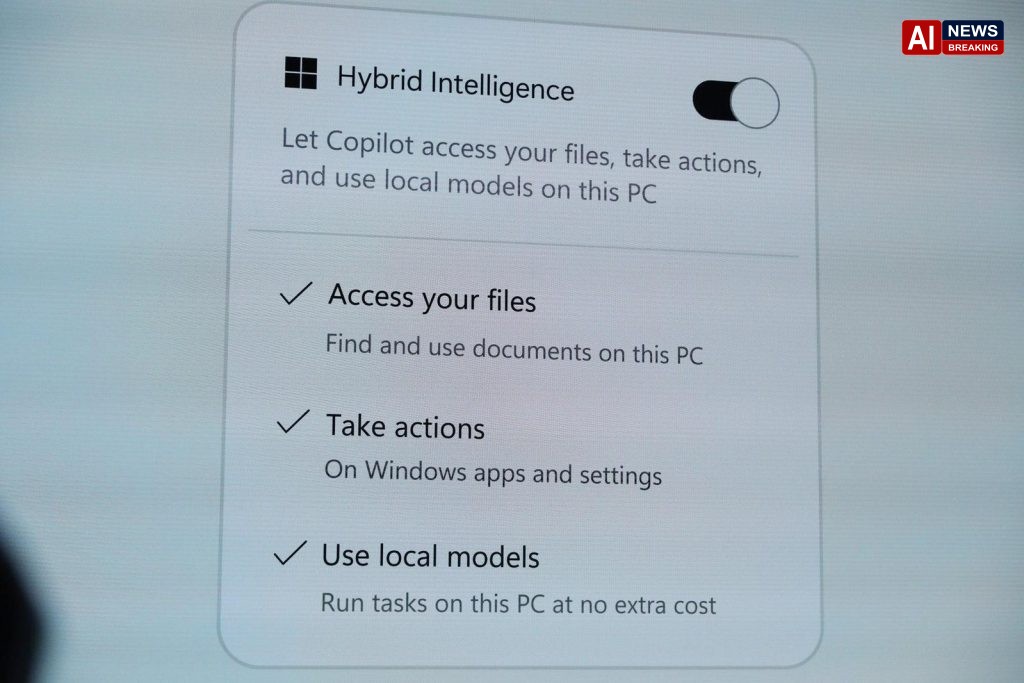
Microsoft has unveiled a significant expansion of its Copilot AI at the company’s latest Windows and Surface event, giving the system deeper access to users’ local files and the ability to perform actions across the operating system. The new capabilities are part of what Microsoft calls “Hybrid Intelligence,” a framework that blends on‑device and cloud‑based AI models to deliver faster, more context‑aware services. In a live demonstration, executive vice president of Copilot Jacob Andre Andreou walked the audience through a scenario where the Copilot assistant, named Autopilot, helped him prepare tax documents using data from his personal computer and a cloud‑hosted accountant’s email.During the demonstration, Andre Andreou asked Autopilot to locate an email from his accountant and retrieve the attached spreadsheet containing his last year’s financials..
The AI then opened the spreadsheet, identified the relevant tax categories, and automatically generated a preliminary tax return draft. Andre Andreou was then able to edit the draft, add a note for a tax deduction, and ask Autopilot to save the updated document and send it to his accountant for final review. The audience watched as the AI navigated the file system, parsed a complex spreadsheet, and even suggested an optimization for his tax filing based on recent legislative changes..
The demonstration highlighted that Autopilot’s new local‑file access is controlled by a set of permissions that users can manage through the Windows privacy settings, and that the system can be instructed to keep certain documents private or share them with approved cloud services.Microsoft’s shift toward hybrid models is intended to address concerns over data privacy that have accompanied the rapid rollout of AI assistants. By running core inference locally, the new Copilot can offer immediate responses without sending all user data to the cloud. At the same time, the system can offload more computationally heavy tasks to Azure, ensuring that users with older hardware still receive a high‑quality experience..
The company said that the hybrid approach will be gradually rolled out across Windows 11 and future Surface devices, with a focus on business productivity applications such as Microsoft Office, Teams, and the new Windows Copilot hub.The announcement comes at a time when competitors are racing to integrate AI into their operating systems. Google has been experimenting with Gemini‑powered features in Android, while Apple is reportedly working on an AI assistant for macOS that respects local privacy. Microsoft’s emphasis on “hybrid” solutions aims to distinguish its approach by offering a middle ground between the fully cloud‑based AI seen in consumer devices and the more isolated AI that some privacy advocates favour.In addition to local file access, the new Copilot can perform a variety of system‑level actions..
The event showcased how the AI could modify system settings, such as adjusting display brightness, enabling battery‑saving mode, and even installing updates. In the tax example, Autopilot suggested closing background applications to free up RAM before generating the document, illustrating that the assistant can make performance‑optimising decisions on the fly. The system is also capable of scheduling tasks, creating calendar events, and sending reminders, effectively acting as a personal productivity manager.Security and privacy were a central theme in the presentation..
Microsoft stressed that the new features are built on existing Windows security frameworks, with data encryption at rest and in transit. The company also announced a new “Copilot Shield” layer, a set of APIs that allow developers to fine‑tune the scope of data the assistant can access. For instance, a developer could restrict Copilot to read only from a specific folder, preventing it from scanning personal documents..
This granular control is designed to reassure users that the assistant can be as private or permissive as they require.The event also revealed that the Copilot’s local models are continuously updated through the Windows Update mechanism. Users will receive periodic patches that improve the AI’s accuracy and add new capabilities without needing to download large model files. According to Microsoft, this approach will keep the assistant’s performance consistent even as the underlying models grow in size and complexity..
The company plans to open a beta program next month for users interested in testing the new features on a wider range of devices.Industry analysts view the move as a strategic response to the growing demand for AI‑enhanced productivity tools. “Hybrid Intelligence is the next logical step,” said Sarah Patel, a senior analyst at Gartner. “Users want instant, context‑aware assistance without compromising privacy, and Microsoft’s architecture aligns with that need.” Critics, however, caution that the line between local and cloud processing could blur, raising questions about where user data ultimately resides..
Microsoft’s leadership addressed these concerns by reaffirming its commitment to transparency in data handling practices.Looking ahead, Microsoft intends to integrate Copilot more deeply into the Windows ecosystem. The company will roll out a dedicated Copilot hub in Windows 11, where users can customise the assistant’s behaviour, view logs of its actions, and manage permissions. The new hub will also host a marketplace for third‑party extensions, allowing developers to build specialised Copilot skills for industries such as legal, medical, and finance..
Early adopters will be invited to test these extensions during the next phase of the beta program.While the full rollout timeline remains to be announced, Microsoft has signalled that the core hybrid Copilot features will become available to Windows 11 users later this year. The company is also working on bringing the same intelligence to its Surface devices, ensuring that both desktop and mobile users can benefit from the same level of automation and context awareness. As businesses and individuals continue to rely on AI to streamline workflows, Microsoft’s hybrid approach positions it to play a pivotal role in shaping the future of personal and professional computing..
Updated: October 7, 2026
Microsoft has expanded Copilot’s capabilities, giving the AI local file access and the ability to act across Windows, from opening spreadsheets to tweaking system settings. The new “Hybrid Intelligence” model blends on‑device processing with cloud power, promising faster, privacy‑conscious assistance that will roll out to Windows 11 and Surface devices later this year.
Microsoft’s “Hybrid Intelligence” move shows the company is betting that privacy‑savvy users will choose an assistant that feels like a local extension rather than a cloud‑bought chatbot, blending the speed of on‑device inference with the power of Azure. This strategy could tilt the AI‑assistant race,