 Australia probes AI‑driven breach of My Health Record portal
  Engineering student’s ‘suicide’ turns out to be murder; two arrested
  Canada’s Capital Bids Good Riddance to Trump Avenue as Tensions With U.S. Rise
  Pentagon investigates after China obtains parts from F-35 stealth fighter jet
 More ragi with less water: Online programme to promote ‘Guli Ragi’ cultivation on September 23
**
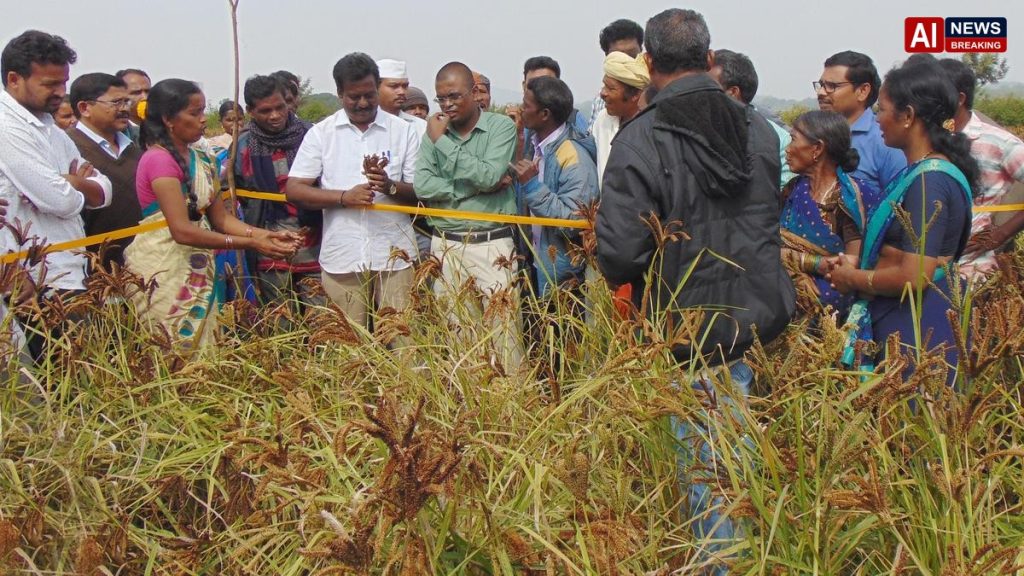
More ragi with less water: Online programme to promote ‘Guli Ragi’ cultivation on September 23 - AI News Breaking
more ragi less water:
Farmers in the Haveri district of Karnataka are being urged to switch to a water‑saving variety of finger millet known locally as “Guli Ragi” after a government‑backed online programme was announced for 23 September. The initiative, part of the state’s broader effort to bolster climate‑resilient agriculture, will be streamed live by the Department of Agriculture and will feature demonstrations, expert talks and a question‑and‑answer session for cultivators across the region. Organisers say the virtual format is intended to reach smallholders in remote villages who have limited access to extension services, while also complying with ongoing public‑health guidelines.The Guli Ragi method, which involves planting a dwarf, short‑statured variety of finger millet, is promoted as requiring up to 30 per cent less irrigation than the traditional tall varieties that dominate the local landscape..
According to data released by the department, pilot farms that adopted the new cultivar in the 2022‑23 season harvested an average of 20 quintals per acre, compared with the 15 quintals typically recorded using conventional seeds. The higher yield, officials claim, is attributable not only to reduced water stress but also to the crop’s shorter growth cycle, which allows for an additional planting window before the onset of the monsoon.The online event will be hosted from the state capital, Bengaluru, and will feature agronomists from the Indian Council of Agricultural Research (ICAR), representatives from the Karnataka State Horticultural Board and a panel of local farmer leaders who have already transitioned to Guli Ragi. Speakers are expected to discuss seed procurement, soil preparation, pest management and post‑harvest handling, as well as the financial incentives available to participants..
A live chat function will enable viewers to pose region‑specific queries, and a follow‑up helpline will be set up to provide ongoing technical support.State officials say the push for Guli Ragi aligns with Karnataka’s commitments under the National Mission for Sustainable Agriculture, which seeks to reduce groundwater extraction and improve water‑use efficiency in rain‑fed and irrigated farms alike. The programme also dovetails with the central government’s emphasis on “climate‑smart” crops, a category under which finger millet is classified because of its tolerance to drought and low‑input requirements. By encouraging adoption of a variety that matures in 90‑100 days, the department hopes to free up water for other crops and reduce the pressure on the region’s over‑exploited borewells.Local agronomist Dr..
Raghavendra, who has overseen the pilot trials, noted that the dwarf stature of Guli Ragi reduces transpiration loss and allows for denser planting. “We observed that the canopy closure occurs earlier, which shades the soil and curtails evaporation,” he explained during a pre‑event briefing. He added that the variety’s robust root system enables it to access deeper moisture layers, a feature that proved vital during the dry spell that hit Haveri last year..
Preliminary soil tests on participating farms also indicated a modest improvement in organic matter content, which Dr. Raghavendra attributed to the reduced need for synthetic fertilizers.Farmers who have already embraced the new seed claim it has transformed their livelihoods. Ramappa Gowda, a 45‑year‑old cultivator from the village of Savanur, told reporters that the higher yields allowed him to store surplus grain for sale during the off‑season, thereby stabilising his income..
“With the old millet, we could barely meet our family’s needs,” he said. “Now we have enough to send our children to school and invest in a small tractor.” Similar testimonies have been recorded in nearby taluks, where cooperative societies are reportedly organising bulk purchases of the certified seed to lower costs for individual growers.Critics, however, caution that the transition to a single variety may carry risks. Agricultural economist Dr..
Meera Nair warned that over‑reliance on Guli Ragi could reduce genetic diversity and make the crop vulnerable to future pest outbreaks or disease strains. “While the current data are encouraging, it is essential to maintain a portfolio of cultivars that can adapt to changing climatic conditions,” she said. The Department of Agriculture has responded by assuring that the programme includes training on integrated pest management and that seed suppliers are maintaining a reserve of alternative finger millet strains.The upcoming online session will also address market linkages, an area of concern for many smallholders who struggle to fetch fair prices for their produce..
Representatives from the Karnataka State Agricultural Marketing Board will outline the role of e‑mandi platforms and cooperative marketing societies that can aggregate Guli Ragi output and connect it with urban retailers and institutional buyers. Officials anticipate that a more predictable supply chain could attract premium buyers interested in millet’s health benefits, thereby offering farmers an additional revenue stream.In the broader context, the Guli Ragi push reflects a growing trend across India to promote millets as a staple in the national diet. The Ministry of Food Processing Industries has recently launched campaigns highlighting millets’ high nutritional value and low water footprint, aiming to reduce the country’s reliance on water‑intensive rice and wheat..
Karnataka, traditionally a strong millet‑producing state, appears poised to lead this shift by leveraging technology, research and community outreach.As the 23 September broadcast approaches, the Department of Agriculture urges all interested farmers to register online through its portal, where they can also download informational brochures in Kannada and English. The session will be recorded and made available on the department’s YouTube channel for those unable to attend live. If the response mirrors the optimism shown in the pilot phase, Guli Ragi could become a cornerstone of Karnataka’s strategy to secure food production while conserving scarce water resources..
Updated: September 22, 2026
If Guli Ragi scales, Karnataka could rewrite its water‑footprint narrative, turning a drought‑prone belt into a low‑input, high‑value millet corridor. Yet the lure of a single “climate‑smart” seed may sow future vulnerability, pressing policymakers to hedge with diversified genetics