Karnataka SIR: Teaching on the back burner
 Trump administration offers mixed messages on limits to Ukraine’s Starshield access
 US Treasury proposes a rule to crack down on high-tech investments in China, other adversaries
 Calley Means, a key MAHA advocate, resigns as a top RFK Jr. adviser
 Spotify Tightens Family Plan Controls with QR Code Verification
Mumbai police detain dozens near Shivaji Park.
**
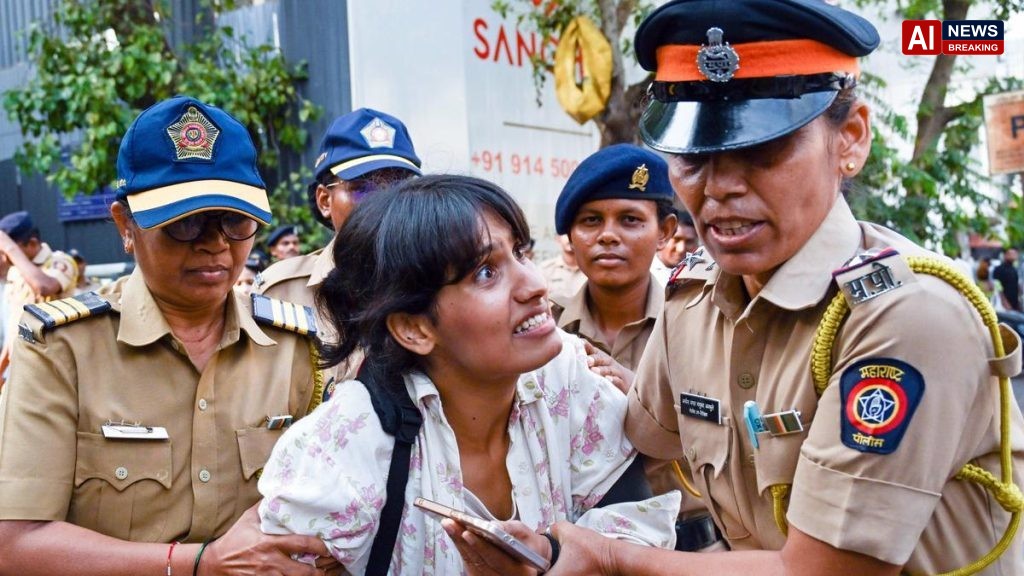
Many detained near Shivaji Park as Mumbai Police prevent protest against CEC - AI News Breaking
The streets surrounding Shivaji Park in Mumbai have become the focus of a growing controversy after police detained dozens of people in the early hours of Thursday, an action the authorities say was aimed at preventing an unauthorised rally against the Chief Election Commissioner (CEC). Eyewitnesses and local residents, however, claim that many of those taken into custody were simply passing through the area or standing nearby, raising questions about the breadth of the police response and the limits of public assembly in a city that has long been a hub for political activism.According to a statement released by the Mumbai Police, the operation was triggered by intelligence reports indicating that a group of activists planned to gather at Shivaji Park to voice dissent over recent appointments within the Election Commission. The police warned that the gathering, if allowed to proceed, could “disrupt public order and threaten the safety of commuters”..
Acting on this assessment, officers deployed in large numbers to the park and its adjoining lanes, intercepting individuals as they entered the vicinity and conducting spot checks before escorting many to the nearby police station for further questioning.Human Rights Watch, which has been monitoring the situation, described the detentions as “disproportionate” and “indicative of a chilling effect on free expression”. The organisation’s regional director, Arjun Patel, said that the pattern of arrests appeared to target not only the alleged organisers but also ordinary pedestrians who happened to be in the vicinity. “In a democratic society, the threshold for intervening in peaceful assembly should be high..
The fact that people who were merely walking or standing were detained suggests an overly broad interpretation of what constitutes a threat,” Patel remarked.Local residents corroborated these concerns, with several reporting that they were stopped while on their way to work or returning from a nearby market. One commuter, who asked not to be named, recounted being handcuffed after a brief exchange with an officer who claimed the individual was “in the area of a potential protest”. “I was just on my way to catch a train..
I didn’t know anything about any protest. They took my phone, asked me questions, and then let me go after a few hours,” she said. Similar accounts have emerged from other witnesses who described a “sweeping” police presence that included roadblocks, loudspeakers announcing the prohibition of any gathering, and the use of metal detectors at entry points to the park.The Chief Election Commissioner’s office declined to comment directly on the police operation, but a senior official from the Election Commission of India (ECI) released a brief statement asserting that the CEC’s office “remains committed to upholding the integrity of the electoral process and welcomes lawful, peaceful expression of dissent”..
The statement stopped short of addressing the specific allegations of excessive police force, instead urging citizens to follow due process and respect public order when organising demonstrations.Legal experts have weighed in on the potential implications of the detentions for constitutional rights. Senior advocate Meera Nair pointed out that while the police have a duty to maintain law and order, the Supreme Court has repeatedly upheld the right to peaceful assembly under Article 19(1)(b) of the Constitution, subject only to reasonable restrictions in the interest of sovereignty, security, and public order. “The key question is whether the police’s pre‑emptive action was a reasonable restriction or an overreach that infringes on fundamental freedoms,” Nair said..
She added that any evidence suggesting that individuals were detained without clear cause could lead to judicial scrutiny and possible compensation claims.The incident has also sparked debate within political circles. Opposition parties, including the Indian National Congress and the Aam Aadmi Party, have condemned what they described as “state‑sanctioned intimidation”. A spokesperson for the Congress party, Rohan Verma, accused the ruling coalition of “using law enforcement as a tool to suppress dissent ahead of the upcoming elections”..
The AAP, meanwhile, called for an independent inquiry, arguing that the police’s heavy‑handed approach could undermine public confidence in the democratic process.In response to the mounting criticism, the Mumbai Police issued a follow‑up press release asserting that all detentions were conducted “in accordance with legal procedures” and that those not directly linked to the alleged protest were released after verification of their identities. The release also highlighted that several of those detained had been found in possession of pamphlets calling for a boycott of the CEC’s recent decisions, suggesting a material link to the planned protest. However, the police did not provide specific numbers or names, leaving observers to question the transparency of the operation.Civil society groups have called for a broader dialogue on the balance between security measures and civil liberties, especially as the country prepares for a series of state elections later this year..
A coalition of NGOs, led by the Centre for Democratic Rights, submitted a petition to the Bombay High Court seeking a writ of mandamus to compel the police to disclose the criteria used for the detentions and to ensure that future actions are narrowly tailored to genuine threats. The petition argues that vague justifications could set a dangerous precedent, eroding the space for lawful protest in public spaces.As the situation unfolds, the narrative surrounding Shivaji Park—a historic venue for political rallies since the 1930s—remains contested. While the police maintain that their intervention was necessary to avert disorder, a growing chorus of citizens, legal scholars, and activists argue that the episode illustrates an unsettling trend toward pre‑emptive suppression of dissent..
The episode is likely to fuel further scrutiny of law‑enforcement practices in India’s urban centres, particularly as the nation heads toward a critical electoral cycle where the balance between authority and freedom will be tested once more..
Updated: October 11, 2026
Police detained dozens around Mumbai’s Shivaji Park in a pre‑emptive sweep to thwart a planned rally against the Chief Election Commissioner, prompting accusations that the operation swept up ordinary commuters. Human‑rights groups and opposition parties warn the crackdown signals an alarming chill on lawful protest ahead of upcoming elections.
Mumbai’s pre‑emptive sweep at Shivaji Park signals a shifting calculus where security narratives increasingly eclipse constitutional safeguards, foreshadowing tighter constraints on civic dissent as elections loom.
If courts deem the arrests an overreach, the backlash could reshape police protocols, turning today’s “prevent