Trump administration offers mixed messages on limits to Ukraine’s Starshield access
 US Treasury proposes a rule to crack down on high-tech investments in China, other adversaries
 Calley Means, a key MAHA advocate, resigns as a top RFK Jr. adviser
 Spotify Tightens Family Plan Controls with QR Code Verification
 Use of Chief Minister C. Joseph Vijay’s deep fake videos to collect money: Rajasthan youth moves Madras High Court seeking bail
Navi Pillay awarded Nobel Peace Prize.
**
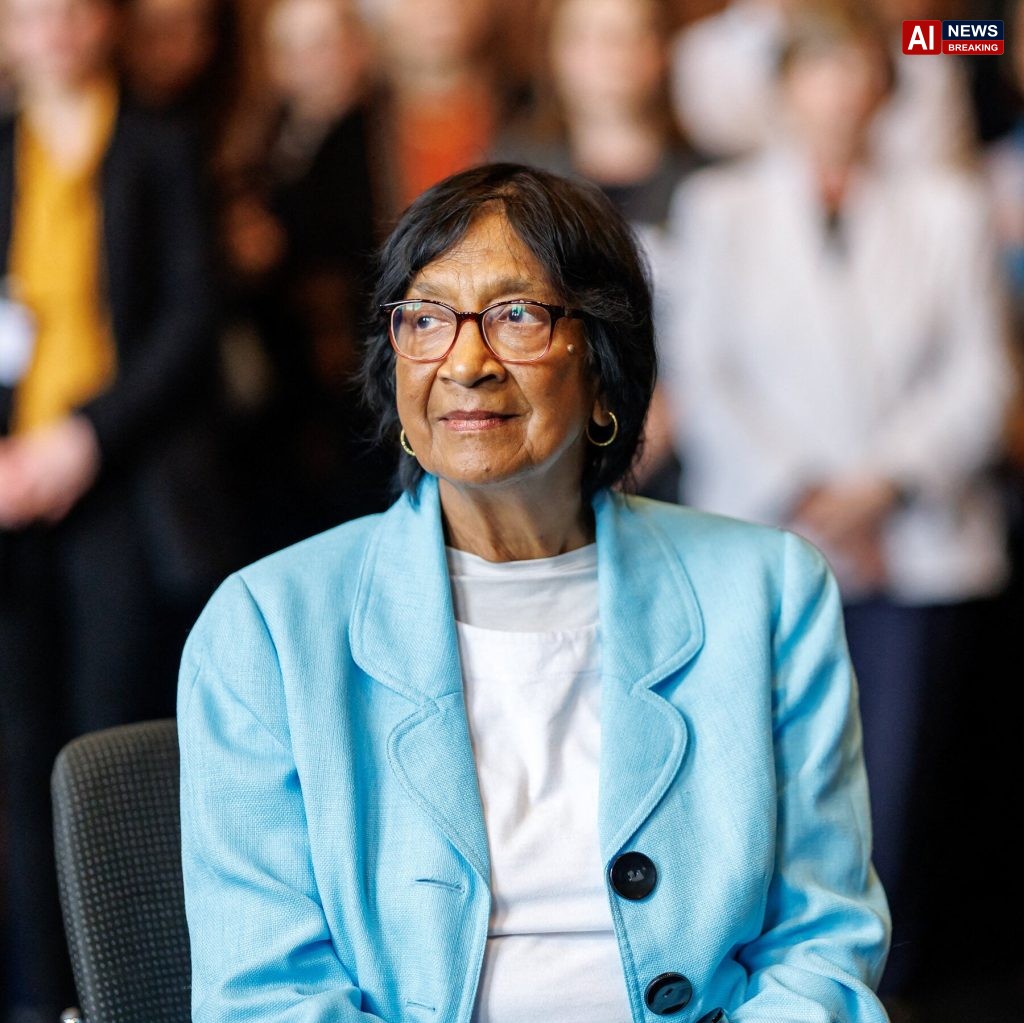
Navi Pillay awarded Nobel Peace Prize. - AI News Breaking
Navi Pillay, South African Jurist, Is Awarded the Nobel Peace Prize In a decision that has sparked intense debate across the globe, the Nobel Committee announced that Navi Pillay, former United Nations High Commissioner for Human Rights, has been awarded the Nobel Peace Prize. The award, presented during the annual ceremony in Oslo, recognises Pillay’s lifelong commitment to human rights and her efforts to bring justice to conflict zones, particularly her role in the United Nations Human Rights Council’s investigations into the Israeli‑Palestinian conflict. The announcement was met with immediate and vocal condemnation from Israeli officials, who criticised the selection as “politically motivated” and “unfair.” In a statement released by the Israeli Ministry of Foreign Affairs, the Prime Minister’s spokesperson called the decision a “blatant political attack on our nation” and warned that the award would deepen divisions in an already fragile region..
Pillay’s appointment as the first female South African jurist to serve as the UN High Commissioner for Human Rights was widely celebrated in 2008. During her tenure, she championed a range of human rights causes, from advocating for the rights of refugees to addressing systemic discrimination in global governance. Her work earned her respect from a diverse array of international actors and cemented her reputation as a principled advocate for vulnerable populations..
In 2022, Pillay was appointed chair of the United Nations Independent Commission of Inquiry on the 2021 Gaza conflict. The commission’s report, released in 2023, concluded that Israel had committed “serious violations of international law” and called for investigations into allegations of genocide against Palestinian civilians. The report was praised by human rights organisations for its rigorous methodology but was denounced by Israel as “bias and distortion.” The commission’s findings have intensified the discourse around the Israeli‑Palestinian conflict, with supporters arguing that accountability is essential for peace and detractors claiming that the report inflames tensions..
Pillay herself has defended the commission’s work, stating that the pursuit of truth and justice is a cornerstone of international law and that the findings were “rooted in evidence and the testimonies of survivors.” Navi Pillay’s Nobel Prize has therefore been seen by some as a vindication of her efforts to bring international scrutiny to the situation in Gaza, while others view it as a politicised act that undermines diplomatic efforts. The United Nations has reiterated its commitment to impartiality, stating that the Nobel Committee’s decision was based on Pillay’s “unwavering dedication to human rights and her role in advancing international justice.” In response to the award, Israel’s ambassador to the United Nations, Tzipi Livni, delivered a statement at the UN General Assembly, condemning the Nobel Committee’s decision as “unacceptable.” She called for the international community to focus on constructive dialogue rather than punitive measures, emphasising the need for a comprehensive peace process that addresses both Israeli security concerns and Palestinian aspirations for statehood. International reactions have been mixed..
Human rights groups in Europe and the Americas have praised the award, citing Pillay’s long record of advocacy as a “symbolic milestone for global human rights.” Conversely, some Middle Eastern governments have expressed disappointment, arguing that the prize may exacerbate regional tensions and distract from practical solutions to the conflict. The Nobel Committee’s spokesman explained that the selection process is independent of political pressures, noting that Pillay’s work in international law and her dedication to protecting human rights were key factors. The committee added that the award recognises not only Pillay’s past achievements but also her continued influence on global human rights policy..
The decision also highlights the broader debate about the role of international bodies in conflict resolution. Critics argue that independent inquiries can sometimes lack context or fail to consider the complexities of armed conflict, whereas supporters assert that such investigations are essential for accountability and preventing future atrocities. Pillay, who was born in Johannesburg and educated at the University of the Witwatersrand, has long been an advocate for the rule of law..
Her career has spanned roles at the South African Constitutional Court, the African Commission on Human and Peoples’ Rights, and the UN Human Rights Council. In each position, she has consistently pushed for mechanisms that hold states accountable for human rights violations, a stance that has earned her both admiration and opposition. As the Nobel Peace Prize ceremony concludes, observers will be watching to see how this award shapes the discourse on international justice and the ongoing Israeli‑Palestinian conflict..
While some see it as a positive step toward greater accountability, others fear it may deepen polarization. The global community remains divided, with the next few weeks likely to see further debate and reflection on the balance between justice, diplomacy, and peace..
Updated: October 9, 2026