Trump administration offers mixed messages on limits to Ukraine’s Starshield access
 US Treasury proposes a rule to crack down on high-tech investments in China, other adversaries
 Calley Means, a key MAHA advocate, resigns as a top RFK Jr. adviser
 Spotify Tightens Family Plan Controls with QR Code Verification
 Use of Chief Minister C. Joseph Vijay’s deep fake videos to collect money: Rajasthan youth moves Madras High Court seeking bail
Nuremberg Airport in Germany Suspends Flights Over ‘Aviation Emergency’
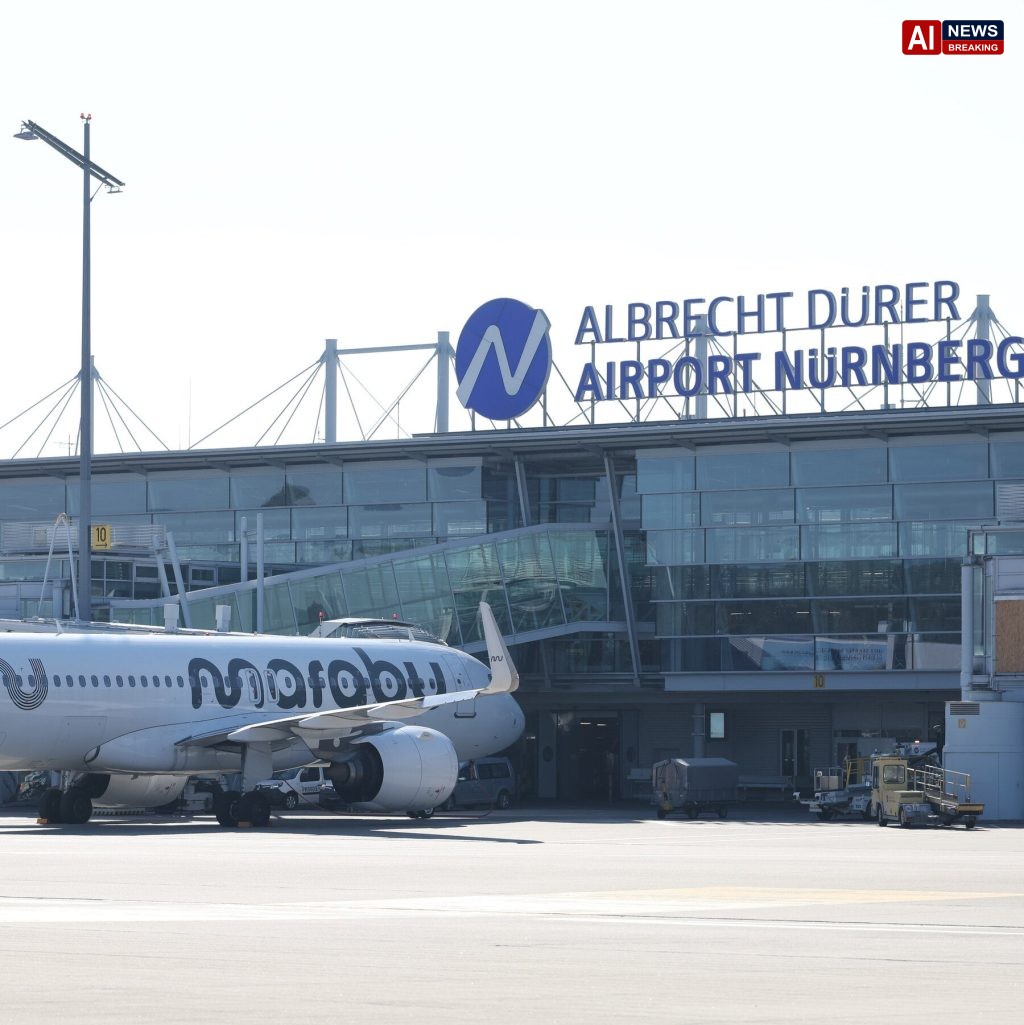
Nuremberg Airport in Germany Suspends Flights Over ‘Aviation Emergency’ - AI News Breaking
nuremberg airport germany suspends:
The regional hub at Nuremberg Airport has been forced to suspend all departing and arriving flights after staff declared an “aviation emergency” on Thursday morning, prompting a rapid response from airport authorities and local emergency services. The sudden halt to operations came at a time when the airport, which handles around 5 million passengers annually, was already coping with a busy travel day following the Easter weekend. Passengers waiting in the terminals were initially left unaware of the seriousness of the situation, as information screens displayed only a generic warning before being replaced by a notice directing travellers to seek assistance at the information desks.Within minutes of the announcement, police and fire crews arrived on site, accompanied by a specialised team from the German Federal Police’s aviation unit..
The units set up a command centre in the airport’s control tower to coordinate the response, while senior airport officials began the process of grounding aircraft on the apron and diverting incoming flights to nearby Munich and Stuttgart airports. By mid‑morning, more than 30 flights had already been rerouted, affecting roughly 12,000 passengers who were stranded at the terminal or in the air. The airport’s official website and social media channels posted updates in both German and English, urging travellers to stay calm and promising that safety was the top priority.The precise cause of the emergency was not disclosed at the time of the suspension..
Initial speculation among aviation analysts ranged from a possible technical fault in the runway lighting system to a security alert involving unidentified objects in the airspace. However, a statement released by the Nuremberg Police Department later in the day clarified that investigators had found “no danger” to passengers, crew or airport infrastructure. The police emphasised that the precautionary measures were taken in line with standard safety protocols, which require immediate grounding of operations whenever an unexplained anomaly is detected in the vicinity of an airport.Airport management confirmed that the suspension would remain in effect until the situation could be fully assessed and cleared by the relevant authorities..
“The safety of our passengers and staff is non‑negotiable,” said the airport’s chief operating officer in a press briefing. “We are working closely with the police, fire services and the Federal Aviation Office to ensure a thorough investigation and a swift return to normal operations.” The spokesperson added that airlines would be reimbursing affected customers according to European Union Regulation 261/2004, which mandates compensation for flight cancellations and long delays, though the exact amount would depend on the length of the disruption and the distance of the journey.Airlines operating from Nuremberg, including Lufthansa, Eurowings and Ryanair, activated their contingency plans, arranging alternative transport for passengers wherever possible. Several carriers provided hotel vouchers and meal vouchers to those whose flights were cancelled, while others offered rebooking on later flights out of Munich..
The German airline association (IATA) issued a brief advisory to its members, urging them to keep passengers informed and to coordinate closely with ground staff to manage the overflow of travellers seeking assistance.The ripple effects of the shutdown extended beyond the airport’s immediate environs. Local businesses, particularly those reliant on airport traffic such as car‑hire firms, cafes and retail shops, reported a sudden drop in customers. The city of Nuremberg, which benefits from the airport’s connectivity to major European hubs, faced potential economic repercussions if the disruption were to linger..
The municipal mayor, who was briefed on the situation, expressed confidence that the emergency would be resolved quickly, citing the region’s robust emergency response infrastructure and its history of handling similar incidents with minimal impact.Aviation experts noted that while such emergencies are rare, they are not unprecedented. “Airports operate under a strict safety regime, and any ambiguous signal—whether it be a technical glitch, an unidentified object, or a security threat—triggers an immediate and coordinated response,” said Dr Karin Müller, a senior lecturer in aviation safety at the Technical University of Munich. She added that the transparent communication from Nuremberg Airport’s authorities was in line with best practices, helping to mitigate passenger anxiety and maintain public trust in the aviation system.By late afternoon, the emergency teams had completed a thorough inspection of the runway, taxiways and surrounding airspace..
The findings, released in a brief press note, confirmed that the initial alert had been triggered by a malfunctioning sensor on the runway’s automated weather monitoring system, which had mistakenly flagged an abnormal wind shear condition. The false alarm, while harmless in itself, required verification by air traffic control and the aviation police before normal operations could resume.Following the clearance, the airport began a staggered resumption of flights, prioritising those that had been diverted to Munich and Stuttgart. Ground staff worked through the night to reposition aircraft, refuel planes and prepare the terminal for the influx of passengers returning from the diversions..
By midnight, most of the scheduled departures for the following day had been restored, though some delays persisted due to the need for additional crew rest periods and the re‑allocation of gate slots.The incident has sparked a broader discussion within Germany about the resilience of regional airports and the importance of robust sensor systems. The Federal Aviation Office announced that it would conduct a review of similar monitoring equipment across the country’s secondary airports to prevent comparable false alerts in the future. Meanwhile, passengers who were affected by the Thursday suspension expressed a mixture of frustration and appreciation for the swift handling of the emergency..
“It was stressful at first, but the staff kept us informed and gave us food vouchers,” said Anna Becker, a business traveller from Hamburg. “I’m glad they took the precaution seriously, even if it turned out to be a technical glitch.”In the wake of the event, Nuremberg Airport has pledged to invest in upgraded detection technology and to enhance its emergency communication protocols. The airport’s management expects that the temporary disruption will have limited long‑term impact on its passenger numbers, citing the resilience demonstrated by airlines and the airport’s ability to restore services within a few hours..
As travel demand continues to recover across Europe, the incident serves as a reminder of the intricate safety net that underpins modern aviation, and of the decisive actions taken when that net is tested..
Updated: October 13, 2026
Nuremberg Airport halted all flights after an “aviation emergency” was declared, diverting roughly 12,000 passengers to Munich and Stuttgart before a sensor glitch was uncovered. The incident prompted a rapid multi‑agency response and sparked a review of regional airport safety systems, with operations largely restored by midnight.
This development highlights evolving dynamics and may have broader implications in the near term.