Trump administration offers mixed messages on limits to Ukraine’s Starshield access
 US Treasury proposes a rule to crack down on high-tech investments in China, other adversaries
 Calley Means, a key MAHA advocate, resigns as a top RFK Jr. adviser
 Spotify Tightens Family Plan Controls with QR Code Verification
 Use of Chief Minister C. Joseph Vijay’s deep fake videos to collect money: Rajasthan youth moves Madras High Court seeking bail
Sudden Starlink Restrictions Hamper Ukraine Just as Russia Escalates
**
Sudden Starlink Restrictions Hamper Ukraine Just as Russia Escalates - AI News Breaking
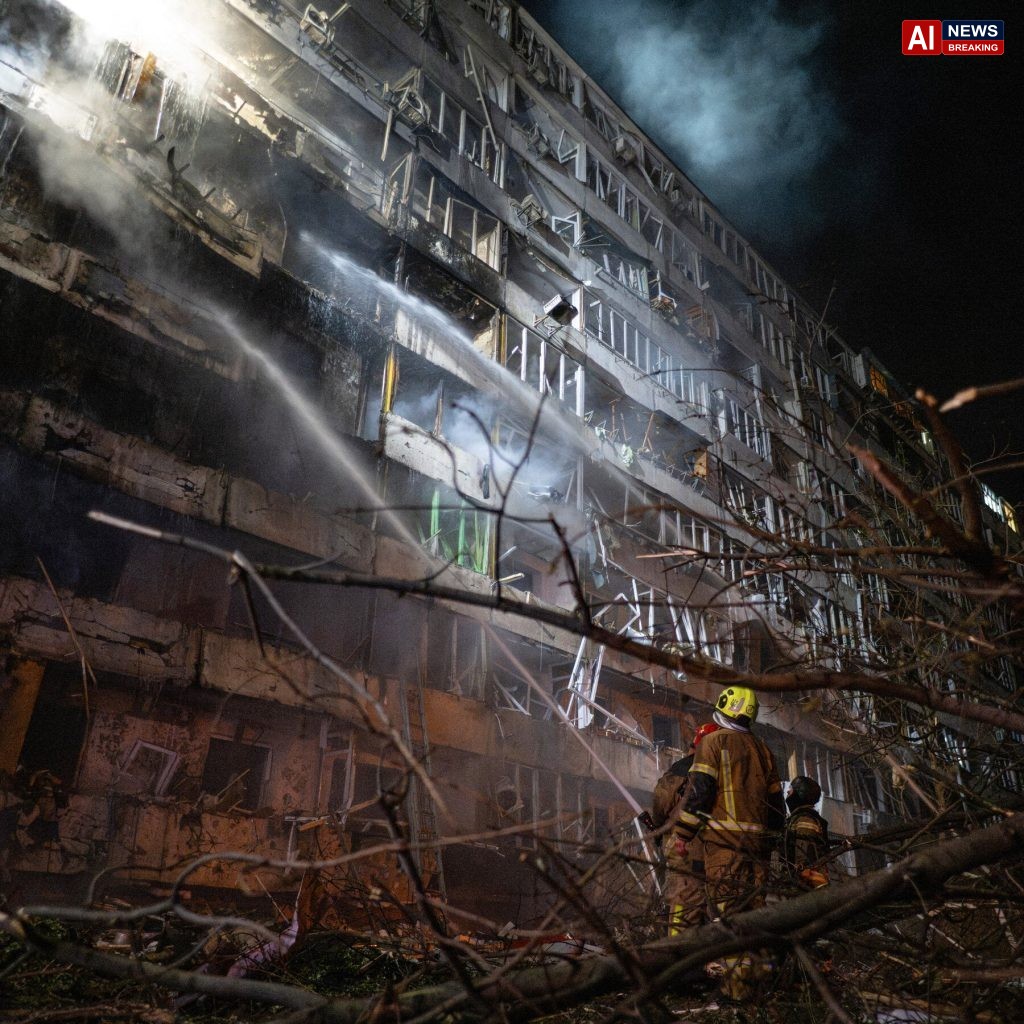
Kyiv’s communications infrastructure has been hit by a double blow that threatens to undermine the city’s resilience as the war on its eastern frontier intensifies. In the early hours of Thursday, a massive power outage plunged roughly 600,000 households in the Ukrainian capital into darkness, a disruption traced to a coordinated Russian missile strike on critical substations outside the city. At the same time, Ukrainian officials reported that a key component of the country’s emergency communications network – the United States‑funded Starlink satellite service – has been throttled, leaving journalists, aid workers and military units scrambling for alternative links..
The convergence of these setbacks arrives at a moment when Moscow has signalled a fresh escalation, prompting concerns that Ukraine’s ability to coordinate its defence and humanitarian response could be severely hampered.The power failure, which lasted for more than six hours in the city’s central districts, was confirmed by Ukraine’s energy ministry as the result of a “targeted strike on high‑voltage transmission lines” in the Kyiv region. The ministry said the attack disabled three of the nine substations that feed the capital, forcing engineers to reroute electricity through backup lines. While the grid was eventually stabilised, the outage forced hospitals to switch to generators, halted public transport, and left many residents without heating during an early autumn chill..
International observers have warned that repeated attacks on energy infrastructure could push Ukraine’s already fragile power system to a breaking point, especially as winter approaches.Compounding the crisis, officials from the Ministry of Digital Transformation announced on Thursday that the speed and reliability of Starlink connections across Ukraine have been abruptly reduced. The service, which has been provided under a programme financed by the U.S. Department of Defense, has been a lifeline for both civilian and military communications since the invasion began in February 2022..
Ukrainian authorities said the slowdown was not the result of a technical malfunction but appeared to be a deliberate restriction imposed by the satellite provider’s operator, SpaceX, following an internal review. The exact reasons for the curtailment have not been disclosed, but analysts suggest it may be linked to concerns about the proliferation of high‑bandwidth data streams that could be intercepted or used for intelligence gathering by Russian forces.For journalists on the ground, the loss of full‑speed internet is more than an inconvenience. The ability to file reports, transmit video footage and coordinate with international newsrooms has been central to maintaining global awareness of the conflict..
“We rely on Starlink for real‑time reporting from the front lines,” said Olena Hryshchenko, a correspondent for a major Ukrainian newspaper. “When the bandwidth drops, we lose the capacity to send live streams, which in turn limits the world’s view of what’s happening on the ground.” Aid organisations have echoed similar concerns, noting that many of their field offices use the satellite service to manage supply chains, track displaced persons and communicate with donors abroad.The Ukrainian military, which has integrated Starlink into its command and control networks, also faces operational challenges. The Defence Ministry’s spokesperson, Colonel Serhiy Kuts, warned that the reduced bandwidth could impair the transmission of drone footage and encrypted communications between forward units and headquarters..
While the armed forces have developed alternative communication channels, including terrestrial mobile networks and legacy satellite links, these are less resilient in contested territories and are vulnerable to jamming. “Our ability to maintain situational awareness is crucial,” Kuts said. “Any degradation of our communications infrastructure directly affects the effectiveness of our defensive operations.”U.S..
officials have responded with cautious reassurance. In a statement released shortly after the reports emerged, the State Department affirmed that the United States remains committed to “supporting Ukraine’s communications capabilities” and that the Pentagon’s satellite programme “continues to function in accordance with its mission.” A spokesperson for SpaceX, however, declined to comment on the specific operational changes, citing ongoing technical assessments. The lack of transparency has fueled speculation in Kyiv that the curtailment could be a pre‑emptive measure to prevent Russian cyber‑espionage, but it has also raised questions about the reliability of a system that relies heavily on a single private provider.The timing of these disruptions coincides with a notable shift in Russian strategy..
Over the past week, Moscow has intensified artillery bombardments around the Donetsk and Luhansk regions, while also deploying additional air defence assets along the front. Russian state media have broadcast footage of new long‑range missile systems being positioned near the Ukrainian border, a move interpreted by NATO officials as an attempt to pressure Kyiv into negotiations. The escalation adds urgency to Ukraine’s need for robust communications, as coordination between civilian authorities, the military and international partners becomes increasingly complex.International experts warn that the confluence of power outages and satellite restrictions could have cascading effects on Ukraine’s broader resilience..
Marta Kovalenko, a senior fellow at the European Institute for Security Studies, noted that “energy and information are the twin pillars of modern conflict resilience.” She argued that sustained attacks on these pillars could erode public morale, hinder the delivery of humanitarian aid and complicate the coordination of defensive measures. Kovalenko urged both NATO allies and private sector partners to diversify Ukraine’s communication pathways, suggesting the deployment of additional low‑orbit constellations and the reinforcement of ground‑based fibre networks where feasible.In the meantime, Ukrainian authorities are mobilising contingency plans. The Ministry of Energy has pledged to accelerate repairs on the damaged substations and to increase the share of renewable sources in the national grid to reduce dependence on vulnerable transmission lines..
Simultaneously, the Digital Transformation Ministry is negotiating with alternative satellite providers, including Europe’s Eutelsat and Japan’s KSAT, to secure backup bandwidth for critical services. Emergency response teams have also set up mobile communication hubs equipped with portable generators and radio equipment to serve hospitals and shelters in the most affected districts.The dual crises underscore the precarious balance that Ukraine must maintain as it confronts a renewed Russian offensive. While the country’s resolve remains steadfast, the recent setbacks highlight the importance of resilient infrastructure in modern warfare..
As the international community watches, the coming weeks will test not only Kyiv’s capacity to restore power and communications but also the durability of the partnerships that have underpinned its defence since the war’s outset..
Updated: October 14, 2026
The twin sabotage of power and bandwidth forces Kyiv to confront a strategic vulnerability: a war‑fighting state can no longer rely on a single, donor‑dependent tech lifeline, prompting a rapid pivot toward diversified, sovereign resilience.
If allies and private firms fail to supply that redundancy, Ukraine’s ability to coordinate defense, humanitarian aid, and global narrative will erode, turning infrastructure attacks into decisive political leverage for Moscow.