Europe warns of Russia’s hybrid attacks but struggles to counter them
  Former chief election commissioner calls SIR scheme illegal.
  A Corruption Scandal Is Reshaping Brazil’s Presidential Election
  US citizen injured in Illinois after ICE agents mistook him for fugitive, tried to arrest him
  At 10 years old, Smithsonian’s Black museum is undaunted amid pressure from Trump administration
 Supreme Court Halts Wrestling Federation of India’s Plea, Allows Vinesh Phogat to Compete
The Supreme Court of India has blocked the Wrestling Federation of India’s plea, allowing ace wrestler Vinesh Phogat to compete in upcoming selection trials, in a crucial development for women’s wrestling in the country, highlighting the ongoing struggle for gender equality in Indian sports.
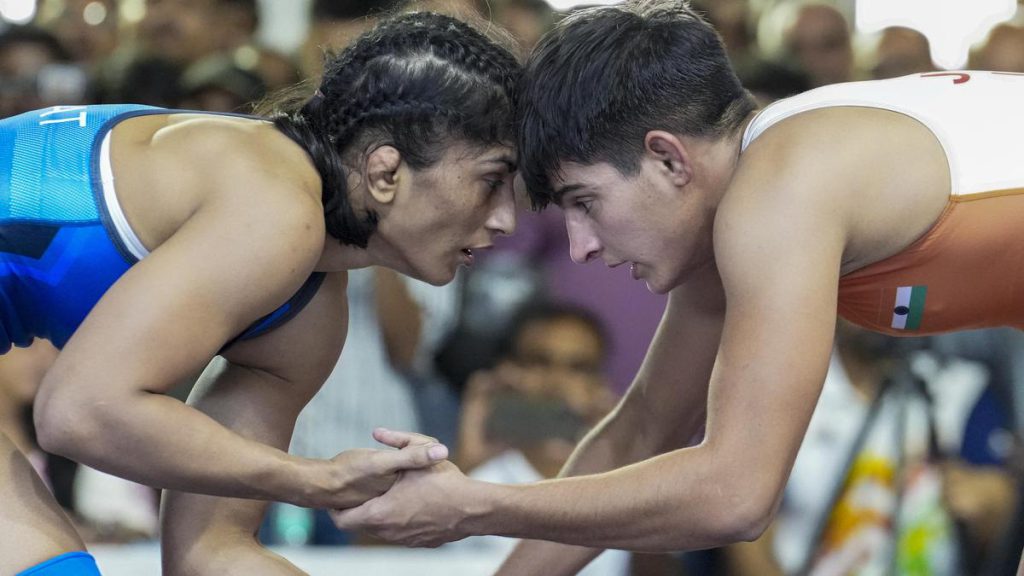
In a highly anticipated judicial intervention, the Supreme Court of India yesterday put the brakes on the Wrestling Federation of India’s (WFI) plea to set aside a recent High Court (HC) decision allowing ace wrestler Vinesh Phogat to participate in the upcoming selection trials.
In what appears to be a crucial development for women’s wrestling in the country, the apex court bench, comprising of Justices P.
Updated: June 4, 2026
In a highly anticipated judicial intervention, the Supreme Court of India yesterday put the brakes on the Wrestling Federation of India’s (WFI) plea to set aside a recent High Court (HC) decision allowing ace wrestler Vinesh Phogat to participate in the upcoming selection trials.
In what appears to be a crucial development for women’s wrestling in the country, the apex court bench, comprising of Justices P.S. Narasimha and Aravind Kumar, chose to focus solely on the procedural aspects of the High Court’s order, refraining from scrutinizing its findings or observations.
WFI had filed an appeal against the Delhi HC order that paved the way for Phogat, a multiple-time Olympic and Commonwealth Games medalist, to participate in the trials in light of a pending petition challenging the WFI’s decision to hold separate trials for men and women at the national level. However, WFI contended that the high court’s order would cause significant confusion and set a bad precedent for future women’s sports competitions.
The case has far-reaching implications for women in sports, particularly wrestlers, who have long been advocating for equal representation and opportunities. The WFI’s stance has been widely criticized as discriminatory and out of sync with the country’s evolving stance on women’s empowerment.
As the SC bench turned down the appeal, citing that its role was to examine the propriety of the HC order rather than delving into its merits, Phogat’s position remains unchanged. The 28-year-old grappler can now proceed to participate in the upcoming trials as scheduled.
WFI’s decision earlier this year to hold separate trials for men and women was met with severe backlash, with many prominent female wrestlers, including Phogat and Sakshi Malik, expressing their discontent with the move. While the apex court’s decision has given women wrestlers a temporary reprieve, concerns over gender equality in Indian sports remain.
Phogat, who has been a vocal advocate for equal opportunities for women in sports, took to social media to express her gratitude to the SC for allowing her to pursue her dreams without any obstructions. However, some critics have warned that the high court’s order may have far-reaching consequences for future sports competitions and challenges to WFI’s policies.
The SC’s decision has also set the stage for a more intense battle between women wrestlers and the WFI, with many expecting the Delhi HC’s order to be revisited in the coming weeks. As the situation unfolds, the spotlight will remain on the country’s sports governing bodies to take a stance on gender equality and ensure that all athletes, regardless of their gender, are treated fairly and given equal opportunities to compete.
For Phogat and her fellow female wrestlers, the Supreme Court’s decision is a welcome respite from the uncertainty and adversity they have faced in recent months. However, the bigger question remains – what does the future hold for women’s wrestling in India, and will the WFI’s stance on gender equality continue to face opposition from the country’s most accomplished female athletes?
The apex court’s decision to focus narrowly on procedural aspects rather than scrutinizing the High Court’s findings has been interpreted by many as a significant setback for women wrestlers in India. While Phogat’s immediate future appears secured, the ongoing tussle between women wrestlers and the WFI is expected to continue.
In a broader context, the case has significant implications for India’s sporting landscape, particularly with regards to gender equality and representation. As the country continues to grapple with its own version of ‘Me Too’ and gender inequality, the WFI’s stance on women’s wrestling has been widely seen as anachronistic and a symbol of the country’s deep-seated biases towards women in sports.
While Phogat and her fellow wrestlers have won a temporary reprieve, the battle for equality in Indian sports remains a long and arduous one. As the country inches closer to the Olympic Games, the spotlight will remain firmly on the WFI and its stance on gender equality.
As the case unfolds, observers are eagerly anticipating the SC’s next move and the broader implications of its decision on Indian sports governance. Whether the WFI will be forced to reconsider its stance on gender equality or face further opposition from women wrestlers remains to be seen.
The case highlights the need for greater accountability and transparency from India’s sports governing bodies, particularly when it comes to issues of gender equality and representation.
Future outlook for women wrestlers, including Phogat, appears to be looking up for now, but the WFI’s stance on gender equality remains a contentious issue that will continue to be debated in the coming weeks and months.
The Supreme Courts decision on WFI’s plea may provide short-term relief for Phogat, but the long-term implications of the case on Indian sports, particularly women’s wrestling, will be far-reaching and transformative.
The case sets a new benchmark for WFI, emphasizing the need for a more inclusive and equal approach to sports competitions. In the months to come, it is expected that WFI will be forced to address these concerns and demonstrate its commitment to promoting gender equality in Indian sports.
The Supreme Court's focus on procedural aspects rather than merit has essentially allowed the system to avoid confronting the deep-seated gender biases that have been perpetuated in India's sports governing bodies. This subtle yet significant shift in approach is a missed opportunity to confront the root cause of inequality in women's sports.
This decision ultimately reinforces the notion that India's sports governing bodies can continue to operate in a manner that