Trump administration offers mixed messages on limits to Ukraine’s Starshield access
 US Treasury proposes a rule to crack down on high-tech investments in China, other adversaries
 Calley Means, a key MAHA advocate, resigns as a top RFK Jr. adviser
 Spotify Tightens Family Plan Controls with QR Code Verification
 Use of Chief Minister C. Joseph Vijay’s deep fake videos to collect money: Rajasthan youth moves Madras High Court seeking bail
Supreme Court to hear habeas corpus petition for missing journalists
**
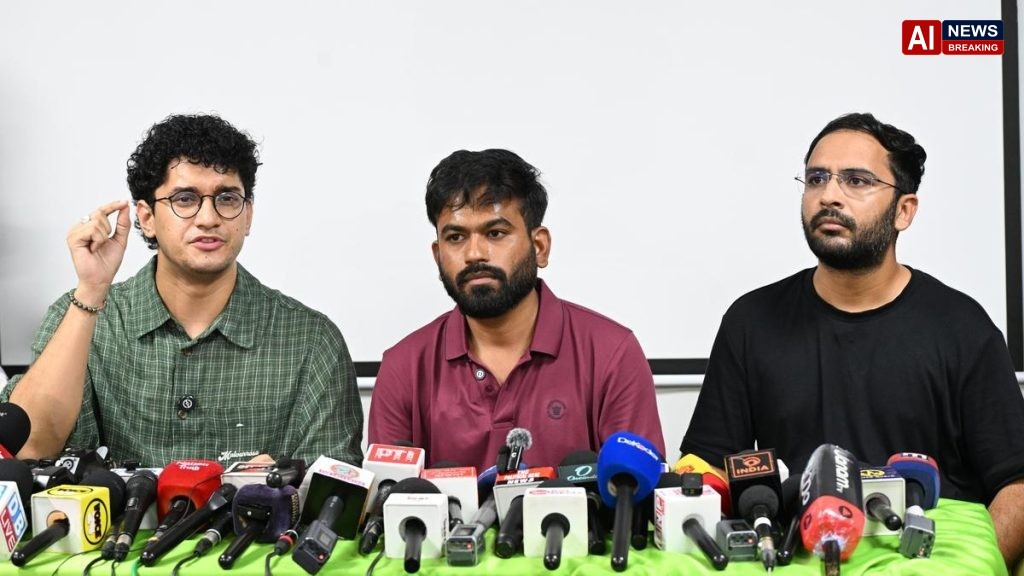
CJP member moves Supreme Court on whereabouts of Dipke, Das, Ranka - AI News Breaking
supreme court hear habeas:
Gaurav Bharti, the coverage coordinator for the Commonwealth Journalists’ Platform (CJP), has filed a habeas corpus petition in the Supreme Court seeking an urgent hearing on October 11 regarding the whereabouts of three journalists – Arjun Dipke, Meera Das and Ravi Ranka – who have been missing for over a month. The petition, submitted on behalf of the CJP’s members and the families of the missing reporters, alleges that the authorities have failed to provide any substantive information about the journalists’ detention, despite multiple requests under the Right to Information Act and repeated appeals to local police. Bharti’s filing underscores a growing concern within the media fraternity about the safety of journalists operating in conflict‑prone regions of the country.The three journalists were last seen on August 28 while covering a protest in the remote district of Karanpur, a region that has seen an escalation of armed clashes between separatist groups and security forces..
Dipke, a senior correspondent for a national daily, was known for his investigative pieces on illegal mining operations; Das, a freelance reporter, had been documenting the impact of the protests on local livelihoods; and Ranka, a photojournalist, was photographing the aftermath of a recent curfew imposed by the state government. Their disappearance has sparked a wave of protests by journalists’ unions across the country, demanding transparent investigations and swift action from the police.In its petition, Bharti argues that the continued silence surrounding the trio’s detention constitutes an unlawful deprivation of liberty, contravening Article 21 of the Constitution, which guarantees the right to life and personal liberty. The Supreme Court’s order to hear the matter on October 11 is expected to be a decisive test of the judiciary’s willingness to intervene in cases where state agencies are alleged to have concealed the status of detained individuals..
Legal experts note that habeas corpus petitions are rarely granted in matters involving national security, but the urgency highlighted by the CJP could compel the apex court to set a precedent for greater judicial oversight in such instances.The filing comes amid mounting criticism of the state’s handling of the case. Local law enforcement officials have repeatedly claimed that they are “actively searching” for the missing journalists, yet they have offered no concrete leads or evidence of any investigations. A senior police official, who spoke on condition of anonymity, admitted that the district’s volatile security situation has hampered search efforts, but insisted that “no official detention has been recorded”..
Human rights organizations, including the National Federation of Journalists, have condemned what they describe as a pattern of intimidation and enforced disappearances targeting reporters who cover sensitive topics in the region.Family members of Dipke, Das and Ranka have been vocal in the media, holding press conferences and staging sit‑ins outside the state ariat. In a joint statement released on September 30, they demanded “immediate access to the whereabouts of our loved ones and an independent investigation into any unlawful detention”. The families have also appealed directly to the Supreme Court, urging it to order the release of any information the authorities may be withholding..
Their pleas have resonated with a broader public that is increasingly wary of the erosion of press freedoms in a climate where journalists often face threats, harassment and, in some cases, violent reprisals.The Supreme Court’s response to the petition could have ramifications beyond the immediate case. Legal scholars point out that a ruling affirming the court’s jurisdiction to compel the release of information about the journalists’ status would reinforce the principle that no individual or agency can operate with impunity when it comes to the fundamental rights enshrined in the Constitution. Conversely, a dismissal of the petition might embolden security agencies to continue opaque practices, potentially deterring journalists from pursuing stories in high‑risk areas..
The bench, led by Chief Justice Anil Mehta, is expected to hear arguments from both the petitioners and the state, though the latter has yet to file a formal response.The CJP has mobilised a network of journalists across the country to monitor the Supreme Court’s proceedings and to document any developments related to the case. In a statement released after the filing, the organization emphasized that the petition is not merely about three individuals, but about safeguarding the broader ecosystem of free press in the nation. “When the liberty of journalists is threatened, democracy itself is under attack,” the statement read, calling for solidarity from media houses, civil society and the international community.International watchdogs have taken note of the case, with the Committee to Protect Journalists (CPJ) issuing an alert that highlighted the risk of “enforced disappearance” in the context of the journalists’ work..
The CPJ’s director, Maria Santos, urged the Indian authorities to provide “immediate clarification and safe return” of the missing reporters, warning that continued inaction could attract scrutiny from UN bodies concerned with human rights violations. The United Nations Office of the High Commissioner for Human Rights has also expressed concern, noting that the pattern of disappearances of journalists in conflict zones demands “prompt and thorough investigation”.Meanwhile, political reactions have been mixed. Opposition parties have seized upon the incident to criticize the ruling government’s handling of press freedom, with several lawmakers demanding a parliamentary debate on the matter..
The government, however, has maintained that the matter falls under the purview of the judiciary and that “law and order” considerations must guide any investigative steps. A spokesperson for the Ministry of Home Affairs reiterated that “the safety of all citizens, including journalists, remains a top priority” and that the authorities are cooperating with the Supreme Court’s directives.As the October 11 hearing approaches, the journalistic community is bracing for a moment that could redefine the relationship between the press and the state in the country. Reporters on the ground have been documenting the unfolding story, noting the heightened security around the district’s police headquarters and the increased presence of human‑rights activists..
Social media platforms have been awash with calls for transparency, with the hashtag #FindDipkeDasRanka trending nationally, reflecting a public appetite for accountability.Regardless of the outcome, the case underscores the precarious position of journalists operating in areas of conflict and the essential role of the judiciary in upholding constitutional safeguards. If the Supreme Court orders the release of information and initiates a probe, it could set a powerful precedent that deters future disappearances and reinforces the legal framework protecting press freedom. If it declines, the incident may deepen the sense of vulnerability among journalists and prompt calls for legislative reforms to strengthen protective mechanisms.The upcoming Supreme Court hearing therefore stands as a litmus test for the nation’s commitment to the principles of a free press and the rule of law..
As Gaurav Bharti and his fellow CJP members await the court’s decision, the eyes of the nation, and indeed the international community, remain fixed on a case that.
Updated: October 10, 2026
Insight: The Supreme Court’s decision will signal whether the state can still cloak its security actions in silence, or whether a judicial mandate will force a hard look at the disappearances that threaten journalistic integrity. A ruling that compels disclosure could break the long‑standing pattern of impunity, while a dismissal would emb