Europe warns of Russia’s hybrid attacks but struggles to counter them
  Former chief election commissioner calls SIR scheme illegal.
  A Corruption Scandal Is Reshaping Brazil’s Presidential Election
  US citizen injured in Illinois after ICE agents mistook him for fugitive, tried to arrest him
  At 10 years old, Smithsonian’s Black museum is undaunted amid pressure from Trump administration
 The Middle East on the Brink: U.S. and Saudi Strikes on Iran Signal a Dangerous New Phase of War
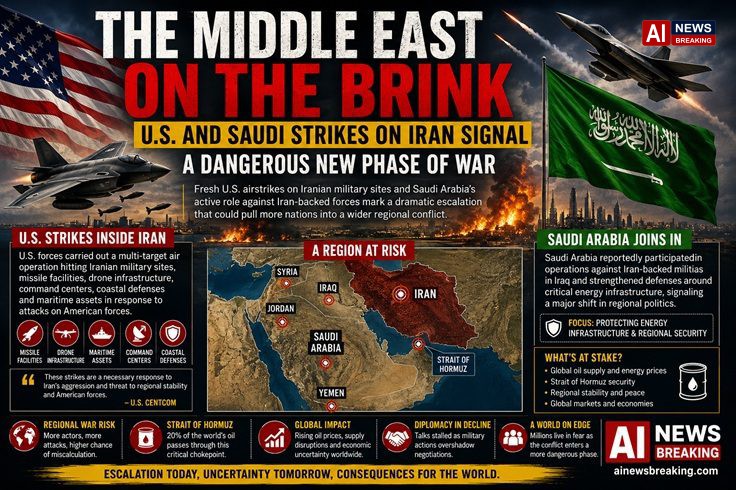
The Middle East on the Brink: U.S. and Saudi Strikes on Iran Signal a Dangerous New Phase of War - AI News Breaking
middle east brink saudi:
The Middle East stands at one of its most perilous moments in decades. What began as a confrontation between Washington, Tehran, and their regional allies has now evolved into a widening conflict threatening to engulf the entire Gulf. Fresh U.S. airstrikes on Iranian military infrastructure, coupled with Saudi Arabia’s increasingly active role against Iran-backed forces, have transformed the Iran war from a bilateral crisis into a regional security emergency.
The latest escalation came after Iran launched ballistic missile attacks targeting U.S. military installations in Jordan and intensified pressure across the Strait of Hormuz. In response, U.S. Central Command carried out a two-hour military operation striking dozens of Iranian-linked targets, including command centers, missile facilities, drone infrastructure, coastal defenses, and maritime assets. President Donald Trump described the operation as a necessary response to what Washington called an attempted surprise attack on American forces.
Simultaneously, Saudi Arabia has moved beyond diplomatic condemnation and has reportedly participated in operations against Iranian-backed militias in Iraq while reinforcing its defenses around critical energy infrastructure. Riyadh’s involvement marks a significant shift in Gulf politics. For years, Saudi Arabia attempted to balance confrontation and engagement with Tehran. Today, that balance appears to be collapsing under the weight of missile attacks, drone incursions, and fears of regional destabilization.
The consequences of this transformation extend far beyond the battlefield.
From Proxy War to Regional War
For much of the past decade, Iran’s conflicts were fought indirectly through proxies across Iraq, Syria, Lebanon, and Yemen. The 2026 conflict has shattered that paradigm. The United States is now striking targets inside Iran itself. Saudi Arabia is openly coordinating with allies to contain Tehran’s influence. Meanwhile, attacks have spilled into Jordan, Egypt, the Red Sea, and the Strait of Hormuz—one of the world’s most strategically important maritime chokepoints.
Every additional actor entering the conflict increases the possibility of miscalculation.
Military strategists often warn that wars do not necessarily expand because leaders intend them to. They expand because events begin to outpace diplomacy. A missile misses its target and hits civilian infrastructure. A drone strike kills foreign personnel. A naval confrontation escalates in crowded waters. History is filled with examples where localized conflicts became international crises overnight.
That risk is now unmistakably visible.
Saudi Arabia’s Strategic Dilemma
Saudi Arabia’s position is particularly significant. The Kingdom has spent years modernizing its economy through Vision 2030, investing hundreds of billions of dollars into tourism, technology, and infrastructure. Stability—not conflict—is essential for those ambitions.
Yet Iran’s repeated threats against Gulf infrastructure have altered Riyadh’s calculations. Iranian-linked attacks on oil facilities, military bases, and regional shipping have convinced Saudi policymakers that neutrality carries its own dangers. By joining operations against Iranian proxies and strengthening defense cooperation with Washington, Saudi Arabia is signaling that Gulf security can no longer be separated from the broader conflict with Tehran.
This development also sends a message to other regional actors.
The United Arab Emirates, Bahrain, Jordan, and Kuwait are watching closely. Any further escalation could create a de facto anti-Iran security coalition stretching across the Gulf—a scenario Tehran has long sought to avoid.
The Strait of Hormuz: The World’s Pressure Point
No discussion of the Iran conflict is complete without mentioning the Strait of Hormuz.
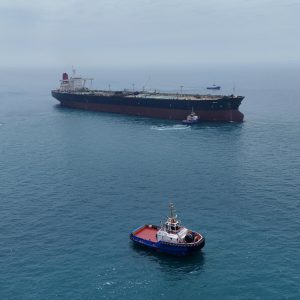
Nearly one-fifth of the world’s oil trade passes through this narrow waterway. Recent disruptions, maritime threats, and sanctions targeting Iranian-linked shipping operations have already caused market anxiety. Insurance costs for commercial vessels have risen, and shipping companies remain cautious about operating in the region.
If the conflict intensifies further, the economic consequences will be global:
- Rising oil prices.
- Increased shipping and insurance costs.
- Supply chain disruptions.
- Inflationary pressure on major economies.
- Greater uncertainty in financial markets.
The world learned during previous energy crises that instability in the Gulf rarely remains a regional issue. It quickly becomes an international economic problem.
Diplomacy Is Losing Ground
Perhaps the most troubling aspect of the current crisis is the diminishing space for diplomacy.
Only days ago, mediators from Oman, Qatar, and Pakistan were attempting to revive indirect negotiations between Washington and Tehran. There were signs of progress. Airstrikes had temporarily paused, and both sides hinted at possible talks. Those hopes have now been overshadowed by renewed military action.
Diplomacy works only when both parties believe they have more to gain from negotiations than from continued fighting. At present, neither Washington nor Tehran appears willing to make that calculation.
The United States seeks deterrence.
Iran seeks resilience.
Saudi Arabia seeks security.
These objectives are increasingly incompatible.
A Defining Moment for the International Order
The Iran war is no longer solely about nuclear ambitions, sanctions, or regional rivalries. It has become a test of the international system’s ability to prevent a broader conflict in one of the world’s most volatile regions.
The United Nations remains largely sidelined. European powers have struggled to exert influence. Russia and China continue to monitor developments while protecting their strategic interests. Meanwhile, millions of civilians across the Middle East live under the growing shadow of uncertainty.
Wars in the modern era are rarely confined by geography. They reshape alliances, redefine security priorities, and leave economic consequences that endure long after the fighting ends.
The latest U.S. and Saudi strikes on Iran may ultimately be remembered not as another chapter in a long-running confrontation, but as the moment the Middle East crossed a dangerous threshold—from contained conflict to regional war.
Editorial Insight
The greatest danger today is not merely the exchange of missiles between adversaries. It is the steady normalization of escalation. Each strike is presented as retaliation; each retaliation becomes justification for another strike. Without an immediate diplomatic off-ramp, the Middle East risks entering a prolonged conflict whose costs will be measured not only in military terms, but in lost stability, disrupted economies, and human lives across an entire region.
The world is watching the skies over Iran, but the real question is whether global leaders are still capable of preventing history from repeating itself.