 Tao Tokyo Spring 2027
 Karnataka SIR: Teaching on the back burner
 Trump administration offers mixed messages on limits to Ukraine’s Starshield access
 US Treasury proposes a rule to crack down on high-tech investments in China, other adversaries
 Calley Means, a key MAHA advocate, resigns as a top RFK Jr. adviser
Trump awards Elon Musk National Medal of Science
**
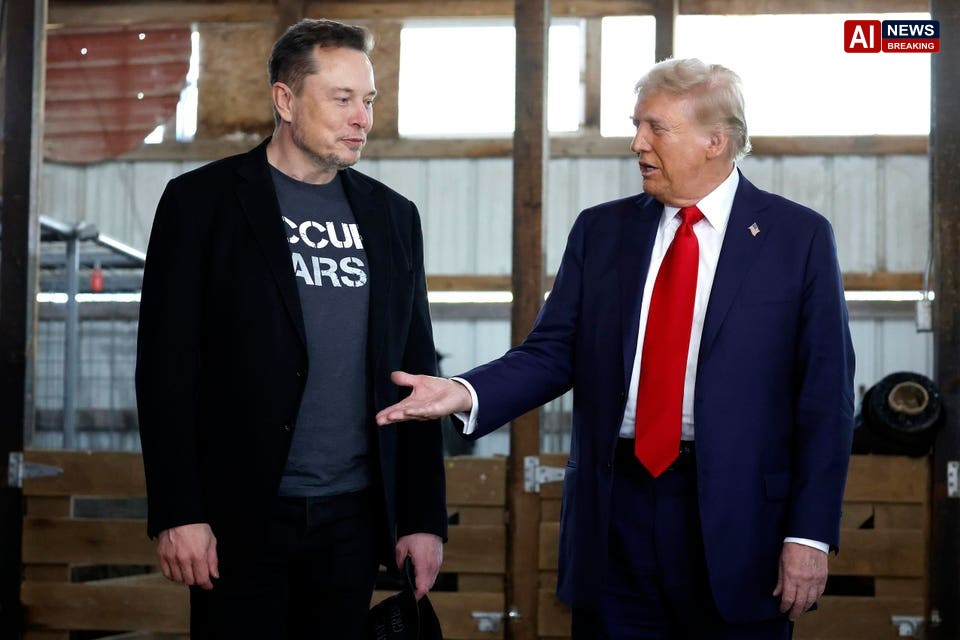
Trump Will Award Musk National Medal Of Science At D.C. Tech Summit - AI News Breaking
The White House will host a high‑profile ceremony on Thursday as President Donald Trump presents the National Medal of Science to entrepreneur Elon Musk, a move that underscores the administration’s renewed emphasis on technological leadership. The award, traditionally reserved for scientists and researchers, will be conferred at a technology summit in Washington, D.C., that brings together industry titans, policymakers and academic figures to discuss the nation’s future in artificial intelligence, quantum computing and space exploration. The event marks the first time a business magnate has been singled out for the nation’s highest scientific honour, a decision that has drawn both praise and criticism from across the political spectrum.Musk, the CEO of SpaceX, Tesla and the newly launched Neuralink venture, will join fellow honoree Jensen Huang, founder of graphics‑chip maker Nvidia, on the stage..
Both men are among six technology leaders who signed the voluntary “White House Accord on Super Intelligence” last month, a pledge to cooperate with federal agencies on the development of advanced AI systems while adhering to ethical guidelines and safety protocols. The accord, which remains non‑binding, seeks to mitigate the risks associated with increasingly powerful machine‑learning models by encouraging transparency, shared research and a commitment to avoid competitive races that could jeopardise public safety.The other signatories of the accord include executives from Microsoft, Alphabet’s DeepMind, Amazon Web Services, and the OpenAI research lab. Their participation reflects a growing recognition among Silicon Valley’s elite that government oversight may become inevitable as AI capabilities approach, and potentially surpass, human-level performance in specialised tasks..
While the accord has been lauded as a proactive step, some experts warn that voluntary commitments may be insufficient to curb the rapid pace of innovation, calling for formal regulation and enforceable standards.President Trump, in a statement released ahead of the summit, highlighted the award as a testament to “American ingenuity and the daring spirit that drives our nation forward.” He praised Musk’s work on reusable rockets, electric vehicles and brain‑computer interfaces, arguing that these breakthroughs are essential to maintaining the United States’ competitive edge against China and the European Union. “When our greatest entrepreneurs push the boundaries of science, they do more than create wealth – they secure our future,” Trump said, adding that the administration would continue to “celebrate and support the brilliant minds that keep America at the forefront of discovery.”Critics of the decision contend that the National Medal of Science has traditionally honoured individuals whose contributions stem from rigorous academic research, not commercial enterprise. Dr Helen Whitaker, a professor of physics at the University of California, Berkeley, expressed concern that the award could blur the line between scientific achievement and market‑driven innovation..
“While Mr Musk’s enterprises have undeniably accelerated progress in several fields, the medal should recognise sustained, peer‑reviewed contributions to knowledge, not merely successful product launches,” she said.The debate over the award’s appropriateness mirrors broader tensions surrounding the role of private capital in public research. In recent years, venture‑backed firms have increasingly taken the lead in developing technologies once confined to university labs or government laboratories. The influx of private funding has accelerated the pace of invention, but it has also raised questions about accountability, data ownership and the societal impacts of rapid deployment..
The summit’s agenda includes panels that will address these issues, with participants ranging from former NASA administrators to civil‑rights advocates concerned about algorithmic bias.Musk’s acceptance speech, delivered in a televised address that will be streamed live from the summit’s main hall, is expected to focus on the intersection of scientific curiosity and entrepreneurial risk‑taking. Sources close to his communications team indicate that he will stress the importance of “open collaboration between the public and private sectors” and will likely reference his company’s recent milestones, such as the successful landing of the Starship prototype and the rollout of the Full Self‑Driving beta in select markets. He may also use the platform to announce new initiatives, possibly extending Neuralink’s research into clinical trials for treating neurodegenerative diseases.Jensen Huang, who will also receive the medal, is poised to discuss Nvidia’s role in powering the AI revolution..
In the past year, the company’s graphics processing units have become the backbone of large‑scale language models, enabling breakthroughs in natural‑language processing, image generation and scientific simulation. Huang’s remarks are anticipated to highlight the company’s recent commitment to “green AI,” a set of practices aimed at reducing the energy consumption of training massive neural networks. His comments may serve to counteract mounting criticism that AI development is contributing significantly to global carbon emissions.The White House Accord on Super Intelligence, signed by the six tech leaders last month, outlines a framework for responsible AI development that includes sharing safety research, establishing joint monitoring mechanisms, and creating a “rapid response team” to address emergent threats from advanced systems..
While the accord is voluntary, its signatories have pledged to allocate a combined $10 billion toward safety research over the next five years, a figure that dwarfs current federal AI funding. Observers note that the private sector’s willingness to fund such initiatives could relieve pressure on Congress to pass sweeping legislation, at least in the short term.Nonetheless, some members of the Senate Intelligence Committee remain skeptical of the accord’s efficacy. Senator Maria Cantwell, chair of the committee’s technology sub‑panel, warned that “without enforceable standards, voluntary accords risk becoming a public‑relations exercise rather than a safeguard.” She called for a bipartisan bill that would establish clear accountability mechanisms for AI developers, including mandatory reporting of high‑risk experiments and independent audits of algorithmic bias..
The upcoming summit may serve as a catalyst for such legislative action, as policymakers seek to balance innovation with national security concerns.The ceremony will conclude with a reception hosted by the National Science Foundation, where representatives from the Department of Energy, the National Aeronautics and Space Administration and leading research universities will mingle with industry leaders. Attendees will have the opportunity to discuss collaborative projects ranging from quantum‑computing research to the development of next‑generation satellite constellations for global broadband coverage. The event reflects a broader strategy by the Trump administration to position the United States as a hub for cutting‑edge scientific collaboration, a stance that contrasts with the more isolationist rhetoric that characterized earlier phases of his presidency.As the nation watches the ceremony, the award’s symbolism will be measured against its practical impact on policy and research..
Whether the National Medal of Science will become a new precedent for recognizing private‑sector contributions remains uncertain, but the event undeniably signals a shift in how the United States frames its relationship with the technology industry. In a world where breakthroughs emerge as quickly as they raise ethical dilemmas, the convergence of political authority, scientific accolade and corporate ambition may prove to be both a un.
President Donald Trump will hand the National Medal of Science to Elon Musk at a Washington technology summit, marking the first time a business magnate receives the country’s top scientific honor. The move sparks debate over the role of private capital in research, as the award’s legitimacy and the broader “White House Accord on Super Intelligence” face scrutiny from both supporters and critics.
The Medal of Science being handed to a Silicon Valley CEO signals a blurring of borders between pure research and market‑driven innovation, hinting that the U.S. may now value commercial impact as much as academic rigor. This shift could accelerate policy‑industry collaboration—yet it also risks elevating profit motives over peer