 Russians across
  Jagan to move Supreme Court again over ‘obstruction’ of YSRCP nominees in Andhra local body polls
  Pentagon directive bans troops from using nonpublic info to bet in prediction markets
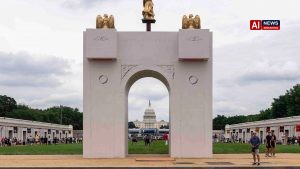
  Plaintiffs in Trump arch project seek injunction to stop administration from beginning work Nov. 5
 Trump Legal Team Threatens 5 Billion Lawsuit Over Center for American Progress Guard Deployment Report

Trump Legal Team Threatens 5 Billion Lawsuit Over Center for American Progress Guard Deployment Report - AI News Breaking
The Center for American Progress (CAP) has found itself at the centre of a legal storm after receiving a letter from former President Donald Trump’s legal team. The correspondence, dated 19 July, warned that the former commander‑in‑chief would pursue a $5 billion lawsuit unless the liberal think‑tank withdrew a report that questions the impact of the National Guard deployments that were rolled out under his administration. The threat has sparked a heated debate about the limits of academic criticism, the politicisation of policing data and the role of the courts in settling policy disputes..
The contested CAP study, released on 13 July, examined three high‑profile Guard deployments – Washington DC, Memphis and Los Angeles – that were launched in 2025 as part of the former president’s “Law and Order” agenda. By collating police‑recorded incidents, emergency‑services calls and hospital admissions, the report concluded that the Guard’s presence did not produce a statistically significant reduction in violent crime, despite an estimated cost of $1.7 billion across the three cities. The authors argue that the decline in violent offences observed in the study period mirrors trends in comparable cities that never saw a Guard presence..
The Trump legal team, led by veteran attorney Joseph DiLorenzo, responded that the report is “fatally flawed” and amounts to a “defamatory attack on a duly elected President’s lawful exercise of authority”. In the letter, DiLorenzo claims the analysis mis‑states the chronology of crime trends, cherry‑picks data points and ignores classified intelligence that, according to the administration, indicated a direct link between Guard deployments and a short‑term dip in gun‑related incidents. CAP’s senior research director, Dr Maya Patel, defended the methodology, saying the team employed “difference‑in‑differences” econometric techniques that are standard in public‑policy evaluation..
“We compared the trajectory of violent crime in the three Guard cities with a control group of demographically similar metros that did not receive Guard assistance,” Patel explained. “The confidence intervals overlapped, meaning there is no credible evidence that the Guard deployments altered the underlying crime curve.” The legal threat arrives at a fraught moment for the former president, who continues to wield considerable influence within the Republican Party while facing a series of investigations ranging from classified‑document handling to alleged campaign‑finance violations. Trump’s lawyers argue that the $5 billion figure reflects projected damages to his reputation and to the “national security interests” that the Guard deployments were intended to protect, although the precise basis for the sum has not been disclosed..
Legal analysts say the lawsuit would be an uphill battle. “To succeed, the plaintiffs would need to prove actual malice – that CAP knowingly published false statements with intent to harm,” noted Professor Elena Garcia of Georgetown Law. “The bar for public‑figure defamation is intentionally high, and think‑tank reports are generally protected as opinion‑based analysis, provided they are grounded in factual data.” Garcia added that a $5 billion claim would likely be dismissed as speculative unless the plaintiffs could demonstrate concrete financial loss..
CAP has not indicated whether it will amend or retract the report. In a brief statement, the organization said it “takes any legal threats seriously but remains committed to rigorous, evidence‑based research that informs public debate.” The think‑tank’s board of directors is expected to convene an emergency meeting next week to decide on a course of action, with some members reportedly urging a defensive legal strategy while others advocate a full public rebuttal. The controversy underscores a broader clash between conservative political operatives and progressive policy institutes over the interpretation of crime data..
Over the past decade, a series of studies have produced mixed findings on the efficacy of militarised policing measures, with some showing short‑term reductions in specific offences and others highlighting long‑term community‑trust erosion. The Trump administration’s Guard rollout, touted as a “quick‑response” solution to surging violence, now faces scrutiny that could influence future federal‑state security collaborations. In Washington, lawmakers from both parties have expressed concern about the precedent such a lawsuit could set..
Senator Lisa Murkowski (R‑AK) warned that “using the courts to silence legitimate research threatens the very foundations of our democratic discourse.” Meanwhile, Representative James Clyburn (D‑SC) called for “greater transparency on the costs and outcomes of any federal deployment of military forces on domestic soil.” Both statements hint at a possible congressional hearing on the matter. The Department of Defense, which oversaw the Guard deployments, released a brief comment stating that the Guard’s “primary mission was to provide a visible deterrent and support local law‑enforcement agencies.” The statement stopped short of evaluating the operation’s effectiveness, citing ongoing internal reviews. An anonymous senior official, speaking on condition of anonymity, told the BBC that preliminary findings “suggest a modest short‑term impact, but the data is still being parsed for longer‑term trends.” Public reaction has been polarised..
Social‑media analytics indicate that the CAP report was shared more than 200 000 times within 48 hours of publication, with hashtags such as #GuardEffectiveness and #TrumpLawsuit trending on both Twitter and Parler. Critics of the former president have lauded the report as “proof that big‑government solutions are wasteful,” while supporters have dismissed it as “partisan sabotage.” The online debate mirrors the split in traditional media, where right‑leaning outlets have highlighted the lawsuit as evidence of a “bullying legal system,” and left‑leaning newspapers have focused on the substantive findings of the research..
Updated: August 22, 2026
Trump’s $5 bn threat signals a shift from political posturing to weaponizing the courts, turning academic debate into a high‑stakes battlefield that could chill rigorous policy research.
If the lawsuit proceeds, it will test whether defamation law can curb think‑tank scrutiny or merely become another tool for