 Australia probes AI‑driven breach of My Health Record portal
  Engineering student’s ‘suicide’ turns out to be murder; two arrested
  Canada’s Capital Bids Good Riddance to Trump Avenue as Tensions With U.S. Rise
  Pentagon investigates after China obtains parts from F-35 stealth fighter jet
 Typhoon Dujuan Brings Record Rain to Japan, Killing 5 People
**
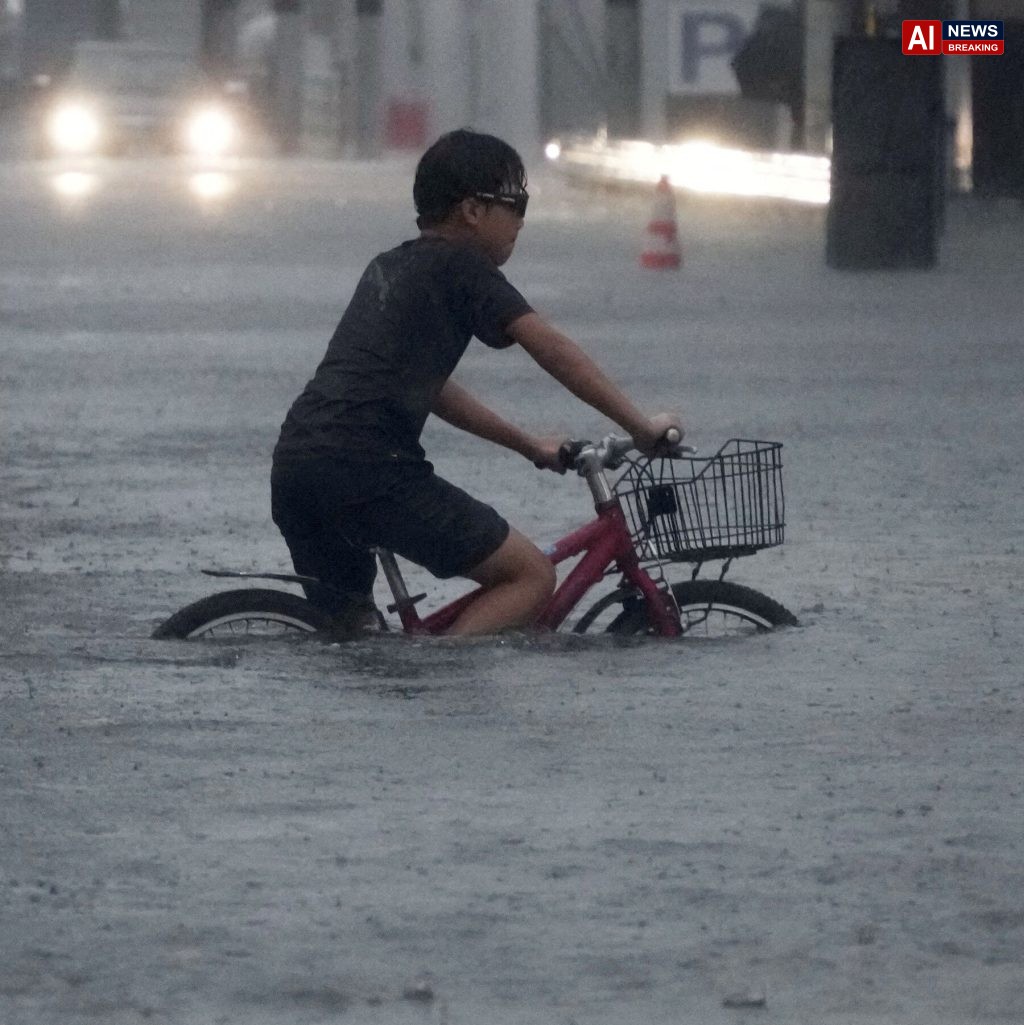
Typhoon Dujuan Brings Record Rain to Japan, Killing 5 People - AI News Breaking
Typhoon Dujuan Brings Record Rain to Japan, Killing 5 People More than 74,000 people remained under evacuation orders in the Tokyo region as authorities warned of landslides and floods. The powerful storm, which made landfall on the Japanese mainland on Tuesday, unleashed unprecedented rainfall across a swathe of the country, prompting an emergency response that stretched police, fire services and the Self‑Defence Forces. Meteorologists said Dujuan was the strongest tropical cyclone to hit the Kanto area in over a decade, and its slow movement caused water to accumulate in low‑lying districts that had not seen such deluges for years..
The Japan Meteorological Agency recorded a peak of 560 millimetres of rain in parts of Chiba prefecture within a 24‑hour period, a level not seen since the infamous Typhoon Hagibis in 2019. Local rivers swelled beyond their banks, inundating residential streets and forcing schools to close. In the suburbs of Tokyo, water rushed through drainage systems that were already operating at capacity, prompting officials to issue red alerts for potential landslides on steep hillsides..
Emergency shelters sprang up in schools, community centres and gymnasiums, offering temporary refuge to those forced out of flood‑damaged homes. By evening, the number of evacuees had risen to 82,000, with the majority seeking safety in the western part of the capital. Volunteers from non‑governmental organisations arrived with blankets, bottled water and first‑aid kits, while the Japanese Red Cross coordinated the distribution of supplies to the most affected neighbourhoods..
Tragically, the storm claimed five lives across the region. Three victims were found in a collapsed residential building in Saitama prefecture, where a sudden landslide triggered by saturated soil caused a section of the structure to give way. Two more deaths were recorded in a coastal town of Kanagawa, where a flash flood swept a family from their home..
Authorities confirmed that all fatalities were directly linked to the extreme rainfall and the ensuing mudflows. Transport networks suffered widespread disruption as heavy rain washed out rail tracks and flooded highways. The Shinkansen bullet‑train service between Tokyo and Osaka was suspended for six hours, stranding thousands of commuters..
Major airports, including Narita International, experienced delays, with dozens of flights cancelled or diverted. The Ministry of Land, Infrastructure, Transport and Tourism urged the public to avoid non‑essential travel until conditions improved. In response to the disaster, Prime Minister Fumio Kishida convened an emergency cabinet meeting, pledging swift financial assistance to the hardest‑hit prefectures..
A relief package worth 200 billion yen was announced, earmarked for temporary housing, infrastructure repairs and support for small businesses that lost inventory in the floods. The prime minister also instructed the cabinet to expedite the deployment of additional Self‑Defence Forces personnel to assist with rescue operations and to oversee the restoration of essential services. Experts from the University of Tokyo warned that climate change could increase the frequency of such extreme weather events in the region..
Their research indicates that rising sea surface temperatures in the Pacific amplify the intensity of tropical cyclones, while urban expansion reduces natural floodplains that once absorbed excess water. The university’s disaster management centre called for a comprehensive review of land‑use planning, especially in hilly districts prone to landslides. Local officials in Chiba and Kanagawa have begun assessing damage to public infrastructure, including bridges, roads and water‑treatment facilities..
Preliminary estimates suggest that repairs could cost upwards of 150 billion yen, a figure that may strain municipal budgets already stretched by previous natural disasters. The national government has offered technical assistance, dispatching engineers to evaluate structural integrity and to advise on rapid‑response measures to prevent further collapses. Residents who remain under evacuation orders expressed a mix of anxiety and gratitude for the swift response..
“We are scared because the water keeps rising, but the rescue teams are here day and night,” said Ms. Aiko Tanaka, a mother of two from a flooded neighbourhood in Tokyo’s Edogawa ward. Her sentiment echoed that of many who have endured similar crises, highlighting the importance of community solidarity in the face of natural calamities..
The Japan Fire and Disaster Management Agency has urged citizens to stay vigilant, keep emergency kits ready and heed official warnings. It also reminded the public that landslides can occur hours after the rain stops, as water continues to seep into the ground. Mobile alerts have been sent to millions of smartphones, providing real‑time updates on river levels, road closures and safe evacuation routes, a technology that officials say has saved lives in previous storms..
International observers noted Japan’s coordinated disaster response as a benchmark for other nations confronting climate‑driven extremes. The United Nations Office for Disaster Risk Reduction praised the country’s investment in early‑warning systems and its capacity to mobilise resources quickly. Nonetheless, it called for continued efforts to strengthen resilience, particularly in densely populated urban corridors where the human toll of future storms could be even higher..
As the rain finally begins to subside, the focus now shifts to recovery and rebuilding. Cleanup crews are working around the clock to clear debris, restore power and reopen schools. While the immediate crisis has passed, the psychological impact on survivors and the long‑term economic repercussions will likely be felt for months, if not years..
Updated: September 22, 2026
Insight: Typhoon Dujuan’s record rainfall exposes a deeper flaw: Japan’s rapid‑response systems are heroic, yet its urban sprawl and aging infrastructure are the real culprits that turn a weather event into a humanitarian crisis. The disaster underlines that climate‑adaptation must move beyond emergency drills to re‑engineer cities