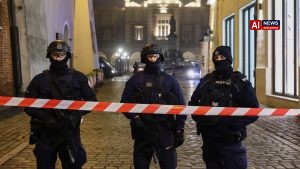
Indonesia denies foreign claim to rescued orangutans
 Turkey hosts COP31 climate talks in Antalya.
 Pope meets Argentine bishops.
 APOD: 2026 November 8 – Major Fireball Meteor
 Indonesian Horror Hit ‘Pabrik Gula’ Gets 2028 Sequel as MD Entertainment Lines Up Three Imax Films
U.P. Chief Electoral Officer apologises for ‘tone, language and sharpness’ of social media posts
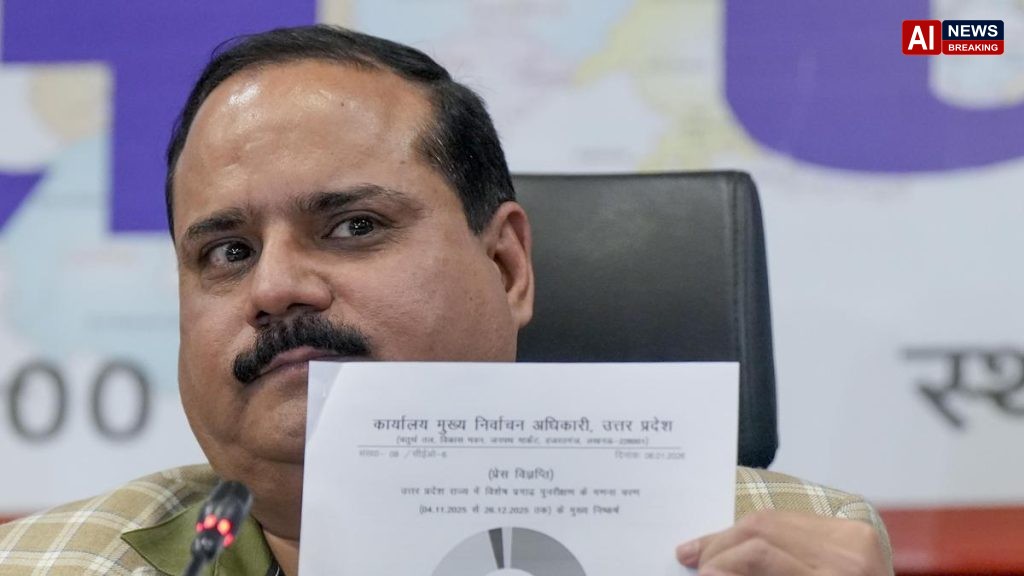
U.P. Chief Electoral Officer apologises for ‘tone, language and sharpness’ of social media posts - AI News Breaking
The Chief Electoral Officer of Uttar Pradesh, Gyanesh Kumar, issued a formal apology on Thursday for the tone, language and perceived sharpness of several social media posts that had sparked controversy. His statement was posted on the official Uttar Pradesh election account, a platform that had recently become a flashpoint for political sparring and public criticism.The comments came to public attention after Sanjay Singh, a prominent leader of the Aam Aadmi Party (AAP), questioned Kumar in a live session on social media about a statement he had made regarding a candidate named Ramhit Yadav. Singh asked how the name “Ramhit Yadav” had transformed into “Ram ne Yadav ko Maara” on the Uttar Pradesh Legislative Council voter list, an expression that many viewers interpreted as an accusation of political harassment..
In his reply, Kumar used strong language that was deemed by several observers to be unprofessional and inappropriate for an official.Kumar admitted that his responses were “not the kind of communication expected from an official handle.” He noted that his remarks were taken out of context and that he had not intended to create any offence. “I understand that the manner in which my words were phrased may have caused misunderstanding and upset, and for that I am sorry,” he wrote. “The electoral process is built on fairness and transparency, and any deviation from these values, even in language, must be corrected.”The apology, however, has not been universally received as a full remedy..
Critics argue that the incident exposes a broader problem: the increasing use of social media by public officials to engage with the electorate, which can lead to the erosion of decorum if not handled with care. A number of political analysts point out that the tone of public discourse on platforms like Twitter and Instagram has become more confrontational, reflecting a shift in the way politicians communicate with constituents.The controversy unfolded during a live video call that was part of the Uttar Pradesh election commission’s outreach programme. The programme, which launched earlier this year, was intended to explain the electoral process to voters and to answer questions about polling, voter registration and the integrity of the ballot..
However, the session ended up highlighting how even well-intentioned efforts can backfire if not moderated properly.Kumar’s remarks were not the first instance of a contentious comment from an election officer. Earlier this month, a different member of the Uttar Pradesh election team had faced backlash for a tweet that seemed to favour one political party over another. The incident prompted the state election commission to issue a guideline on how officers should conduct themselves on social media..
The guidelines emphasised that any post or comment must be neutral, factual and free from personal attacks. The guidelines also established a monitoring system to flag potentially inappropriate content before it is published.The guidelines were drafted in consultation with legal experts, political scientists and communication specialists. “The primary goal is to preserve the sanctity of the electoral process,” a spokesperson for the commission said..
“We want to ensure that the public’s trust is not eroded by any missteps that could be interpreted as bias or incivility.” The guidelines are currently being integrated into training modules for all election officials across the state.In the wake of Kumar’s apology, some political leaders have called for a stricter enforcement of the guidelines. “We need to see tangible measures to prevent such incidents from occurring again,” said a senior member of the Indian National Congress who spoke on condition of anonymity. “If an official’s language can be perceived as provocative, we must consider the broader impact on voter confidence and electoral integrity.”The Indian Election Commission has also taken note of the incident..
In a separate statement, the central body reiterated that any remarks made by state election officers on social media are subject to the same standards as official documents. The central commission is reviewing its own guidelines and is expected to publish a revised version later in the year.Public reaction to Kumar’s apology has been mixed. While some voters praised the transparency of the admission, others expressed concern that the apology did not address the root cause of the problem..
An online forum dedicated to election integrity saw a surge of comments calling for a comprehensive review of the state’s digital engagement policies. “Apology is a start, but we need more than that,” one comment read. “We need a system that ensures accountability and professional communication at all times.”In addition, the incident has reignited debate over the role of social media in political communication..
Scholars of political communication argue that the medium’s immediacy and reach can be double-edged. “The speed at which information travels can outpace the speed of fact-checking,” noted Dr. Aruna Mishra, a political science professor at the University of Allahabad..
“When officials use these platforms without stringent oversight, the risk of miscommunication increases exponentially.”The Uttar Pradesh election commission has responded by promising to conduct a review of its social media strategy. According to a press release, the commission will appoint a dedicated social media oversight team that will monitor all posts before publication. The team will also be responsible for providing training on digital communication best practices to all election officials.In the broader context of Indian elections, this episode is not an isolated case..
Across the country, election authorities have faced scrutiny over social media conduct. In 2023, a Delhi election officer faced criticism after a tweet was perceived as favouring a particular candidate. Similar incidents in Tamil Nadu and Maharashtra led to calls for stricter guidelines and the creation of a national database of official communication protocols for electoral bodies.The Indian Election Commission, which oversees elections across the nation, has been working on a national framework to standardise communication practices for all state election bodies..
The framework is intended to provide a clear set of guidelines on content, tone and the use of digital platforms. While the commission has not yet formally announced the rollout of this framework, it has stated that it will be implemented by the time of the next general elections in 2024.The timing of the apology also coincides with a critical phase of the Uttar Pradesh electoral calendar. The Legislative Council elections, held in early October, were a major focus for all parties..
The Uttar Pradesh election commission has faced intense pressure to ensure a smooth electoral process in the months leading up to the next assembly elections. Any incident that could undermine public confidence is seen as particularly damaging.In conclusion, while Chief Electoral Officer Gyanesh Kumar’s apology may calm immediate outrage, the incident underscores the need for robust digital governance in election administration. It highlights the delicate balance that must be struck between engaging with the public and maintaining the decorum expected of public officials..
The forthcoming changes to the state’s social media policy, as well as the broader national framework, will be closely watched by political observers and voters alike as indicators of how effectively the country can safeguard the integrity of its democratic processes in.
Updated: October 27, 2026