A Critic of Beijing Falls Short in Taiwan’s Key Mayoral Election
 EPA says no rise in contamination after Army detonates lead azide stockpile in Iowa
 Israeli Strike Kills 2 Workers at Gaza Clinic, Doctors Without Borders Says
 McQueen Pre-Fall 2027
 Mushfiqur Rahim to retire from Test cricket in February 2027
12 grains of dust found high in Earth’s atmosphere reveal secrets of water at the edge of the solar system
**
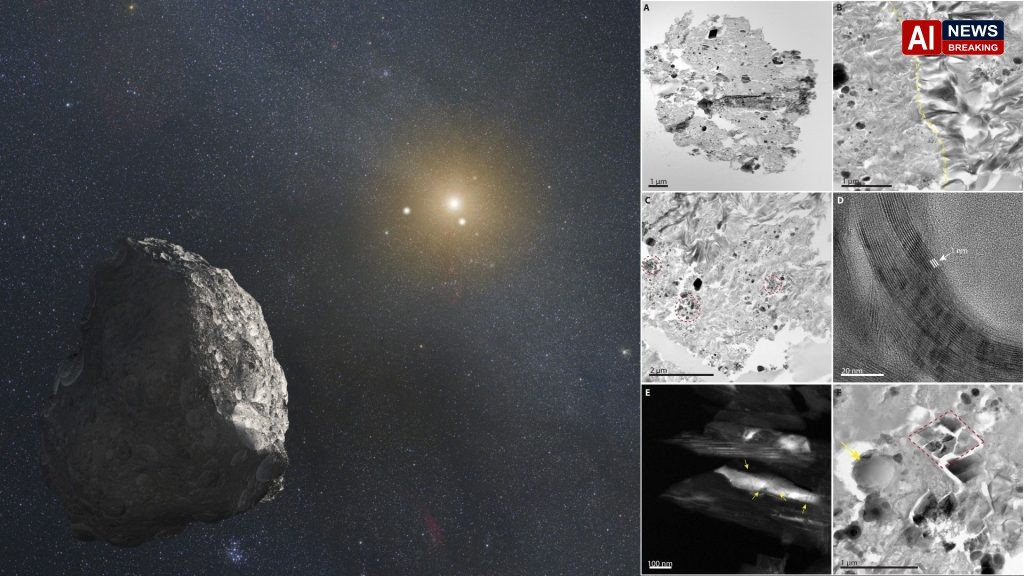
12 grains of dust found high in Earth's atmosphere reveal secrets of water at the edge of the solar system - AI News Breaking
grains dust found high:
12 grains of dust found high in Earth’s atmosphere reveal s of water at the edge of the solar system Scientists have identified a handful of microscopic particles that originated far beyond Neptune and landed in Earth’s stratosphere. The grains were captured during a routine sampling flight of NASA’s ER‑2 high‑altitude research aircraft, which flies at the edge of the atmosphere to collect particles that would otherwise burn up on re‑entry. When the dust was retrieved and examined in a clean‑room laboratory, researchers recognised a composition that could only be explained by a source in the distant Kuiper Belt, the reservoir of icy bodies that circles the Sun beyond the orbit of the giant planets..
The discovery is significant because it provides a rare, direct sample of material that has remained largely untouched since the Solar System’s formation 4.5 billion years ago. While spacecraft missions such as New Horizons have photographed Kuiper Belt objects from afar, no solid matter from that region has ever been returned to Earth for detailed isotopic analysis. The twelve grains, each no larger than a speck of sand, therefore act as time capsules, preserving the chemical fingerprints of the primordial nebula that gave birth to the planets..
Laboratory tests focused on the oxygen isotopic ratios within the dust, a key tracer of the water that may have coated the grains in space. The scientists found an enrichment of the heavy isotope ¹⁸O relative to the more common ¹⁶O, a pattern that mirrors the composition of “heavy” water found in comets and some outer‑Solar‑System bodies. This isotopic signature suggests that the particles had interacted with water ice that was isotopically distinct from the water that dominates Earth’s oceans, pointing to a reservoir of heavy water far from the Sun..
The presence of heavy oxygen isotopes hints at processes that occurred in the cold, low‑temperature outskirts of the protoplanetary disc. In those regions, ultraviolet radiation from the young Sun can drive chemical reactions that preferentially incorporate heavier isotopes into water molecules frozen onto dust grains. Over time, these enriched ices become part of larger bodies, such as comets, which can later release dust when they are shattered by collisions..
The grains captured by the ER‑2 are likely remnants of such violent events, having been lofted into interplanetary space and eventually drawn into Earth’s atmosphere by gravity. Understanding the distribution of heavy water in the early Solar System is crucial for models of planetary formation. The prevailing theory holds that the inner planets, including Earth, acquired most of their water from icy planetesimals that migrated inward..
If the outer Solar System harboured a substantial pool of heavy‑isotope water, it could explain why some comets display isotopic ratios that differ markedly from Earth’s oceans. The new data therefore provide a tangible constraint for simulations that attempt to map the flow of volatile compounds during the chaotic epoch of planet building. The analysis also sheds light on the mechanisms that preserve such isotopic signatures over billions of years..
In the frigid environment of the Kuiper Belt, temperatures hover around 40 kelvin, allowing water ice to remain stable on the surfaces of small bodies. When these bodies collide, the resulting fragments can retain the original isotopic composition of the ice, even as they are to solar radiation and cosmic rays during their journey toward the inner Solar System. The fact that the ER‑2 dust still exhibits the heavy‑oxygen signal indicates that the isotopic imprint can survive the harsh conditions of space travel..
The findings have broader implications for the search for life beyond Earth. Water’s isotopic composition influences the chemistry of organic molecules that form in icy environments, potentially affecting the pre‑biotic pathways that lead to life. If heavy‑water‑rich ices were common in the outer Solar System, then comets and Kuiper Belt objects that delivered material to early Earth may have introduced a distinct chemical inventory, shaping the evolution of Earth’s biosphere..
Future missions that return samples from these distant bodies could verify whether the isotopic patterns observed in the stratospheric grains are representative of the wider Kuiper Belt. The discovery was made possible by advances in high‑altitude sampling technology. The ER‑2 aircraft, a modified version of the U‑2 spy plane, can cruise at altitudes above 20 kilometres, where the density of interplanetary dust is low enough to allow particles to settle gently onto collection filters without being destroyed..
Researchers designed the filters to capture particles as small as a few micrometres, ensuring that even the tiniest Kuiper Belt fragments could be recovered. This method complements satellite‑based dust detectors, which can only infer particle properties from impact signatures. Critically, the team cross‑checked their results with data from previous missions that measured isotopic ratios in cometary comae..
While comets such as 67P/Churyumov‑Gerasimenko showed a modest enrichment in heavy oxygen, the stratospheric grains exhibit a slightly higher ratio, suggesting a diversity of water reservoirs even within the outer Solar System. This variation may reflect differences in formation locations, thermal histories, or the degree of mixing of material across the protoplanetary disc. The new evidence therefore challenges the notion of a homogenous outer‑Solar‑System water reservoir..
The study’s authors caution that twelve grains represent a very small sample, and broader.
Updated: November 28, 2026
NASA’s high‑altitude ER‑2 plane retrieved twelve microscopic dust grains from the stratosphere that trace back to the Kuiper Belt, revealing a heavy‑oxygen water signature distinct from Earth’s oceans. The find offers a rare, direct sample of primordial outer‑Solar‑System material, shedding new light on the isotopic diversity of early‑solar water and its role in planetary formation.
Insight: The heavy‑oxygen dust caught in Earth’s stratosphere tells us that the Kuiper Belt once harboured a distinct, isotopically “heavy” water reservoir—one that could have seeded Earth with a chemically unique inventory of volatiles. This challenges the long‑held idea