A Critic of Beijing Falls Short in Taiwan’s Key Mayoral Election
 EPA says no rise in contamination after Army detonates lead azide stockpile in Iowa
 Israeli Strike Kills 2 Workers at Gaza Clinic, Doctors Without Borders Says
 McQueen Pre-Fall 2027
 Mushfiqur Rahim to retire from Test cricket in February 2027
50% Delimitation Bill 2026: Lok Sabha Seats to Rise to 850, What It Means for India’s Political Future
The Union Cabinet has cleared the 50% Delimitation Bill 2026, proposing an increase in Lok Sabha and state Assembly seats, 33% women’s reservation and protection of states’ relative parliamentary representation until 2051.
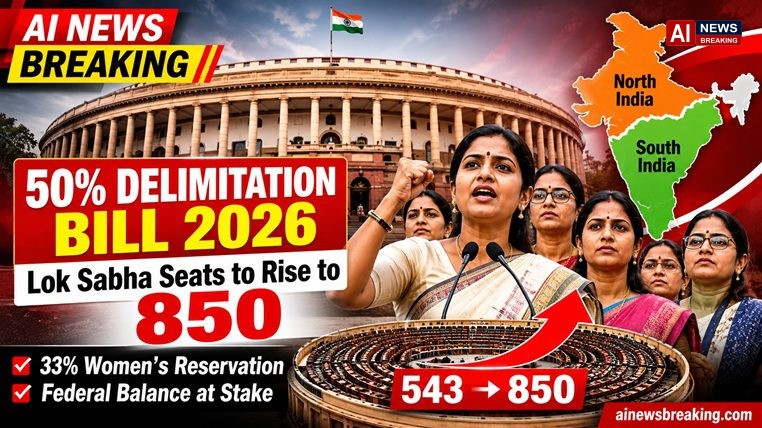
delimitation bill 2026 sabha:
AI News Breaking Editorial Analysis | India Politics | November 28, 2026
India is preparing for one of the most consequential constitutional and political debates in recent years. The proposed 50% Delimitation Bill 2026 seeks to expand the strength of the Lok Sabha and state Legislative Assemblies, introduce a new framework for electoral constituencies and facilitate the implementation of 33% reservation for women in Parliament and state legislatures.
The proposal has generated a major national debate because delimitation is not simply about increasing the number of elected representatives. It directly affects the distribution of political power among Indian states, the relationship between population and representation, and the future of India’s federal democratic structure.
The Union Cabinet has cleared the proposed legislative package, with a special parliamentary sitting scheduled to begin on November 30, 2026. However, Cabinet approval does not mean that the proposal has become law. It must still pass through the constitutional legislative process.
The biggest question surrounding the proposal is whether India can expand democratic representation without creating new political inequalities between northern and southern states.
Key Highlights: 50% Delimitation Bill 2026
- 50% increase in seats: The proposal seeks to increase Lok Sabha and state Assembly seats by 50% across states and Union Territories.
- Lok Sabha expansion: The proposed constitutional framework provides for a maximum strength of 850 members.
- 33% women’s reservation: The proposal aims to facilitate one-third reservation for women in Parliament and state Legislative Assemblies.
- Protection of state representation: The proposal seeks to protect the existing relative share of seats among states until 2051.
- Fresh constituency boundaries: A Delimitation Commission would undertake the exercise using the latest published Census figures available under the proposed framework.
What Is the 50% Delimitation Bill?
Delimitation is the process of fixing or redrawing electoral constituency boundaries and determining the distribution of elected representatives.
In simple terms, delimitation decides how many parliamentary constituencies a state will have, where their geographical boundaries will be drawn and how citizens will be represented in elected institutions.
India’s parliamentary seat allocation has remained subject to constitutional freezes for decades. These arrangements were originally introduced to encourage population stabilisation and prevent states that successfully controlled population growth from losing their relative political representation.
The proposed 50% delimitation framework seeks to change the existing arrangement by increasing the number of seats across states and Union Territories.
Instead of simply reallocating parliamentary seats according to population growth, the proposal seeks to provide a uniform proportional increase while protecting the existing relative distribution of representation among states until 2051.
This is particularly important because India’s population growth has not been uniform across regions.
How Will the Lok Sabha Change?
One of the most significant consequences of the proposal would be the expansion of India’s Lower House of Parliament.
The Lok Sabha currently has 543 elected seats. The proposed constitutional framework would increase its maximum strength to 850 members.
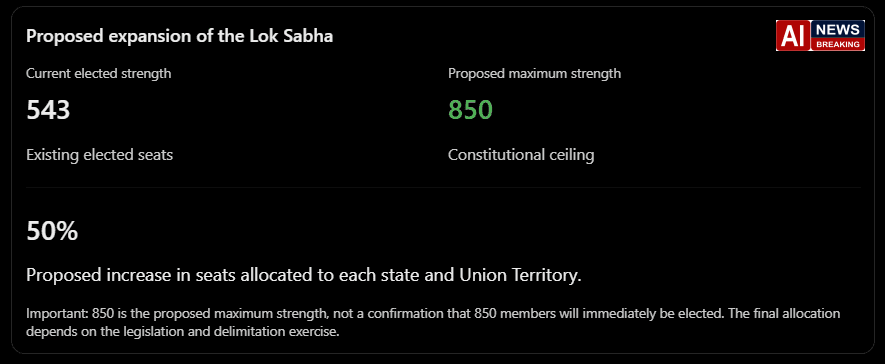
Under the proposed arrangement:
- Up to 815 members could represent states.
- Up to 35 members could represent Union Territories.
- The maximum strength of state Legislative Assemblies would increase from 500 to 650.
It is important to distinguish between the proposed maximum strength and the actual number of seats that will ultimately be filled. The final allocation will depend on the legislation and the subsequent delimitation exercise.
An expanded Lok Sabha could provide greater opportunities for regional representation and allow more constituencies to be represented in Parliament.
However, increasing the number of MPs alone will not guarantee better governance. Parliamentary accountability, legislative scrutiny and the quality of representation will remain equally important.
Why Are Southern States Concerned About Delimitation?
The most politically sensitive aspect of the delimitation debate is the difference in population growth between northern and southern India.
States such as Uttar Pradesh, Bihar, Madhya Pradesh and Rajasthan have experienced substantial population growth over recent decades.
On the other hand, states such as Tamil Nadu, Kerala, Karnataka and Andhra Pradesh have made significant progress in population stabilisation through education, healthcare and family-planning initiatives.
Southern states have repeatedly expressed concern that a population-based redistribution of parliamentary seats could increase the political influence of states with faster population growth while reducing their relative representation.
Their argument is that states should not be politically penalised for successfully controlling population growth.
The proposed 50% increase attempts to address this concern by providing a proportional expansion across states and protecting their existing relative representation until 2051.
However, the issue is not entirely resolved.
A fundamental democratic question remains: should parliamentary representation be determined primarily by population, or should the federal structure also protect the political influence of states that have successfully managed demographic growth?
Both principles deserve serious consideration.
North India Versus South India: A New Political Balance?
The delimitation debate has the potential to become one of the biggest federal political discussions in India.
Northern states have large populations and substantial electoral constituencies. Southern states have made significant contributions to economic development, education, healthcare, industrialisation and population stabilisation.
If delimitation is not handled transparently, the issue could deepen regional political tensions.
The debate should not become a competition between northern and southern India. Instead, Parliament must develop a constitutional framework that recognises the democratic rights of citizens while protecting the federal balance between states.
India’s unity depends not only on political representation but also on the confidence of every state that its voice matters in national policymaking.
Why Is the Government Linking Delimitation With Women’s Reservation?
The proposed delimitation reform is closely connected with the Nari Shakti Vandan Adhiniyam, passed in 2023.
The 106th Constitutional Amendment provided for 33% reservation for women in the Lok Sabha and state Legislative Assemblies.
However, the implementation of this reservation was linked to a future Census and subsequent delimitation exercise.
The new legislative proposal seeks to facilitate the implementation of women’s reservation through an expanded legislative structure.
This could represent a major transformation in Indian politics.
Women remain underrepresented in many elected institutions. A 33% reservation could provide more opportunities for women to participate in legislative decision-making and influence national and state policies.
However, the implementation mechanism will be critical.
Important questions include how reserved constituencies will be selected, how frequently they will rotate and how representation for Scheduled Caste and Scheduled Tribe women will be protected.
Women’s political participation should not be limited to reserved constituencies. Political parties must also create meaningful leadership opportunities for women across all levels of electoral politics.
What Does the Bill Mean for Uttar Pradesh, Bihar, Tamil Nadu and Other States?
The proposed 50% increase could significantly change the number of elected representatives across the country.
The following calculations illustrate what a 50% increase would look like using existing Lok Sabha seat numbers.
| State | Existing Seats | Illustrative 50% Increase |
|---|---|---|
| Uttar Pradesh | 80 | 120 |
| Maharashtra | 48 | 72 |
| West Bengal | 42 | 63 |
| Bihar | 40 | 60 |
| Tamil Nadu | 39 | 58.5 |
| Madhya Pradesh | 29 | 43.5 |
| Karnataka | 28 | 42 |
| Gujarat | 26 | 39 |
| Rajasthan | 25 | 37.5 |
| Kerala | 20 | 30 |
| Punjab | 13 | 19.5 |
These figures are illustrative calculations, not official proposed seat allocations. Actual allocations will depend on constitutional provisions, rounding, applicable limits and the final delimitation exercise.
For Uttar Pradesh and Bihar, the increase could mean more parliamentary constituencies and a larger number of elected representatives.
For Tamil Nadu, Kerala and Karnataka, protection of the existing relative share of representation is particularly significant.
Punjab, Haryana, Assam, Odisha and other states could also experience changes in constituency boundaries and electoral competition.
The final outcome will depend on the delimitation formula and the implementation of the proposed legislation.
The 2011 Census Question: Why Does It Matter?
The Census is an important foundation for delimitation because population figures help determine the size and boundaries of electoral constituencies.
India’s 2011 Census remains the latest completed Census with published population figures as of November 28, 2026.
The proposed framework refers to the latest published Census figures available when the legislation comes into force.
This raises important questions about the timing and methodology of the exercise.
Using older population data may not fully reflect the current demographic realities of the country. Using newer Census data could produce different population calculations and constituency boundaries.
The timing of the Census, publication of its results and commencement of the legislation will therefore be crucial.
The government must provide clarity on these issues to ensure that the delimitation exercise is transparent and constitutionally defensible.
Political Opposition and the Constitutional Debate
The proposed delimitation framework is expected to face significant political scrutiny.
An earlier legislative package introduced in April 2026 failed to secure the required two-thirds majority in the Lok Sabha.
Opposition parties raised concerns about the possible imbalance between northern and southern states, the distribution of parliamentary representation and the relationship between delimitation and women’s reservation.
The revised proposal seeks to address some of these concerns through a uniform 50% increase in seats and protection of the existing relative share of states until 2051.
Nevertheless, constitutional and political questions remain.
A constitutional amendment requires a special majority in both Houses of Parliament. Depending on the provisions being amended, ratification by at least half of the state legislatures may also be necessary.
The government will therefore need to build broad political consensus.
Delimitation cannot be treated as an ordinary political announcement. It affects the constitutional structure of India’s representative democracy and the distribution of political power.
What Does the Delimitation Bill Mean for Indian Democracy?
India is the world’s largest democracy, with enormous differences in population, geography, economic development and social structure.
Expanding the Lok Sabha could offer several advantages.
First, it could improve representation by allowing more elected MPs to represent citizens and local communities.
Second, it could accelerate women’s political participation through the implementation of 33% reservation.
Third, it could provide an opportunity to modernise electoral constituencies and improve regional representation.
Fourth, it could strengthen parliamentary democracy by accommodating a growing and increasingly diverse population.
However, the reform also carries risks.
A larger Parliament could increase administrative expenditure, complicate legislative coordination and intensify political competition.
More importantly, if the delimitation formula is not perceived as fair, it could deepen regional tensions and weaken trust between the Centre and state governments.
The success of the reform will depend not simply on how many seats are added but on the transparency, fairness and constitutional legitimacy of the entire process.
India’s Federal Structure: Will Political Power Become More Centralised?
The delimitation debate raises a broader question about the future of Indian federalism.
India’s political structure depends on a balance between the Union government and state governments. Every state has its own economic priorities, demographic challenges, regional identity and political interests.
Changes in parliamentary representation could influence the political weight of different regions in national decision-making.
The proposed protection of the relative share of seats until 2051 is intended to provide stability. However, it also raises questions about whether a fixed distribution can adequately reflect demographic changes over the next 25 years.
India needs a system that recognises two equally important democratic principles:
- Every citizen should have meaningful and reasonably equal representation.
- Every state should retain a fair voice in national policymaking.
These principles must be reconciled through constitutional safeguards, consultation and transparent decision-making.
The delimitation exercise should not become a North versus South political contest. It should strengthen the federal character of India.
What Happens Next? Parliament’s Special Sitting
The government’s Cabinet approval is only the beginning of the legislative process.
The special parliamentary sitting is scheduled to begin on November 30, 2026, with the Rajya Sabha scheduled to meet from December 2.
The key developments to watch include:
- Introduction and debate on the Constitution (132nd Amendment) Bill, 2026.
- Consideration of the Delimitation (Second) Bill, 2026.
- Parliamentary voting and the required constitutional majority.
- Any necessary ratification by state legislatures.
- Constitution of the Delimitation Commission.
- Publication of new constituency boundaries.
- Implementation of women’s reservation.
The outcome could influence India’s electoral architecture for decades.
Cabinet approval does not mean that the new system will automatically come into effect. Parliamentary approval, constitutional requirements and implementation procedures will determine the final outcome.
Conclusion: A Historic Democratic Reform or a New Political Challenge?
The proposed 50% Delimitation Bill is much more than an increase in the number of Lok Sabha seats. It represents an attempt to reshape India’s democratic representation, accelerate women’s political participation and establish a new framework for the distribution of electoral power.
There is a strong argument for expanding parliamentary representation as India’s population and political complexity grow. There is also a compelling case for ensuring that women receive meaningful representation in elected institutions.
But democratic reform must be based on fairness, transparency and constitutional consensus.
The government must address concerns raised by southern states, clarify the relationship between population-based representation and the proposed seat increase, and ensure that no region feels politically disadvantaged.
India does not need a North versus South political contest. It needs a democratic system in which every citizen, every state and every region has a meaningful voice.
The real test of the 50% Delimitation Bill will not be how many seats Parliament adds, but whether the reform makes Indian democracy more representative, balanced and accountable.
AI News Breaking Editorial Analysis: The proposed delimitation reform could become one of the defining constitutional decisions of this decade. Its success will depend on whether political consensus can be achieved alongside the principles of democratic equality, women’s empowerment and cooperative federalism.