The Supreme Court will decide whether assault weapons bans violate the Second Amendment
 A Critic of Beijing Falls Short in Taiwan’s Key Mayoral Election
 EPA says no rise in contamination after Army detonates lead azide stockpile in Iowa
 Israeli Strike Kills 2 Workers at Gaza Clinic, Doctors Without Borders Says
 McQueen Pre-Fall 2027
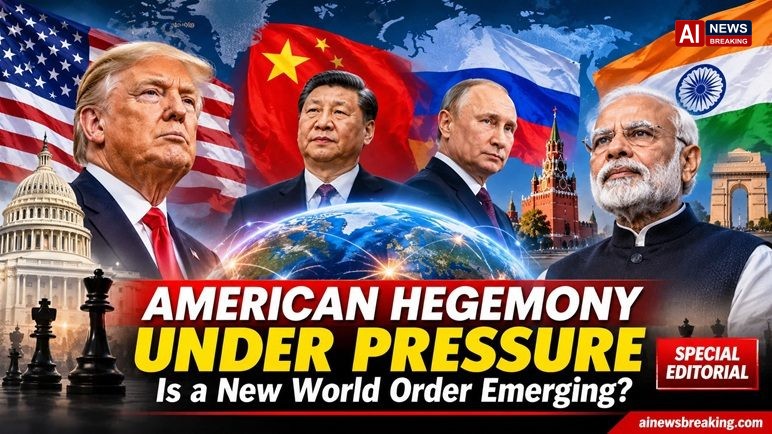
American Hegemony Under Pressure: Is a New World Order Emerging as China, Russia and Emerging Powers Challenge Washington
The global balance of power is shifting as China, Russia and emerging economies challenge the traditional dominance of the United States. From geopolitical conflicts and economic competition to BRICS expansion
american hegemony pressure world:
World News | International Relations | US Foreign Policy | China | Russia | Special Editorial
The global balance of power is undergoing a period of significant transformation. For decades, the United States has occupied a dominant position in international politics, global finance, military alliances, technological development and international institutions. However, a combination of geopolitical conflicts, economic competition, trade disputes and changing international partnerships is raising a fundamental question: Is American hegemony gradually weakening, and is a new multipolar world order emerging?
Developments in November 2026 have brought this debate into sharper focus. Washington is simultaneously dealing with the consequences of the Iran conflict, difficult negotiations over the Russia-Ukraine war, competition with China and growing questions about the future of its international alliances.
The November midterm elections have also changed the domestic political landscape, with Democrats gaining control of Congress. Although the US President retains considerable authority over foreign policy, the election results could complicate the administration’s domestic agenda and influence its international calculations.
At the same time, China is strengthening its economic and technological position, Russia continues to challenge Western pressure, and emerging economies are increasingly seeking greater influence over international decision-making.
These developments do not establish that American power has collapsed. They do, however, suggest that the international system is becoming more contested.
Key Highlights
- American global influence faces growing challenges from geopolitical and economic competition.
- China continues to strengthen its position in international trade, technology and strategic diplomacy.
- Russia remains a major geopolitical actor despite Western sanctions and the continuing Ukraine conflict.
- The US midterm election results have introduced new political constraints on President Donald Trump.
- BRICS and other international partnerships reflect growing demands for a more representative global order.
- India’s strategic autonomy gives New Delhi an important position in the changing international balance.
The Foundations of American Hegemony
Following the Second World War, the United States emerged as one of the world’s most powerful economic and military nations.
The creation of institutions such as the International Monetary Fund and World Bank, the establishment of the Bretton Woods financial framework and the expansion of American-led security alliances helped Washington shape the post-war international system.
After the collapse of the Soviet Union in 1991, the United States entered a period of unmatched global influence.
The dollar became the dominant international reserve currency, American financial markets gained extraordinary importance, and US-led military alliances expanded their reach.
American technology companies, universities, financial institutions and cultural industries also became major sources of international influence.
However, global dominance is not permanent. Economic competitors emerge, military interventions create strategic costs, alliances change and new centres of power develop.
The current international environment is testing the durability of the American-led system.
China: The Biggest Economic Challenge to Washington
China represents one of the most significant challenges to American economic and technological leadership.
Its position in global manufacturing, industrial supply chains, electric vehicles, batteries, telecommunications, renewable energy and critical minerals gives Beijing substantial international influence.
The US-China relationship has increasingly become a competition over more than trade.
Technology restrictions, semiconductor exports, artificial intelligence, rare-earth minerals, investment screening and access to strategic markets have become central issues.
Recent trade discussions have also demonstrated that the two powers remain economically interdependent.
According to reporting on November 12, Washington and Beijing reached a proposed pathway to reduce certain export-control restrictions. China indicated that it would supply magnets and rare-earth materials, while the United States discussed measures involving Chinese students at American universities. The arrangement still required final approval from both presidents.
This development illustrates an important reality: even when strategic rivalry intensifies, both economies have reasons to negotiate.
The competition is therefore not simply about which country can dominate the other. It is about who will shape the rules, technologies and economic institutions of the next generation.
India: An Emerging Power That Refuses to Be Part of Any Single Bloc
India’s growing geopolitical influence is becoming one of the most important developments in the emerging multipolar world. Unlike countries that operate primarily within one strategic alliance, New Delhi has consistently pursued a policy of strategic autonomy, maintaining relationships with Washington,
Moscow, Beijing and European capitals while protecting its independent national interests. India purchases energy from Russia, strengthens defence and technology cooperation with the United States, participates in BRICS and the Shanghai Cooperation Organisation, and works with partners through the Quad in the Indo-Pacific region. This diplomatic flexibility gives India the ability to engage with competing powers without automatically accepting their geopolitical positions.
However, India’s ambitions extend beyond diplomatic balancing. Its expanding economy, growing defence manufacturing capabilities, digital infrastructure, space programme, pharmaceutical industry and technological ecosystem are strengthening its position as an independent centre of global power. India’s role in the Global South is equally significant, as developing nations increasingly seek greater representation in international financial institutions, trade negotiations and global decision-making.
Nevertheless, India faces considerable challenges, including dependence on imported crude oil, military tensions with China, regional security concerns, unemployment and the need to strengthen domestic manufacturing. The real test of India’s rise will be whether it can convert its economic potential and diplomatic influence into long-term strategic independence.
In the emerging world order, India does not necessarily want to replace one dominant power with another; it wants a global system in which its national interests and the voices of developing countries receive greater recognition.
Russia: Sanctions Have Not Ended Moscow’s Strategic Influence
Russia remains another major factor in the changing international order.
Western governments have imposed extensive sanctions following the invasion of Ukraine, targeting financial institutions, energy exports, technology access and individuals associated with the Russian state.
However, sanctions have not eliminated Russia’s ability to influence global energy markets or participate in international diplomacy.
Moscow has strengthened economic relationships with several non-Western partners, particularly in energy and trade.
The latest developments in November demonstrate the continuing contradictions in Western policy.
The European Union is preparing additional sanctions targeting approximately 150 entities and 50 banks, according to statements by France on November 12.
At the same time, the Trump administration has pursued diplomatic negotiations involving Russia and Ukraine.
Recent US-mediated discussions have raised questions about the future of European security, Ukraine’s sovereignty, sanctions relief and the role of NATO.
The challenge for Washington is to balance pressure on Moscow with the need to achieve a sustainable peace.
Russia, meanwhile, wants a settlement that recognises its strategic demands and reduces Western military influence near its borders.
Whether such a settlement can be achieved without compromising Ukraine’s sovereignty remains one of the biggest questions in international politics.
The Trump Factor: American Power and the Limits of Unilateral Policy
President Donald Trump’s foreign policy approach has introduced considerable uncertainty into international relations.
His administration has used tariffs, sanctions, negotiations and military pressure as instruments of American strategic influence.
Supporters argue that this approach places American interests first and challenges arrangements that Washington considers unfair.
Critics argue that unpredictable policy changes can weaken alliances, create economic uncertainty and reduce confidence in American leadership.
The November 2026 midterm election results have added another dimension.
Democrats have gained control of Congress, increasing their ability to investigate the administration, scrutinise nominations and challenge parts of its domestic agenda.
However, the President retains substantial constitutional authority over foreign policy and military decisions.
The political outcome therefore does not automatically mean a reversal of American international strategy.
It does mean that the administration must operate in a more difficult domestic political environment.
The Middle East: A Test of American Strategic Influence
The Iran conflict has become an important test of American influence in West Asia.
The region remains central to international energy security because of its strategic shipping routes, oil and gas resources and military importance.
The Strait of Hormuz is particularly significant because disruption to shipping through this narrow waterway can affect global energy prices and international trade.
Military pressure can demonstrate American military capabilities, but it does not automatically produce a stable political settlement.
The consequences of prolonged conflict can include higher energy costs, regional instability, pressure on international shipping and economic uncertainty.
For countries such as India, which depend heavily on imported energy, the effects can extend far beyond the Middle East.
The conflict also raises a wider question about the effectiveness of military power in achieving long-term political objectives.
A country may possess extraordinary military capabilities, but sustainable influence also depends on diplomacy, economic stability and international legitimacy.
BRICS and the Rise of a Multipolar World
The expansion and diplomatic activities of BRICS reflect the growing demand for a more representative international system.
The grouping has become an important platform for discussions involving emerging economies, development finance, trade cooperation and international governance.
At the BRICS summit in New Delhi earlier this year, leaders raised concerns about unilateral sanctions, Middle East instability and the need to strengthen the voice of developing countries.
Prime Minister Narendra Modi emphasised that BRICS should not be viewed simply as an anti-Western alliance.
This distinction is important.
India maintains strategic relationships with the United States, Russia, Europe, Japan and countries in West Asia. Its interests are not identical to those of Beijing or Moscow.
The rise of BRICS should therefore not automatically be interpreted as the creation of a unified anti-American bloc.
Instead, it demonstrates that several emerging economies want more influence in international financial institutions and greater freedom to pursue independent foreign policies.
The long-term question is whether these countries can transform their collective economic weight into effective institutional influence.
The Dollar and the Future of Global Financial Power
The international financial system remains one of the strongest foundations of American influence.
The US dollar plays a central role in global trade, international reserves, financial markets and commodity transactions.
American financial institutions and capital markets also provide enormous advantages to the United States.
However, several countries are exploring alternative payment arrangements, bilateral currency settlements and regional financial cooperation.
These initiatives are partly driven by concerns about sanctions exposure and dependence on Western-controlled financial infrastructure.
Nevertheless, replacing the dollar is not an easy task.
An alternative international reserve system would require deep financial markets, confidence in institutions, currency convertibility, reliable legal protections and sufficient liquidity.
No single alternative currently provides all the advantages of the dollar-based system at comparable global scale.
The more realistic possibility is gradual diversification rather than an immediate collapse of dollar dominance.
India’s Opportunity in the Emerging World Order
India occupies a particularly important position in this changing geopolitical environment.
It maintains defence and energy relationships with Russia while expanding strategic cooperation with the United States and its Indo-Pacific partners.
It also participates in BRICS, the G20, the Quad and multiple international institutions.
This diplomatic flexibility gives New Delhi opportunities to negotiate with different centres of power.
India’s priorities include energy security, access to technology, defence modernisation, export growth, manufacturing investment and protection of its strategic interests.
However, balancing relationships will become more complicated if international tensions intensify.
Washington may expect greater alignment from India on certain security and technology questions, while Moscow and Beijing will pursue their own strategic interests.
India’s challenge is to avoid becoming dependent on any single major power.
Strategic autonomy will remain valuable only if supported by economic strength, technological capabilities, military preparedness and diplomatic credibility.
Is the World Moving Towards a New Cold War?
The current geopolitical environment has similarities with the Cold War period, particularly in strategic competition, military alliances, technology restrictions and economic pressure.
However, the international system is much more economically interconnected than it was during the original US-Soviet confrontation.
China and the United States remain connected through trade, investment and supply chains. European economies depend on global markets, while emerging economies maintain relationships with competing powers.
The world is therefore not divided into two completely separate camps.
Instead, countries are increasingly choosing issue-based partnerships.
A country may cooperate with Washington on defence while maintaining energy relations with Moscow and trade partnerships with Beijing.
This flexible international environment makes the emerging order more complicated than a traditional two-superpower rivalry.
AI News Breaking Special Editorial Analysis: Is American Hegemony Ending or Simply Changing?
The idea that American hegemony is ending should be examined carefully.
The United States continues to possess extraordinary advantages in military capabilities, financial markets, technological innovation, global alliances and institutional influence.
China has not replaced America as the world’s dominant power, and Russia does not possess the economic capacity to independently lead a comparable international system.
However, global influence is no longer determined by military strength alone.
Economic resilience, technological independence, control over critical supply chains, energy security, diplomatic relationships and international legitimacy are becoming equally important.
The greatest challenge to Washington may not be the emergence of a single rival but the growing unwillingness of other countries to accept a world in which strategic decisions are determined primarily by one capital.
The United States may remain the most powerful country, but maintaining leadership will increasingly require cooperation rather than unilateral pressure.
The emerging world order is likely to be multipolar, competitive and complicated. China, the United States, Russia, India, Europe and other regional powers will all seek to protect their interests.
For India, this transition presents both opportunities and risks.
“If the 20th century was largely shaped by American-Soviet rivalry and the post-Cold War period by American dominance, the 21st century could increasingly be shaped by a multipolar balance in which India emerges not merely as a balancing power, but as an independent architect of the new global order.”
The next world order may not be defined by who replaces America. It may be defined by whether any single country can still control the direction of global affairs.
AI News Breaking Special Editorial | 13 November 2026