Pakistan’s leaders hail first astronaut aboard Chinese craft: ‘Proud one of us has gone into space’
 British tourist travels 29 hours from Mumbai to Amritsar for ₹5,461, rates Indian Railways 10/10 | Viral video
 The Supreme Court will decide whether assault weapons bans violate the Second Amendment
 A Critic of Beijing Falls Short in Taiwan’s Key Mayoral Election
 EPA says no rise in contamination after Army detonates lead azide stockpile in Iowa
Cummins goes above and beyond, but questions remain
**
Cummins goes above and beyond, but questions remain - AI News Breaking
cummins goes above beyond:
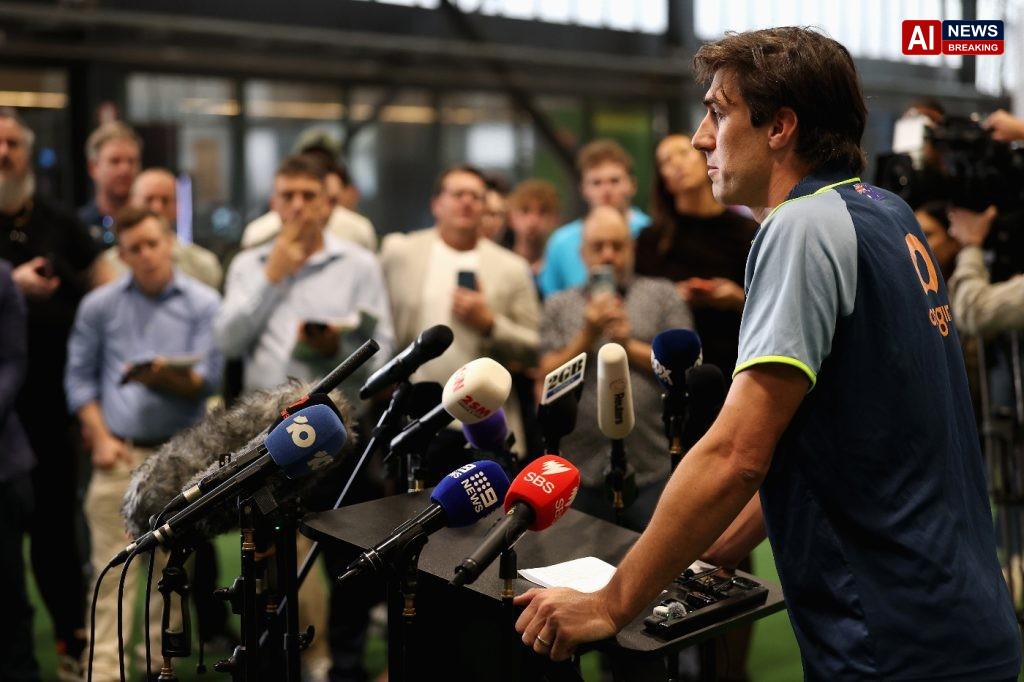
The Australian cricket team found itself under an unprecedented spotlight on Thursday when captain Pat Cummins addressed allegations of ball‑tampering made by former opener Usman Khawaja. The press conference, which lasted just over an hour, was the longest in the nation’s cricketing history and signalled a new level of scrutiny for a sport that has struggled with integrity issues in recent years. Cummins, known for his measured demeanor on and off the field, attempted to balance a defence of his side’s processes with an acknowledgement that the sport’s governing bodies must do more to restore public confidence..
While his statements were largely measured, they raised as many questions as they answered, leaving fans and analysts alike to wonder whether the measures outlined will be sufficient to prevent a repeat of past controversies.Khawaja, who retired from international cricket in 2022, raised the issue during a televised interview on a leading Australian sports network, claiming that he had observed suspicious activity involving the ball during the second innings of the recent Test against England at the Sydney Cricket Ground. He cited specific moments when the ball appeared to have an unusual seam position and suggested that a member of the Australian side may have tampered with it to gain an advantage. Although Khawaja’s comments were brief, they sparked an immediate reaction across social media, prompting calls for a full investigation and intensifying pressure on Cricket Australia (CA) to act swiftly.Cummins opened the press conference by reiterating the importance of “playing the game in its purest form” and stressed that the Australian side had a “zero‑tolerance” policy towards any form of illicit ball manipulation..
He detailed the existing protocols that players are required to follow, including regular ball inspections by match officials and the presence of a dedicated “ball‑tampering liaison officer” appointed by CA for each series. Cummins insisted that these procedures had been observed rigorously during the England Test, and that no breach had been reported by the umpires or the match referee at the time. He also highlighted that all players had undergone a mandatory integrity briefing before the series, a step he described as “essential in reinforcing the values we stand for”.The captain’s assurances, however, were met with skepticism from several quarters..
Former players and cricket historians pointed out that past incidents – notably the 2018 sandpaper scandal involving senior Australian batsmen – had gaps in the sport’s internal monitoring. Those critics argued that reliance on self‑reporting and the limited scope of on‑field inspections could not be sufficient to detect sophisticated tampering methods. They urged CA to adopt more robust, technology‑driven solutions, such as high‑resolution ball‑tracking cameras and real‑time seam‑analysis software, which have already been trialled in other major cricketing nations.In response, Cummins announced that CA would commission an independent review panel, chaired by former International Cricket Council (ICC) adjudicator David Boon, to examine the allegations and evaluate the efficacy of current anti‑tampering measures..
The panel, he said, would be tasked with producing a report within six weeks, and its recommendations would be presented to the board for immediate implementation. He also pledged that any player found to be in breach of the rules would face a “severe and transparent” sanction, reinforcing the board’s commitment to a “clean sport”.The announcement was received positively by some stakeholders, who viewed the independent review as a step towards greater accountability. The ICC itself issued a brief statement supporting the move, noting that “consistent application of anti‑tampering protocols is vital for the credibility of the game worldwide”..
Yet the ICC also cautioned that the review should not become a “quick fix” and urged national boards to collaborate on developing a unified global standard. This sentiment was echoed by the England and Wales Cricket Board (ECB), which expressed willingness to share its own data on ball‑condition monitoring, hinting at a possible joint effort to enhance cross‑border integrity safeguards.Despite these overtures, the underlying tension between player privacy and stringent monitoring remains unresolved. Cummins acknowledged that increased surveillance could be perceived as intrusive, potentially affecting player morale and performance..
He suggested that any new technology would need to be “balanced” with respect for the athletes’ dignity, proposing a phased rollout of camera systems that would focus on the ball’s surface without capturing excessive player behaviour. This nuanced stance reflects a broader debate within the sport, where the line between necessary oversight and overreach is constantly being negotiated.The press conference also touched on the cultural aspects that may contribute to an environment where tampering could be considered. Cummins spoke about the “winning mentality” that pervades elite Australian cricket, emphasizing that while competitiveness is essential, it must never cross ethical boundaries..
He referenced the mentorship programmes introduced by CA in 2021, designed to inculcate younger players with a strong sense of sportsmanship from the outset of their careers. Though well‑intentioned, these programmes have faced criticism for being “top‑down” and lacking measurable outcomes, prompting calls for more rigorous evaluation mechanisms.In the aftermath of the conference, a series of reactions from the public and the media painted a picture of divided opinion. A poll conducted by a leading Australian news outlet indicated that 57 per cent of respondents believed further investigation was necessary, while 28 per cent expressed confidence that the existing protocols were adequate..
Social media platforms were awash with commentary ranging from outright condemnation of any alleged misconduct to defensive posts championing the team’s integrity. Notably, former Australian captain Steve Waugh took to a radio interview to commend Cummins for his “candid” approach, yet warned that “the court of public opinion will be the real judge until concrete evidence is presented”.Looking ahead, the independent review’s findings will be pivotal in shaping the next phase of anti‑tampering policy in Australian cricket. If the panel recommends sweeping technological upgrades, CA will need to secure funding and navigate logistical challenges, especially given the sport’s varied infrastructure across domestic venues..
Conversely, if the review concludes that existing measures are sufficient, the burden will shift to rebuilding public trust through transparent communication and perhaps more stringent penalties for future breaches. Either scenario underscores the delicate balancing act that cricket administrators must perform: safeguarding the game’s integrity while preserving the spirit that has endeared it to millions.The episode has undeniably placed Pat Cummins at the centre of a critical discourse about governance, accountability and cultural change within Australian sport. His willingness to engage with the media for an extended period, rather than deflect or minimize the allegations, marks a departure from previous crisis‑management approaches..
Whether this openness translates into substantive reforms remains to be seen. As the sport moves forward, the eyes of both domestic and international audiences will remain fixed on how effectively Australia can address the lingering doubts.
Updated: November 13, 2026
Pat Cummins’ marathon press‑conference signals a shift from damage‑control to proactive transparency, forcing Cricket Australia to treat integrity as a strategic brand asset rather than a reactive checkbox.
If the forthcoming independent review embraces tech‑driven monitoring, it could redefine the sport’s trust calculus, but any half