Pakistan’s leaders hail first astronaut aboard Chinese craft: ‘Proud one of us has gone into space’
 British tourist travels 29 hours from Mumbai to Amritsar for ₹5,461, rates Indian Railways 10/10 | Viral video
 The Supreme Court will decide whether assault weapons bans violate the Second Amendment
 A Critic of Beijing Falls Short in Taiwan’s Key Mayoral Election
 EPA says no rise in contamination after Army detonates lead azide stockpile in Iowa
Pakistan’s leaders hail first astronaut aboard Chinese craft: ‘Proud one of us has gone into space’
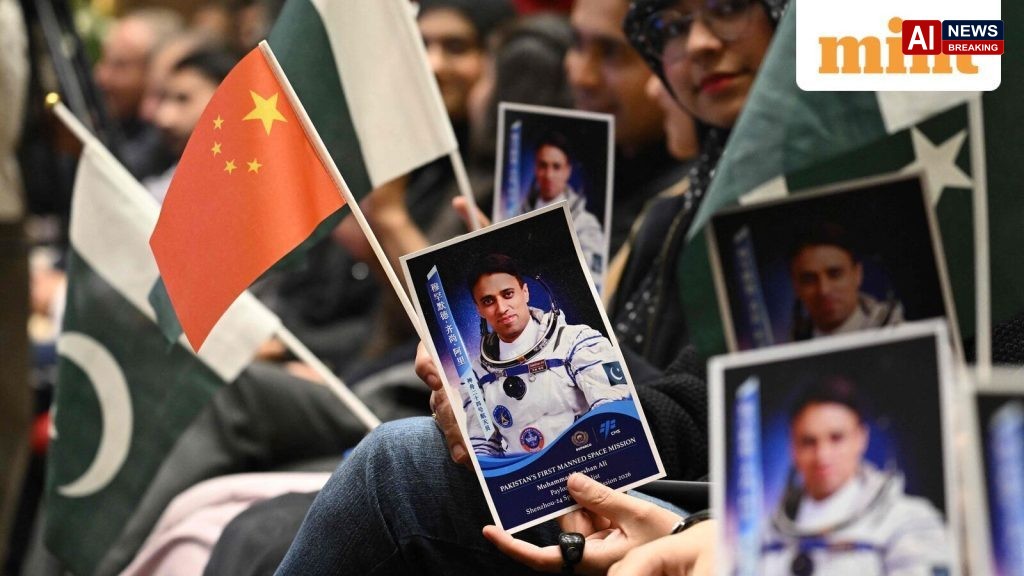
Pakistan's leaders hail first astronaut aboard Chinese craft: 'Proud one of us has gone into space' - AI News Breaking
pakistans leaders hail first:
Pakistan’s leaders hail first astronaut aboard Chinese craft: ‘Proud one of us has gone into space’ By Ayesha Khan, BBC News – Islamabad Date: 28 November 2026 — The historic launch of Muhammad Zeeshan Ali aboard China’s Shenzhou‑12 spacecraft on 12 October has ignited a wave of national pride across Pakistan. The 38‑year‑old test pilot, who became the first foreigner to ride China’s crewed programme, completed a 14‑day orbital mission that included scientific experiments, Earth‑observation tasks and joint technology demonstrations. His successful return to Earth on 26 October was marked by a televised reception at the Jinnah International Airport, where Pakistan’s President Arif Alvi, Prime Minister Shehbaz Sharif and senior military officials greeted the astronaut with applause and a cascade of congratulatory remarks..
The mission, officially named “Sagar‑2026”, is the first concrete outcome of the bilateral space‑cooperation agreement signed by the two governments in February 2025. Under the pact, China pledged to train Pakistani astronauts, share satellite‑navigation technology and assist in the development of a future joint space station module. Zeeshan’s flight therefore represents more than an individual achievement; it is the tangible fulfilment of a strategic partnership that both nations have touted as a cornerstone of their evolving defence and scientific collaboration..
In a speech that captured the sentiment of a nation, President Alvi described Ali’s journey as “a beacon for our youth and a testament to what can be achieved when we look beyond borders.” He added that the astronaut’s experience would be “leveraged to accelerate Pakistan’s own space ambitions, from satellite launches to planetary research.” The president’s remarks were echoed by Prime Minister Sharif, who announced the creation of a new national aerospace council tasked with integrating the lessons learned from the mission into domestic programmes. The Pakistani government has already earmarked ₨ 150 billion (approximately $850 million) for the establishment of a dedicated astronaut training centre at the Pakistan Aeronautical Complex in Kamra. The facility, expected to be operational by mid‑2028, will host a cohort of engineers, medical specialists and flight controllers who will work alongside their Chinese counterparts..
Officials say the centre will also serve as a hub for regional cooperation, inviting scholars from neighbouring countries to partake in joint research projects. While the political euphoria is palpable, scientists and experts are quick to underline the scientific payload that accompanied Ali’s flight. Among the experiments were micro‑gravity studies on the behaviour of locally sourced wheat germ, a series of radiation‑exposure tests on Pakistani‑manufactured electronic components, and high‑resolution imaging of the Indus River basin to monitor flood patterns..
The data, transmitted in real time to a ground station in Karachi, is already being analysed by teams at the Space and Upper Atmosphere Research Commission (SUPARCO), which hopes the findings will inform both agricultural policy and disaster‑management strategies. SUPARCO’s director-general, Dr Sajid Raza, described the mission as “a watershed moment for our scientific community.” He noted that the wheat‑germ experiment could pave the way for developing crop varieties that are more resilient to the stresses of climate change, while the radiation tests are expected to improve the reliability of Pakistan’s growing fleet of communication satellites. Dr Raza also hinted at a possible future joint mission to the Moon’s south pole, a prospect that would mark Pakistan as the first South‑Asian nation to set foot on an extraterrestrial body..
The Chinese side has praised the smooth execution of the joint mission, with the People’s Liberation Army Rocket Force chief, General Zhang Wei, stating that the cooperation “demonstrates the depth of trust between our peoples.” He also highlighted the technical proficiency of Ali’s crew‑integration training, which involved months of intensive simulation, zero‑gravity flights and language immersion. Chinese officials underscored that the success of Sagar‑2026 will serve as a template for future multinational missions under the Belt and Road Space Initiative. Public reaction in Pakistan has been overwhelmingly positive, with social‑media trends such as #ZeeshanInSpace and #ProudPakistani trending for days after the astronaut’s safe splash‑down..
Schools across the country reported a surge in enrolments for science and engineering courses, while television channels aired special programmes featuring interviews with Ali, his family and the engineers who supported the mission. A popular online poll conducted by the national broadcaster PTV showed that 78 % of respondents felt the mission would inspire a new generation of Pakistani innovators. Critics, however, caution against letting nationalistic fervour eclipse pragmatic considerations..
A parliamentary committee led by opposition MP Nadia Khan raised concerns about the cost of the space partnership, arguing that the funds earmarked for the astronaut centre could be redirected to pressing domestic needs such as education and health. The committee called for greater transparency in the allocation of resources and urged the government to ensure that the benefits of the programme are equitably distributed across the nation. In response, the Ministry of Science and Technology released a detailed white paper outlining the expected economic multiplier effects of the space collaboration..
The document projects a 3.5 % increase in high‑technology exports by 2030, alongside the creation of over 12 000 skilled jobs in research, manufacturing and satellite operations. It also points to the potential for commercial launch services from the planned Karachi Spaceport, which could attract regional clientele and generate revenue streams that offset the initial outlay. International observers view the Sagar‑2026 mission as.
Updated: November 28, 2026
Pakistan’s President Alvi and Prime Minister Sharif lauded the safe return of pilot Muhammad Zeeshan Ali, the first Pakistani in China’s Shenzhou‑12, calling the flight a milestone for national pride and a catalyst for future space ambitions. The historic mission, part of a 2025 bilateral pact, has triggered plans for an astronaut training centre, a new aerospace council, and a $850 million investment aimed at boosting scientific research, satellite technology and regional cooperation.
This development highlights evolving dynamics and may have broader implications in the near term.