
 Pakistan’s leaders hail first astronaut aboard Chinese craft: ‘Proud one of us has gone into space’
 British tourist travels 29 hours from Mumbai to Amritsar for ₹5,461, rates Indian Railways 10/10 | Viral video
 The Supreme Court will decide whether assault weapons bans violate the Second Amendment
 A Critic of Beijing Falls Short in Taiwan’s Key Mayoral Election
 EPA says no rise in contamination after Army detonates lead azide stockpile in Iowa
Quad members face uncertainty amid potential US political
**
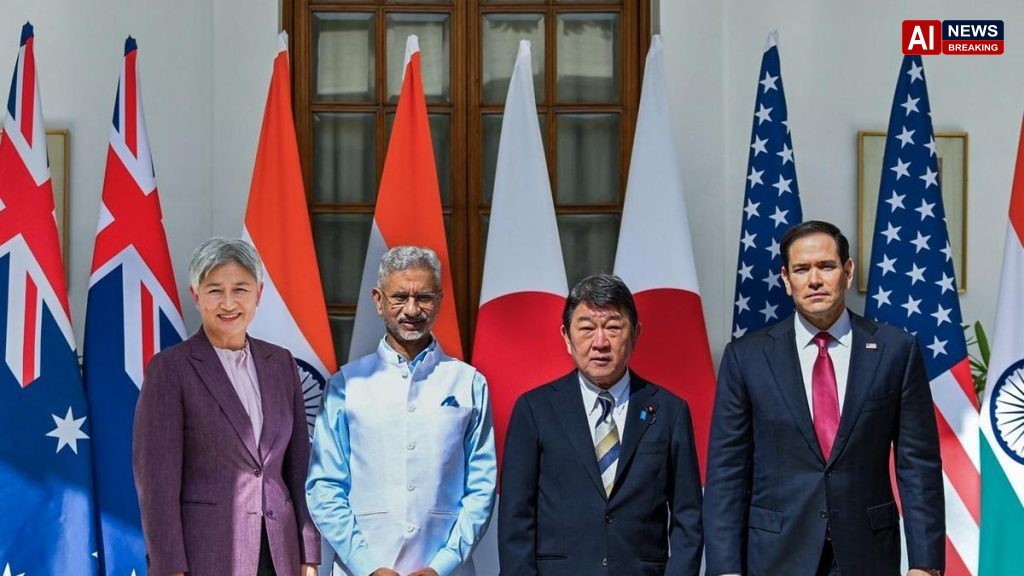
The challenge of holding the Quad together - AI News Breaking
The challenge of holding the Quad together The Quad – an informal security dialogue linking the United States, Japan, India and Australia – has emerged over the past decade as a cornerstone of Washington’s strategy to counterbalance China’s growing influence in the Indo‑Pacific. Its members share democratic values and a common interest in preserving freedom of navigation, yet the coalition remains fragile, hinging on the political will of its leaders. Recent developments, from renewed naval drills to high‑level diplomatic visits, have underscored both the potential of the partnership and the doubts that linger about its long‑term cohesion, especially as the United States heads toward a potentially turbulent electoral season..
At the heart of the uncertainty is the prospect of Donald Trump returning to the White House. Trump’s foreign‑policy record, marked by abrupt reversals and a willingness to engage directly with Beijing, diverges sharply from the Quad’s current trajectory of coordinated pressure on China. Analysts warn that a Trump administration could adopt a more transactional approach, prioritising short‑term trade gains over the deep strategic alignment the Quad has cultivated..
Such a shift would test the resolve of the other three members, each of which has invested heavily in building institutional ties that extend beyond mere security cooperation. Japan, under Prime Minister Fumio Kishida, has positioned the Quad as a vital component of its “Free and Open Indo‑Pacific” vision. Tokyo has been proactive, hosting joint exercises and championing supply‑chain resilience initiatives that reduce dependence on mainland China..
Yet Japan also faces domestic pressures: a pacifist constitution, an ageing electorate wary of entangling alliances, and a need to maintain stable economic links with Beijing. Balancing these internal considerations against a potential U.S. pivot towards a more conciliatory stance could force Tokyo to recalibrate its commitment to the Quad, a move that would reverberate throughout the alliance..
India’s stance is equally nuanced. Prime Minister Narendra Modi has leveraged the Quad to showcase India’s emergence as a regional power, emphasizing maritime security and infrastructure development. New Delhi, however, remains cautious of overtly antagonising China, its largest trading partner and a long‑standing border adversary..
The recent Quad summit in Washington saw India pledge to expand naval cooperation, but Modi’s government has also signalled openness to dialogue with Beijing on climate and trade. approach that oscillates between confrontation and negotiation could leave India scrambling to protect its own strategic autonomy while preserving economic stability. Australia, traditionally the most outspoken of the group on China‑related concerns, has doubled down on defence spending and intelligence sharing since the 2020‑21 “AUKUS” pact..
Prime Minister Anthony Albanese has framed the Quad as essential to safeguarding Australia’s sovereignty and regional order. Yet Canberra’s economy is heavily intertwined with Chinese tourism, education and commodities, creating a domestic tension between security imperatives and economic realities. Should Trump adopt a harsher trade posture, Australian businesses could face heightened tariffs, pressurising the government to temper its Quad commitments in favour of protecting national industries..
Beyond the four capitals, the broader Indo‑Pacific geography presents a complex tapestry of interests that could either cement or strain the Quad. Southeast Asian nations such as Vietnam, the Philippines and Malaysia are simultaneously courted by Washington and Beijing, seeking security guarantees while avoiding being drawn into a great‑power rivalry. The Quad’s outreach programmes, including maritime domain‑awareness training and infrastructure financing, aim to win hearts and minds, but they also risk provoking Chinese retaliation that could destabilise the region..
The balance between offering a credible alternative to Chinese investment and respecting the sovereignty of smaller states remains delicate. Economic dimensions are increasingly central to the Quad’s agenda. In recent months the group has launched a joint task force on critical minerals, aiming to secure supply chains for lithium, rare earths and other materials essential to green‑technology transitions..
This initiative reflects a broader strategy to diminish China’s dominance in high‑tech sectors. However, the success of such projects depends on coherent policy coordination and sustained funding from all four members. trade policy under a second Trump term could either accelerate these efforts through aggressive market incentives or undermine them by re‑introducing protectionist measures that alienate partners..
The diplomatic machinery supporting the Quad has also evolved. Regular ministerial meetings, a rotating “chair” system and the establishment of a permanent ariat in Washington signal a move towards institutionalisation. Yet the lack of a formal treaty and the reliance on consensus decision‑making make the group vulnerable to divergent national priorities..
Critics argue that without binding commitments, the Quad risks becoming a forum for rhetorical posturing rather than a decisive strategic bloc. The upcoming summit in Tokyo will test whether the members can translate lofty statements into actionable, joint policy steps. Public opinion across the Quad nations adds another layer of complexity..
Polls in the United States show a mixed view of China, with concerns about trade balanced against fears of military escalation. In Japan and Australia, a growing segment of the population expresses unease about being drawn into a potential conflict, while in India, the electorate remains largely focused on domestic economic issues. These domestic sentiments influence leaders’ willingness to endorse a hardline stance..
administration adopts a confrontational tone without clear domestic backing, it could exacerbate public scepticism and erode political capital for continued Quad engagement. China’s own response to the Quad continues to shape its trajectory. Beijing has launched a “Global Development Initiative” and deepened ties with the Belt and Road network, positioning itself as a reliable partner for infrastructure and investment..
The Quad’s cohesion is being tested as internal politics, economic ties to China and the prospect of a Trump‑era shift in U.S. policy threaten the delicate balance among the United States, Japan, India and Australia. Analysts warn that without strong, unified commitment, the partnership risks devolving into a loose forum rather than a decisive counterweight to Beijing’s influence.
A Trump revival could transform the Quad from a cohesive strategic bulwark into a transactional club, forcing each member to juggle domestic pressures against a wavering U.S. commitment.
If the alliance cannot convert rhetoric into concrete, coordinated policies, its credibility will erode, leaving the Indo‑Pacific vulnerable to a renewed China‑led economic and security swing.





