
 Pakistan’s leaders hail first astronaut aboard Chinese craft: ‘Proud one of us has gone into space’
 British tourist travels 29 hours from Mumbai to Amritsar for ₹5,461, rates Indian Railways 10/10 | Viral video
 The Supreme Court will decide whether assault weapons bans violate the Second Amendment
 A Critic of Beijing Falls Short in Taiwan’s Key Mayoral Election
 EPA says no rise in contamination after Army detonates lead azide stockpile in Iowa
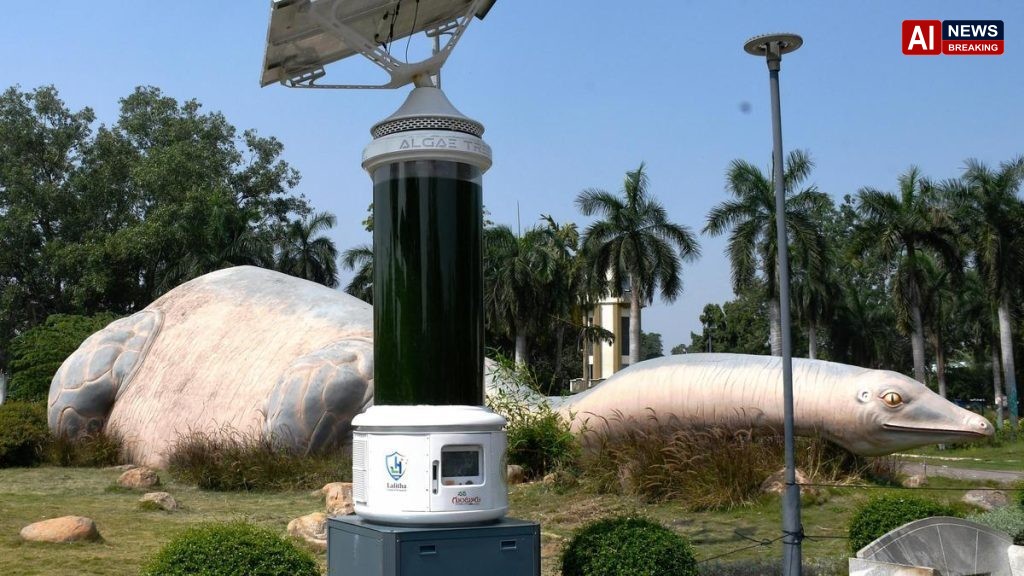
Algae-based artificial tree to help check air pollution in Guntur
**
Algae-based artificial tree to help check air pollution in Guntur - AI News Breaking
algaebased artificial tree help:
A novel “Algae Tree” has been installed in Guntur, Andhra Pradesh, marking what officials describe as the state’s first large‑scale experiment in using micro‑algae to mitigate urban air pollution. The structure, resembling a conventional street tree but fitted with transparent panels and a network of glass tubes, draws in ambient air, channels it through a bioreactor where specially cultivated algae absorb carbon dioxide and other pollutants, and then releases purified oxygen back into the environment. The project, launched jointly by the Andhra Pradesh Pollution Control Board, the Department of Biotechnology and a consortium of local universities, is intended to complement existing measures such as vehicle emission controls and the planting of conventional green belts.The technology behind the Algae Tree is not entirely new, but its deployment in a densely populated Indian city is unprecedented..
Micro‑algae, which are photosynthetic microorganisms capable of rapid growth, have long been studied for carbon capture and bio‑fuel production. In this application, the algae are housed in closed‑loop photobioreactors that receive a constant supply of light, either natural sunlight or supplemental LED illumination, to sustain photosynthesis. As air passes through the reactors, the algae consume carbon dioxide and, in the process, convert nitrogen oxides and sulfur compounds into less harmful substances..
The purified air is then expelled through the canopy, creating a localized “clean‑air bubble” around the installation.The Guntur installation consists of three units, each standing about eight metres tall and occupying a footprint of roughly four square metres. Sensors embedded in the structure continuously monitor concentrations of carbon dioxide, particulate matter, nitrogen oxides and ozone, transmitting data to a central monitoring hub managed by the state pollution board. According to preliminary figures released by the board, the three units together have removed an estimated 1.2 kg of CO₂ and 0.8 kg of nitrogen oxides from the surrounding atmosphere in the first week of operation..
While these quantities are modest compared to city‑wide emissions, officials argue that the project is intended as a proof of concept that can be scaled up if the results prove consistent.Supporters of the initiative point to the broader environmental benefits of algae cultivation. The harvested algae biomass, which accumulates at a rate of about 10 kg per unit per week, can be processed into bio‑fertiliser or animal feed, providing a circular‑economy model that reduces waste. Moreover, the system operates with relatively low energy input; the only external power required is for the pumps that circulate air and for the lighting that supplements sunlight during overcast periods..
The energy is supplied by solar panels installed on the roof of the adjacent municipal building, further reducing the carbon footprint of the project.Critics, however, caution that the impact of a handful of installations may be limited in the face of Guntur’s growing vehicular traffic and industrial emissions. Ravi Kumar, a senior researcher at the Indian Institute of Technology Hyderabad, notes that while algae can efficiently capture CO₂ under controlled conditions, the variability of urban air quality, temperature fluctuations, and dust accumulation on the panels can impair performance. “The technology is promising, but it must be rigorously tested under real‑world conditions before we can claim significant pollution mitigation,” he said in an interview.The project also about maintenance and long-term sustainability..
Algae cultures are sensitive to changes in pH, temperature and nutrient levels, requiring regular monitoring and occasional replenishment of growth media. To address these challenges, the consortium has established a dedicated operations team that conducts weekly inspections, calibrates sensors and harvests the algae for downstream processing. Funding for these activities comes from a combination of state grants, corporate sponsorships and a modest fee levied on nearby commercial establishments that benefit from the cleaner air.Public reaction in Guntur has been generally positive..
Residents living within a 200‑metre radius of the Algae Tree report noticing a faintly fresher scent in the early mornings and an apparent reduction in visible smog on days when the devices are active. Local schools have organized field trips to the site, using the installation as a practical teaching tool for students studying environmental science and renewable energy. The municipal council plans to install informational placards that explain the science behind the system, hoping to raise awareness about the role of innovative technologies in combating climate change.If the pilot proves successful, the state government has outlined a roadmap for expanding the network of Algae Trees to other pollution hotspots, including the industrial corridors of Vijayawada and Visakhapatnam..
The plan envisions the deployment of up to fifty units over the next three years, each integrated with a data analytics platform that aggregates air‑quality metrics across the network. Such a system could inform city planners and policymakers in real time, enabling more targeted interventions such as temporary traffic restrictions or the strategic placement of additional green infrastructure.International observers are watching the Guntur experiment closely, as many rapidly urbanising regions grapple with the twin challenges of rising emissions and limited space for conventional green belts. A recent report by the United Nations Environment Programme highlighted micro‑algae bioreactors as a “promising low‑tech solution” for cities with high population density, provided that local conditions support reliable operation..
The Algae Tree project therefore not only contributes to Andhra Pradesh’s climate action goals but also adds to a growing body of evidence that biological carbon capture can be adapted to urban contexts.While the ultimate effectiveness of the Algae Tree in reducing Guntur’s overall air‑pollution burden remains to be quantified, the initiative signals a willingness among Indian policymakers to experiment with hybrid solutions that combine biotechnology, renewable energy and data‑driven management. As the world searches for scalable ways to meet the Paris Agreement targets, small‑scale innovations such as this may pave the way for larger, more integrated systems that blend nature’s own mechanisms with modern engineering..
Updated: November 14, 2026
Insight: If algae‑powered “trees” can reliably scrub pollutants while producing marketable biomass, they could become the urban equivalent of a dual‑purpose utility—clean air and a renewable feedstock—reshaping how cities monetize sustainability. Their true breakthrough will hinge on scaling the bioreactor’s resilience to real‑world






