Pakistan’s leaders hail first astronaut aboard Chinese craft: ‘Proud one of us has gone into space’
 British tourist travels 29 hours from Mumbai to Amritsar for ₹5,461, rates Indian Railways 10/10 | Viral video
 The Supreme Court will decide whether assault weapons bans violate the Second Amendment
 A Critic of Beijing Falls Short in Taiwan’s Key Mayoral Election
 EPA says no rise in contamination after Army detonates lead azide stockpile in Iowa
Thousands of flights canceled as airlines work to dig out from nationwide ground stop
A nationwide FAA ground stop triggered by severe weather and radar failures halted departures from the 30 busiest U.S. airports, canceling thousands of flights and affecting more than 1.2 million travelers. Airlines and airports are scrambling to re‑sequence aircraft, crew and maintenance schedules while passengers face long waits and uncertainty. The disruption, the worst in 25 years, carries an estimated immediate cost of over $500 million.
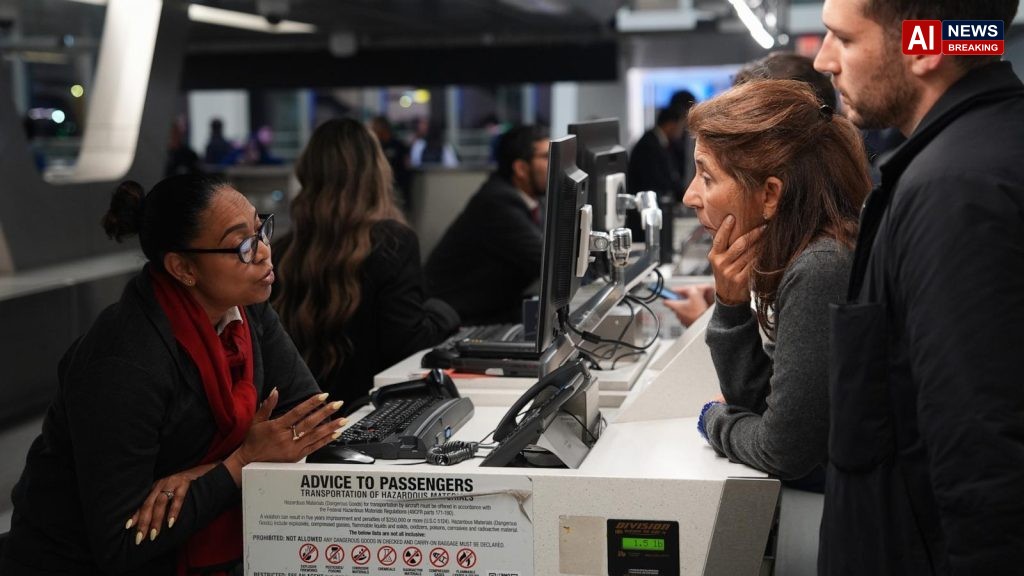
Thousands of flights canceled as airlines work to dig out from nationwide ground stop - AI News Breaking
thousands flights canceled airlines:
Airlines across the United States are grappling with the fallout from a nationwide ground stop that has forced the cancellation of thousands of flights, marking the longest such interruption in 25 years. The halt, imposed by the Federal Aviation Administration (FAA) after a series of severe weather events and technical failures, has left passengers stranded, airports congested and the aviation industry scrambling to restore normal operations. While the FAA has begun to lift restrictions in stages, the logistical challenge of re‑sequencing aircraft, crew and maintenance schedules remains daunting for carriers and airport operators alike.The ground stop, which began early on Tuesday, was triggered by a cascade of disruptions that began with a massive thunderstorm complex sweeping across the Midwest, followed by a sudden loss of radar capability at a key FAA en‑route center..
The combination of reduced visibility, heavy precipitation and the temporary unavailability of critical air‑traffic control infrastructure prompted the agency to issue an unprecedented order to halt all departures from the 30 busiest airports in the country. By the time the order was lifted late Thursday, more than 8,500 flights had been delayed or cancelled, affecting an estimated 1.2 million passengers.Airlines have responded with a mix of emergency measures designed to mitigate the impact on travelers and to protect the safety of their crews. Major carriers such as Delta Air Lines, American Airlines and United Airlines have mobilised additional staff to re‑book passengers, issued refunds and vouchers, and opened special assistance desks at affected airports..
Smaller regional operators have also been forced to ground portions of their fleets, citing crew‑duty limits that were exceeded as pilots and cabin crew were kept on standby for extended periods. The ripple effect of these constraints is expected to linger for several days, as airlines work to re‑balance aircraft rotations and comply with federal labor regulations.The FAA’s decision to implement the ground stop was supported by senior officials who cited the need to preserve safe separation between aircraft while the technical fault was diagnosed and repaired. “Our primary responsibility is to ensure the safety of the national airspace system,” said FAA Administrator Mike Whitaker in a press briefing on Wednesday..
“We are working around the clock with our partners to restore full functionality and to minimize the impact on the traveling public.” He added that the agency expects to complete the necessary system checks within 48 hours, after which a gradual resumption of normal departure rates will be permitted.Airports have reported a surge in passenger volume as stranded travellers seek alternative routes or wait for re‑booked flights. Chicago O’Hare International Airport, one of the hubs most heavily affected by the ground stop, saw its terminal concourses fill beyond capacity, prompting the deployment of additional security personnel and the opening of temporary waiting areas. Similar scenes unfolded at Dallas/Fort Worth, Denver International and the New York metropolitan airports, where long lines formed at information desks and baggage claim areas..
Airport operators have urged passengers to stay informed through airline apps and official airport websites, noting that the situation remains fluid and that further delays could occur as aircraft are repositioned.The economic repercussions of the disruption are already being felt across the aviation supply chain. Ground handling companies, catering services and fuel providers have reported a sharp decline in activity, while airlines face mounting costs associated with crew overtime, aircraft repositioning and passenger compensation. Industry analysts estimate that the immediate financial impact could exceed $500 million, with longer‑term effects on airline profitability depending on how quickly normal schedules are restored..
“This is a stress test for the resilience of our network,” said Laura Chen, an aviation economist at the International Air Transport Association. “The speed and coordination of the recovery will determine whether the industry can absorb the shock without lasting damage.”Consumer advocacy groups have called for greater transparency from airlines and the FAA regarding the criteria used to initiate and lift the ground stop. The Airlines for America trade association, representing major U.S..
carriers, defended the actions taken, emphasizing that safety considerations outweighed any inconvenience. “The FAA acted in accordance with established protocols, and airlines complied fully,” the association’s spokesperson said. Nonetheless, passengers have expressed frustration over inconsistent communication and the difficulty of securing alternative travel arrangements, especially for those with tight connections or time‑sensitive commitments.In response to the crisis, the Department of Transportation announced a temporary waiver of certain consumer‑protection rules, allowing airlines more flexibility in re‑booking passengers on other carriers without incurring additional fees..
The waiver also permits airlines to waive change penalties for affected tickets, a move intended to alleviate pressure on travelers seeking to rearrange their itineraries. Critics argue that such measures may set a precedent for future disruptions, while supporters contend that they are a pragmatic solution to an extraordinary situation.Looking ahead, the FAA has outlined a series of corrective actions aimed at preventing a recurrence of the technical failure that contributed to the ground stop. These include upgrades to radar and communication systems, enhanced redundancy protocols, and increased staffing at critical control centers..
The agency also plans to conduct a comprehensive after‑action review involving airline partners, airport authorities and the National Transportation Safety Board. Findings from that review are expected to be released later in the month, providing insight into the root causes of the outage and recommendations for systemic improvements.As the nation’s air travel network slowly regains momentum, passengers are advised to remain flexible, monitor airline communications closely and consider alternative modes of transport where feasible. While the immediate crisis appears to be abating, the lingering effects on flight schedules, crew availability and airport operations suggest that full recovery may take several more days..
For now, the emphasis remains on restoring safety, reliability and confidence in a system that, despite today’s setbacks, continues to move millions of people each day..
A massive FAA‑ordered ground stop, triggered by severe weather and radar failures, halted departures at the nation’s 30 busiest airports, cancelling over 8,500 flights and stranding 1.2 million passengers. Airlines and airports are now scrambling to re‑sequence crews, aircraft and services while the FAA works to restore systems and prevent a repeat of the disruption.
The massive ground stop exposes how tightly airline economics are intertwined with fragile air‑traffic infrastructure, warning that any future technical glitch could quickly translate into multi‑hundred‑million‑dollar losses and a credibility crisis for both carriers and regulators.
If the FAA’s promised system upgrades fail to deliver true redundancy, the industry may face mounting pressure for legislative oversight that could reshape safety protocols and consumer‑rights protections for years to come.