
 Pakistan’s leaders hail first astronaut aboard Chinese craft: ‘Proud one of us has gone into space’
 British tourist travels 29 hours from Mumbai to Amritsar for ₹5,461, rates Indian Railways 10/10 | Viral video
 The Supreme Court will decide whether assault weapons bans violate the Second Amendment
 A Critic of Beijing Falls Short in Taiwan’s Key Mayoral Election
 EPA says no rise in contamination after Army detonates lead azide stockpile in Iowa
In Jharkhand, even jails are not safe: Babulal Marandi
**
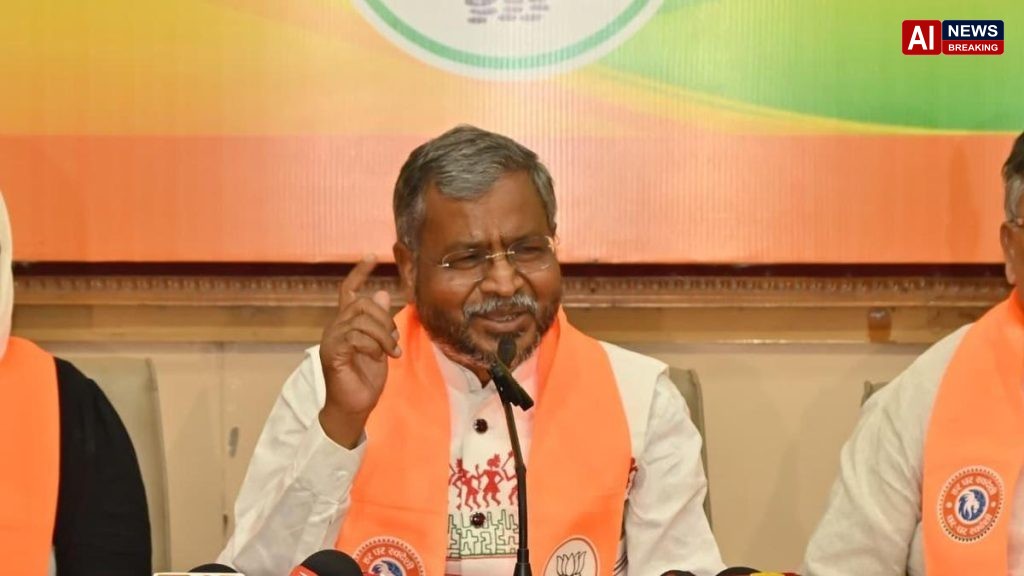
In Jharkhand, even jails are not safe: Babulal Marandi - AI News Breaking
jharkhand even jails safe:
The chief minister of Jharkhand, Hemant Soren, found himself under intense scrutiny on Tuesday after Babulal Marandi, the state’s former chief minister and current president of the Jharkhand BJP, warned that even the state’s prisons were no longer safe. Speaking at a rally in Ranchi, Marandi said the law‑and‑order situation in Jharkhand had “collapsed,” adding that the deteriorating security environment raised “serious questions about the functioning of the government.” His remarks, delivered in a tone that blended alarm with political criticism, quickly became the focus of a heated debate across the state’s political spectrum and in national media.Marandi’s comments came on the back of a series of incidents that have shaken public confidence in Jharkhand’s criminal‑justice system. In the past month, three high‑profile inmates – two convicted murderers and a notorious gang leader – have been killed in separate prisons, allegedly by rival factions..
In the central jail at Ranchi, a scuffle between inmates escalated into a full‑blown riot that left four prisoners dead and several others injured. In a separate facility in Dhanbad, a gang member was found dead in his cell, with officials initially attributing the death to a “natural cause” before an autopsy revealed signs of strangulation.These episodes have forced the state’s law‑enforcement agencies to confront a grim reality: the infrastructure and staffing levels in Jharkhand’s prisons are ill‑equipped to handle the growing number of inmates and the complex gang dynamics that have taken root. According to a recent report by the National Crime Records Bureau, the state’s prison occupancy rate stands at 158 per cent of its sanctioned capacity, a figure that eclipses the national average of 125 per cent..
Overcrowding, coupled with inadequate surveillance and a shortage of trained prison guards, has created an environment where violence can erupt with alarming regularity.The chief minister’s office responded swiftly, issuing a statement that rejected Marandi’s characterization of a “collapse.” “The administration remains committed to maintaining law and order,” the statement read, adding that “the government has already taken decisive steps to strengthen prison security, including the deployment of additional personnel, the installation of CCTV cameras in high‑risk zones, and the initiation of a comprehensive audit of all correctional facilities.” The statement also highlighted a recent order to transfer several senior prison officials suspected of negligence, asserting that those responsible would be held accountable.Opposition leaders, however, seized on Marandi’s remarks as evidence of systemic failure. The Jharkhand Congress, which holds a significant presence in the state assembly, demanded an immediate parliamentary inquiry into the prison incidents. “When the very places meant to contain criminality become breeding grounds for murder, it is a clear sign that the government’s promises of safety are hollow,” said Congress MLA Anil Kumar Singh at a press conference in Jamshedpur..
The party also called for a statewide review of the prison recruitment process, arguing that many guards are hired on temporary contracts without proper background checks.Legal experts have weighed in, cautioning that the current crisis could have broader implications for the rule of law in Jharkhand. Professor Ramesh Prasad of Ranchi University’s Department of Criminology warned that “systemic lapses in prison management not only jeopardise the lives of inmates but also erode public trust in the entire criminal‑justice apparatus.” He noted that the United Nations Standard Minimum Rules for the Treatment of Prisoners, known as the Mandela Rules, prescribe strict standards for inmate safety, and failure to adhere to them could invite scrutiny from national human‑rights bodies.Civil‑society organizations have also entered the fray, demanding transparency and reform. The Jharkhand Human Rights Commission, in a recent press release, urged the state government to publish a detailed report on the circumstances surrounding each of the recent inmate deaths..
“Families of the deceased have a right to know the truth, and the public deserves assurance that corrective measures are being implemented promptly,” the commission’s chairperson, Dr. Several NGOs have called for an independent investigative panel, comprising former judges, prison administrators, and forensic experts, to examine the lapses and recommend actionable reforms.In the background, the central government has signalled its willingness to assist. The Ministry of Home Affairs, through its spokesperson, confirmed that the Union Home ary would visit Ranchi next week to assess the situation and coordinate with state officials..
“Ensuring the safety and dignity of inmates is a shared responsibility,” the spokesperson said, adding that the central government could provide technical assistance, including training modules for prison staff and the deployment of rapid‑response teams for emergency situations.Political analysts suggest that Marandi’s sharp attack may also be a calculated move ahead of the upcoming state assembly elections, scheduled for early 2027. “By foregrounding law and order, Marandi is tapping into a potent electoral issue that resonates with voters across rural and urban constituencies,” observed Sunil Verma, a senior fellow at the Indian Institute of Public Affairs. Verma noted that the BJP, despite being in opposition at the state level, has been positioning itself as a “law‑and‑order” alternative, leveraging incidents like the prison killings to portray the incumbent government as inept..
Whether this strategy will translate into electoral gains remains to be seen, but it undeniably intensifies the political pressure on the Soren administration.As the debate unfolds, the immediate priority for Jharkhand’s authorities is to prevent further loss of life within its correctional facilities. The next few weeks will be crucial in determining whether the promises of increased staffing, upgraded surveillance and rigorous audits will materialise into tangible outcomes, or whether the state will continue to grapple with a prison system that appears, as Marandi put it, “no longer a place of safety.” The coming investigations, both internal and possibly judicial, are expected to shed light on the depth of the problem, while also offering a roadmap for reforms that could restore public confidence and align Jharkhand’s penal institutions with national and international standards..
Updated: November 14, 2026
Jharkhand’s prison fiasco exposes a governance blind spot that threatens to erode citizen confidence in the rule of law, turning correctional facilities into political fault lines. If the Soren administration fails to convert rhetoric into concrete, transparent reforms, the BJP’s law‑and‑order narrative could become the decisive swing in the 2027 election.






