Pakistan’s leaders hail first astronaut aboard Chinese craft: ‘Proud one of us has gone into space’
 British tourist travels 29 hours from Mumbai to Amritsar for ₹5,461, rates Indian Railways 10/10 | Viral video
 The Supreme Court will decide whether assault weapons bans violate the Second Amendment
 A Critic of Beijing Falls Short in Taiwan’s Key Mayoral Election
 EPA says no rise in contamination after Army detonates lead azide stockpile in Iowa
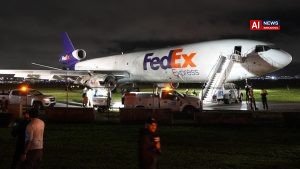
FAA orders nationwide ground stop of flights
**
Could everything be broken? Grounded jets, Microsoft outage, AI chaos make some wonder - AI News Breaking
The United States woke on Friday to a rare, nationwide halt to commercial air travel, as the Federal Aviation Administration (FAA) ordered a ground stop that left airports from New York to Los Angeles eerily quiet. The decision, announced just before 9 a.m. Eastern time, was prompted by an unexpected technical glitch in the national air traffic control system, a problem that officials said could not be resolved quickly enough to ensure safe operations..
As a result, more than 4,000 flights were cancelled or delayed, stranding millions of passengers and disrupting supply chains that rely on time‑sensitive cargo. While the FAA worked to restore service, the incident has sparked a broader conversation about the fragility of the digital infrastructure that underpins modern life.The FAA’s statement described the issue as a “system‑wide anomaly” affecting the Automated Flight Service Station (AFSS) network, which coordinates flight plans and relays critical data between pilots and controllers. Engineers identified a corrupted data packet that propagated through the system, causing inconsistencies in aircraft positioning information..
Although the glitch did not pose an immediate safety risk, the FAA deemed the uncertainty too great to allow departures to continue. Within hours, the agency began a phased restart, prioritising high‑traffic routes and essential services, but full normalcy was not expected until late Thursday night. The incident marks the first complete national ground stop in the United States since the 9/11 attacks, underscoring the rarity and seriousness of the event.The timing of the FAA’s emergency has been noted by analysts as coincidental with a series of high‑profile technology disruptions that have rattled confidence in the resilience of critical systems..
Just days earlier, Microsoft experienced a worldwide outage of its Office 365 suite, affecting Outlook, Teams, and SharePoint for an estimated 200 million users. The outage, traced to a misconfiguration in the company’s data‑center network, lasted for over 12 hours and forced businesses, schools, and governments to revert to legacy communication tools. Meanwhile, the artificial‑intelligence sector has been rocked by a cascade of controversies, ranging from the arrest of a prominent AI entrepreneur on suspicion of espionage to the rapid spread of disinformation generated by large language models..
Together, these events have amplified concerns that the interconnected nature of modern technology may amplify the impact of a single point of failure.The AI billionaire at the centre of the espionage allegations is a co‑founder of a fast‑growing startup that specialises in generative AI for content creation. According to court documents unsealed in late April, prosecutors allege that the entrepreneur engaged in a romantic relationship with an individual identified as a foreign intelligence operative, and that the relationship may have facilitated the transfer of proprietary AI research to a rival state‑backed lab. While the legal case remains in its early stages, the allegations have sent shockwaves through Silicon Valley, prompting boardrooms to re‑examine internal security protocols and leading investors to scrutinise the governance structures of AI‑focused ventures more closely..
The episode has also fed into a broader narrative that the rapid commercialisation of powerful AI tools could outpace the regulatory frameworks designed to safeguard national security.In the wake of the Microsoft outage, corporate leaders have voiced renewed calls for redundancy and diversification in their digital ecosystems. “We cannot afford to have a single vendor dictate the continuity of our operations,” said a senior executive at a multinational finance firm who asked to remain anonymous. The firm, which relies heavily on Microsoft’s cloud services for transaction processing and client communications, had to activate a manual backup system that, while functional, slowed transaction times by up to 40 percent..
Similar challenges were reported by hospitals, universities and small‑to‑medium enterprises, many of which found that contingency plans were either outdated or insufficiently tested. Industry analysts warn that the frequency of high‑impact outages may increase as demand for cloud‑based services grows, and they urge a shift towards multi‑cloud strategies and more robust incident‑response rehearsals.The convergence of these three high‑visibility incidents—air traffic control disruption, a major cloud‑service failure, and a scandal involving AI research—has reignited a debate that stretches back to the early days of the internet: how to balance the benefits of technological integration with the risks of systemic vulnerability. Policy makers in Washington have begun to draft legislation aimed at enhancing the resilience of critical infrastructure, including provisions for mandatory redundancy, regular stress testing, and clearer reporting requirements for private‑sector operators..
In a hearing last week, a Senate committee chair highlighted the need for “a national strategy that treats digital infrastructure with the same seriousness as our power grid or water supply.” Critics, however, caution that overly prescriptive regulations could stifle innovation and place undue burdens on smaller firms that lack the resources to meet stringent standards.Airlines, meanwhile, are confronting the financial fallout of the ground stop, which industry estimates put at roughly $1.2 billion in lost revenue, compensation, and operational costs. Major carriers such as Delta Air Lines, United Airlines and American Airlines have issued apologies to passengers and pledged to expedite refunds, but the process is expected to take weeks due to the volume of claims. Consumer advocacy groups have urged the Department of Transportation to enforce stricter penalties for airlines that fail to provide timely reimbursements, arguing that the current framework leaves travellers with little recourse..
The FAA, for its part, faces scrutiny over the robustness of its own backup systems. While the agency maintains that its safety record remains exemplary, the incident has prompted a review of legacy software dependencies that date back to the 1970s.Beyond the immediate economic impact, the grounding of flights has revealed secondary effects on sectors that rely on just‑in‑time logistics. Perishable goods, such as fresh produce and pharmaceuticals, have faced delays that could translate into waste and supply shortages..
Some manufacturers reported that components needed for assembly lines were stuck at distribution hubs, potentially pushing back product launches. The ripple effect on the broader economy, although difficult to quantify, underscores the interconnectedness of transportation, digital services and manufacturing in a globalised market. Economists note that while the event was brief, the perception of vulnerability can influence business confidence and investment decisions in the longer term.Public reaction to the cascade of disruptions has been mixed, with some expressing heightened anxiety about the reliability of technology, while others view the incidents as isolated glitches that are inevitable in complex systems..
A poll conducted by a leading research institute in early May showed that 58 percent of respondents now consider the risk of a major digital outage “high,” up from 42 percent a year earlier. The same survey indicated that 37 percent of respondents would be willing to pay more for services that guarantee greater redundancy, suggesting a potential market shift towards premium, resilience‑focused offerings..
Updated: November 15, 2026
The grounding exposed a fragile tech backbone that can collapse overnight, turning everyday travel and supply chains into a ticking time bomb. If lawmakers keep tightening red tape, innovators may flee to smaller, less‑regulated markets—leaving the very resilience they seek to protect at risk.