
 Pakistan’s leaders hail first astronaut aboard Chinese craft: ‘Proud one of us has gone into space’
 British tourist travels 29 hours from Mumbai to Amritsar for ₹5,461, rates Indian Railways 10/10 | Viral video
 The Supreme Court will decide whether assault weapons bans violate the Second Amendment
 A Critic of Beijing Falls Short in Taiwan’s Key Mayoral Election
 EPA says no rise in contamination after Army detonates lead azide stockpile in Iowa
Tripura Government prioritising socio-economic development of tribals: CM Manik Saha
** Speaking at the Janjatiya Gaurav Diwas in Chawmanu, Tripura CM Manik Saha highlighted a 15 % budget hike for tribal welfare, new bilingual schools, tele‑medicine hubs, road and solar projects, and a tribal agro‑innovation centre, aiming to lift the state’s 31 % tribal population through education, health, infrastructure and cultural preservation.
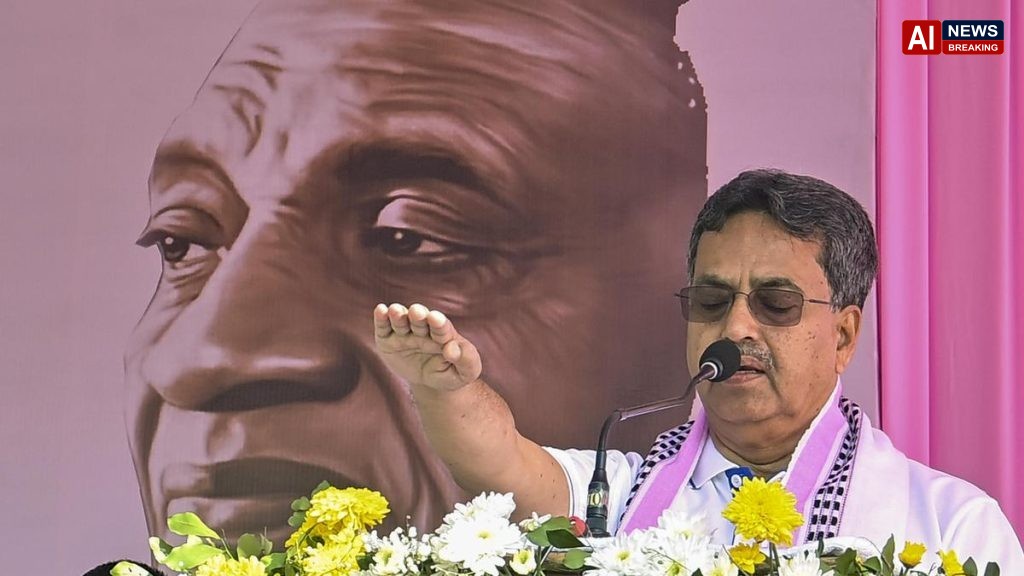
Tripura Government prioritising socio-economic development of tribals: CM Manik Saha - AI News Breaking
tripura government prioritising socioeconomic:
The Chief Minister of Tripura, Manik Saha, used the occasion of the Janjatiya Gaurav Diwas programme in Chawmanu, Dhalai district, to underscore his administration’s focus on the socio‑economic upliftment of the state’s tribal population. Speaking to a gathering that included tribal elders, community leaders and government officials, Saha traced the historical contributions of tribal icons such as Bir Sa Munda to India’s freedom struggle, positioning those legacies as a foundation for contemporary development initiatives. He asserted that the state’s policy framework now seeks to translate that legacy into tangible improvements in education, health, infrastructure and livelihood opportunities for tribal communities.In his address, Saha highlighted the demographic significance of tribes in Tripura, noting that they constitute roughly 31 per cent of the state’s total population..
He argued that this sizeable share warrants a proportionate allocation of resources, and announced that the forthcoming fiscal year would see a 15 per cent increase in the budgetary allocation for tribal welfare schemes. The additional funds, he explained, are earmarked for expanding the network of primary schools in remote villages, upgrading sub‑centres to full‑fledged health facilities, and strengthening the existing tribal development corporations that manage community‑run enterprises.The Chief Minister outlined a series of sector‑specific interventions designed to address persistent gaps in human development indicators. In education, the government plans to introduce bilingual curricula that integrate tribal languages alongside the state’s official language, a move intended to improve enrolment and reduce dropout rates among tribal children..
Scholarships for higher education will be expanded, with a particular emphasis on science, technology, engineering and mathematics (STEM) fields, to create a pipeline of skilled professionals from tribal backgrounds. Saha also announced the launch of a mobile learning unit that will travel to hard‑to‑reach hamlets, delivering digital content and vocational training to youths who lack access to regular schooling.Health was another focal point of the speech. Saha cited recent data from the state health department showing that infant mortality among tribal families remains higher than the state average, and that malnutrition continues to afflict a significant proportion of children under five..
To combat these trends, the administration will deploy additional health workers to tribal districts, increase the supply of essential medicines, and implement a nutrition supplementation programme that will provide fortified food packets to pregnant women and lactating mothers. A new tele‑medicine hub, to be installed in the district headquarters of Dhalai, will connect local health practitioners with specialist doctors in Agartala, thereby reducing the need for long‑distance travel for advanced medical care.Infrastructure development was presented as a catalyst for broader economic growth. Saha announced the completion of a 45‑kilometre road linking Chawmanu to the district’s main market centre, a project that is expected to cut travel time for traders and farmers by half..
He also disclosed plans to extend electricity coverage to an additional 1,200 households in remote tribal settlements, leveraging solar micro‑grids where grid connection is impractical. The government’s focus on connectivity, he said, is intended to open up new avenues for small‑scale entrepreneurship, particularly in the areas of agro‑processing and handicrafts, which have traditionally been the mainstay of tribal economies.Agriculture, a sector that employs a majority of tribal families, was addressed with a suite of measures aimed at modernising practices while preserving traditional knowledge. The state will provide subsidised seeds of high‑yielding varieties, alongside training in sustainable farming techniques such as integrated pest management and organic fertiliser use..
A credit guarantee scheme will be introduced to facilitate easier access to bank loans for tribal farmers, reducing the reliance on informal money lenders. In addition, the government intends to establish a “Tribal Agro‑Innovation Centre” in Dhalai, which will serve as a hub for research, demonstration plots and market linkage support for indigenous crops that command premium prices in national and international markets.Cultural preservation, according to Saha, is integral to the broader development agenda. He reiterated the state’s commitment to protect and promote tribal heritage through the establishment of cultural museums, documentation of oral histories, and support for traditional art forms such as folk music and dance..
Funding will be allocated to organise annual festivals that showcase tribal craftsmanship, providing both a platform for cultural expression and an opportunity for artisans to connect with buyers. Saha emphasized that economic empowerment cannot be divorced from cultural dignity, and that the state’s policies aim to create a synergy between the two.The speech also touched upon the legal and institutional framework governing tribal rights. Saha reaffirmed Tripura’s adherence to the provisions of the Constitution that safeguard tribal land ownership and forest rights, and pledged to expedite pending cases before the Tribal Advisory Council..
He announced the creation of a dedicated grievance redressal cell that will receive complaints related to land disputes, resource allocation and implementation delays, promising a response within thirty days. This move, he argued, is intended to enhance transparency and accountability in the delivery of government schemes.In concluding remarks, Saha called upon tribal youth to actively participate in the state’s development narrative, urging them to pursue education, acquire new skills and engage in community‑led initiatives. He appealed to the broader citizenry, stating that the success of tribal development hinges on collective effort and inclusive governance..
The Chief Minister’s message was received with applause, and several tribal representatives expressed optimism that the announced measures would translate into measurable improvements in their daily lives.The Janjatiya Gaurav Diwas event, while commemorating the historical contributions of tribal heroes like Bir Sa Munda, therefore served as a platform for the Tripura government to articulate a comprehensive development roadmap. By linking cultural pride with concrete policy actions across education, health, infrastructure, agriculture and legal safeguards, the administration aims to address long‑standing disparities. Observers note that the real test will lie in the implementation phase, where coordination among multiple departments, timely disbursement of funds and effective monitoring will determine whether the ambitious targets set out by Chief Minister Manik Saha can be realised for the benefit of Tripura’s tribal communities..
Updated: November 15, 2026
Summary: Tripura Chief Minister Manik Saha pledged a 15 % boost in tribal‑welfare funding, unveiling plans for bilingual schools, expanded health services, new roads, solar power and agricultural support aimed at uplifting the state’s 31 % tribal population. He tied these initiatives to cultural preservation and promised faster grievance redressal to ensure the promised development translates into tangible benefits.
Tripura’s amplified tribal budget signals a political calculus that the state’s stability now hinges on converting cultural homage into measurable human‑development gains, lest tokenism erode electoral trust among its 31 % indigenous electorate.
If the promised bilingual schooling, tele‑medicine hubs and micro‑grid networks materialise, they could reposition tribal communities from marginalised peripheries to catalytic agents of a diversified regional economy—yet any lag in execution will reinforce the historic pattern of well‑intention






