Pakistan’s leaders hail first astronaut aboard Chinese craft: ‘Proud one of us has gone into space’
 British tourist travels 29 hours from Mumbai to Amritsar for ₹5,461, rates Indian Railways 10/10 | Viral video
 The Supreme Court will decide whether assault weapons bans violate the Second Amendment
 A Critic of Beijing Falls Short in Taiwan’s Key Mayoral Election
 EPA says no rise in contamination after Army detonates lead azide stockpile in Iowa
Trump Praises PM Modi as ‘Tough Man’ and ‘Great Leader’ at Manila Quad Summit 2026 India Pushes for Stronger Indo-Pacific Cooperation
US President Donald Trump praised Prime Minister Narendra Modi at the Manila Quad Summit 2026, calling him a tough man, great leader and friend. Modi highlighted the Quad’s role in strengthening Indo-Pacific security, maritime cooperation, technology and resilient supply chains.
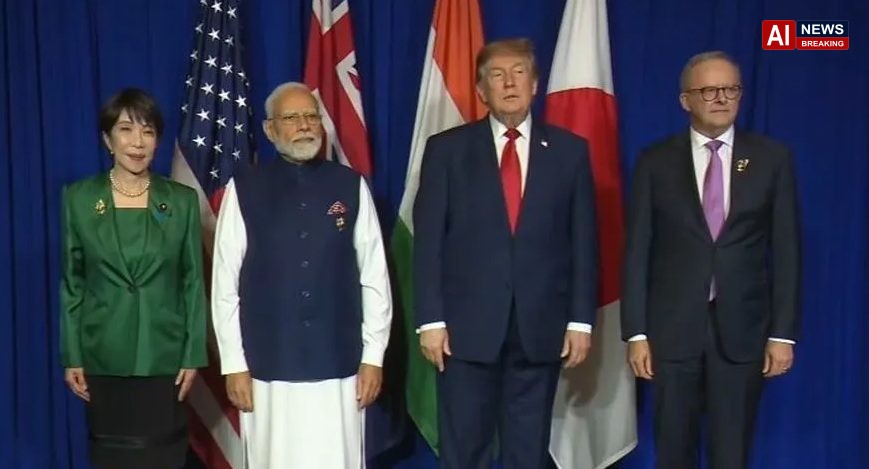
trump praises modi tough:
Summary: US President Donald Trump praised Indian Prime Minister Narendra Modi during the Quad leaders’ meeting in Manila, Philippines, describing him as a “tough man”, a “great leader” and his friend. The meeting brought together the leaders of India, the United States, Japan and Australia to discuss regional security, maritime cooperation, technology, resilient supply chains and the future of the Indo-Pacific. Modi described the Quad as a trusted partnership and called for practical cooperation to address emerging regional and global challenges.
Key Highlights
- Donald Trump praised PM Narendra Modi during the Manila Quad Summit 2026.
- Trump described Modi as a tough man, a great leader and his friend.
- PM Modi highlighted the importance of the Quad as a trusted international partnership.
- Leaders from India, the US, Japan and Australia discussed Indo-Pacific security and economic cooperation.
- Maritime security, artificial intelligence, critical technologies and supply-chain resilience remained important priorities.
- The summit comes amid continuing geopolitical competition and changing economic relationships in the Indo-Pacific.
Trump Praises Narendra Modi at Manila Quad Summit 2026
MANILA, November 17, 2026: US President Donald Trump praised Prime Minister Narendra Modi during the Quad leaders’ meeting in Manila, Philippines, describing the Indian Prime Minister as a “tough man” and a “great leader”. Trump’s remarks attracted considerable attention during the diplomatic gathering, highlighting the personal relationship between the two leaders as India, the United States, Japan and Australia discussed their shared priorities in the Indo-Pacific region.
Trump also referred to Modi as his friend, adding a personal dimension to an important international meeting focused on regional stability, economic security and strategic cooperation. His comments came at a significant moment for India-US relations, which have expanded across defence, technology, trade and diplomatic engagement over recent years.
The Manila meeting brought together four major Indo-Pacific countries at a time when regional governments are increasingly concerned about maritime security, geopolitical competition, economic uncertainty and technological dependence. The leaders discussed ways to strengthen cooperation and ensure that the Quad remains relevant to the changing strategic environment.
For India, the summit represents an opportunity to strengthen its international partnerships while maintaining its independent foreign policy. Modi’s participation also reflects India’s growing engagement with Southeast Asian countries and its wider ambitions in the Indo-Pacific.
PM Modi Calls Quad a Trusted Partnership
Prime Minister Narendra Modi emphasised the importance of the Quad as a constructive and trusted partnership during his engagement with the other three leaders.
Modi highlighted that cooperation among India, the United States, Japan and Australia should produce practical outcomes that benefit the region. He identified maritime security, reliable supply chains, emerging technologies, disaster management and regional stability as important areas for cooperation.
The Indian Prime Minister also recalled Manila’s historical connection with the Quad. The first meeting of Quad officials took place in the Philippine capital in 2007, while consultations resumed there in 2017 after a period of inactivity.
The renewed engagement in Manila carries historical and diplomatic significance because the grouping has gradually developed from an informal dialogue into an established leaders-level platform.
Modi’s message also reflects India’s approach towards the Indo-Pacific. New Delhi supports a free, open, inclusive and rules-based regional order in which countries can pursue economic development and maintain peaceful commercial and diplomatic relationships.
India has repeatedly emphasised that regional cooperation should respect sovereignty, international law and the legitimate interests of all countries.
Who Participated in the Quad Summit 2026?
The Manila meeting brought together the leaders of four countries that have significant economic, technological, diplomatic and security interests in the Indo-Pacific.
Narendra Modi – Prime Minister of India
Modi represented India’s interests in regional security, maritime cooperation, economic development and strategic autonomy. India views the Quad as an important platform for strengthening cooperation without entering a formal military alliance.
Donald Trump – President of the United States
Trump represented Washington’s regional security and economic priorities. The United States considers the Indo-Pacific an important region for international trade, maritime security, technological competition and diplomatic engagement.
Sanae Takaichi – Prime Minister of Japan
Japan plays a significant role in regional manufacturing, advanced technology, semiconductor supply chains and infrastructure investment. Its participation is important for discussions about economic resilience and regional stability.
Anthony Albanese – Prime Minister of Australia
Australia contributes important strategic capabilities, natural resources and critical minerals. Its geographical position and security partnerships make it an important participant in Indo-Pacific cooperation.
Together, the four countries form a diplomatic partnership with complementary economic and strategic capabilities.
Why the Manila Quad Summit Is Important for India
The importance of the Manila summit extends beyond Trump’s public remarks about Modi. It comes at a time when the Indo-Pacific is becoming increasingly important to international security, global manufacturing, energy supplies and commercial shipping.
India occupies a strategically significant geographical position connecting the Indian Ocean with major international trade routes. The country has expanding economic interests across Southeast Asia and maintains important relationships with the United States, Japan and Australia.
The Quad provides an opportunity for India to coordinate with these countries on common challenges.
India’s Growing Role in the Indo-Pacific
The Indo-Pacific has emerged as one of the most important regions in international politics and economics. It contains major manufacturing economies, important energy routes, rapidly expanding consumer markets and strategically significant maritime waterways.
India’s location gives it a central role in discussions about Indian Ocean security.
The Indian government has increasingly focused on strengthening maritime surveillance, improving naval capabilities, expanding defence partnerships and developing regional connectivity.
The Quad offers a framework for cooperation in these areas.
India can benefit from information-sharing, technology partnerships, maritime domain awareness and coordinated efforts to protect international shipping routes.
However, India’s participation is not limited to military or security issues. The country also wants greater investment, technology access, manufacturing cooperation and economic opportunities through its international partnerships.
China and the Changing Geopolitical Environment
China’s growing economic and military influence remains an important factor in Indo-Pacific diplomacy.
Beijing has expanded its presence across the region through infrastructure investment, trade relationships, maritime activities and defence modernisation.
Its territorial disputes in the South China Sea have created concerns among several regional governments, particularly the Philippines.
India also has its own security concerns involving China, especially regarding the unresolved border issues and competition for regional influence.
The Quad is frequently discussed in the context of China’s growing presence. However, it is important to understand that the grouping is not a formal military alliance and does not operate like NATO.
Its agenda includes maritime cooperation, infrastructure, technology, climate resilience, humanitarian assistance, health security and economic development.
Nevertheless, the strategic significance of the Quad cannot be separated from the wider competition for influence across the Indo-Pacific.
For India, the grouping provides an opportunity to strengthen cooperation with important international partners while maintaining diplomatic engagement with countries outside the Quad.
Trump, Modi and the Future of India-US Relations
Trump’s praise of Modi has attracted attention because India-US relations are among the most important bilateral partnerships in contemporary international diplomacy.
The two countries cooperate in defence, technology, energy, education, intelligence-sharing, space exploration and regional security.
Their relationship has developed across different US administrations, reflecting shared interests in maintaining stability in the Indo-Pacific and expanding economic cooperation.
However, the relationship also faces challenges.
Trade tariffs, market access, investment restrictions, immigration policies, technology controls and differences over international issues can create friction between the two governments.
Trump’s personal comments about Modi may contribute to a positive diplomatic atmosphere, but the future of the relationship will depend on policy decisions and practical cooperation.
For India, important priorities include:
- Expanding access to advanced American technologies.
- Attracting investment in Indian manufacturing.
- Strengthening defence-industrial cooperation.
- Increasing semiconductor and electronics production.
- Expanding energy and infrastructure partnerships.
- Improving trade and commercial engagement.
- Strengthening maritime security and intelligence cooperation.
India will also seek to ensure that cooperation with Washington supports its domestic economic and strategic objectives.
The relationship is therefore about more than personal chemistry between political leaders. It involves long-term economic interests, security considerations and international policy decisions.
The China Factor in Trump’s Indo-Pacific Strategy
The Manila meeting also takes place against the background of continuing US-China strategic competition.
Washington and Beijing compete across several areas, including advanced technology, semiconductor manufacturing, trade, military influence and access to critical minerals.
The United States has been seeking stronger cooperation with regional partners to maintain its presence in the Indo-Pacific.
China, meanwhile, remains an important economic partner for countries across Asia and continues to expand its regional influence.
The Quad gives Washington a platform to coordinate with India, Japan and Australia on selected regional priorities.
However, the four countries have different relationships with Beijing.
India has significant border and security concerns. Japan has its own territorial and maritime issues. Australia has experienced economic and diplomatic tensions with China, while the United States manages a broad strategic and commercial relationship with Beijing.
Consequently, the Quad must balance common strategic interests with the different national priorities of its members.
India’s approach is particularly important because New Delhi does not want its foreign policy to become dependent on the strategic objectives of another country.
India maintains that international partnerships should serve Indian national interests.
Trade, Investment and Resilient Supply Chains
Economic security is becoming a central issue in international relations.
The COVID-19 pandemic, geopolitical tensions, shipping disruptions and competition over critical technologies exposed vulnerabilities in global supply chains.
Governments are now seeking to diversify the sources of essential products and reduce excessive dependence on individual countries.
The Quad can play a role in this process.
India, the United States, Japan and Australia have complementary economic capabilities that could support cooperation in advanced manufacturing and strategic industries.
Important sectors include:
- Semiconductor manufacturing.
- Artificial intelligence and advanced computing.
- Electric vehicle components.
- Battery technology.
- Critical minerals.
- Pharmaceuticals.
- Telecommunications.
- Renewable energy.
- Industrial electronics.
- Digital infrastructure.
India has a particular interest in expanding domestic manufacturing and becoming a more important participant in international supply chains.
The country has been seeking to attract foreign investment, improve industrial infrastructure and strengthen its position in electronics, automobiles, pharmaceuticals and other manufacturing sectors.
Japan has advanced industrial technology and manufacturing capabilities. Australia has important mineral resources, while the United States has major strengths in software, advanced computing and research.
Cooperation among the four countries could create new opportunities for investment and industrial development.
However, diplomatic announcements alone cannot guarantee economic results. Businesses require predictable regulations, infrastructure, access to markets and long-term policy stability.
The success of supply-chain cooperation will therefore depend on actual investment and implementation.
Artificial Intelligence and Emerging Technologies
Artificial intelligence is rapidly changing the global economy.
AI applications are transforming healthcare, education, financial services, manufacturing, transportation, defence and communications.
Countries with access to advanced computing infrastructure, semiconductor technology, high-quality data and skilled professionals are likely to play an important role in the next phase of technological development.
India has significant opportunities in this sector because of its large technology workforce, software industry, digital public infrastructure and expanding startup ecosystem.
The Quad can provide a framework for cooperation in artificial intelligence, cybersecurity, telecommunications and emerging technologies.
India could benefit from joint research, technology partnerships, investment and access to advanced computing capabilities.
The development of secure digital infrastructure is also important for national security.
As governments and businesses become more dependent on digital systems, cybersecurity threats and technological vulnerabilities are becoming increasingly important.
The four countries can cooperate on standards, research, information-sharing and the development of reliable digital systems.
For India, the objective should be to strengthen domestic technological capabilities while maintaining access to international innovation.
Maritime Security: A Central Priority for the Quad
Maritime security is one of the most important areas of cooperation among the four countries.
The Indian Ocean, Malacca Strait, South China Sea and wider Pacific maritime network are essential to international commerce.
A significant volume of global trade and energy transportation depends on these routes.
Disruptions caused by geopolitical tensions, piracy, illegal fishing, trafficking or maritime accidents can affect international shipping and economic stability.
India’s geographical position gives it a major role in the Indian Ocean.
The Indian Navy has expanded its regional engagement through exercises, patrols, information-sharing and cooperation with friendly countries.
The Quad can strengthen these efforts through maritime domain awareness and regional capacity-building.
For smaller countries, improved maritime monitoring can help address illegal fishing, trafficking, piracy and other challenges.
The wider objective is to ensure that international shipping routes remain accessible and that regional countries can protect their maritime interests.
ASEAN and India’s Act East Policy
The Manila Quad meeting is also important because it coincides with India’s wider engagement with ASEAN.
The Association of Southeast Asian Nations is a regional organisation comprising 11 member countries in 2026.
India has developed extensive economic, cultural and diplomatic relationships with Southeast Asia.
Its Act East Policy, strengthened in 2014, seeks to expand India’s engagement with East and Southeast Asian countries.
Prime Minister Modi’s participation in the ASEAN-India Summit and East Asia Summit in Manila reflects this commitment.
India’s engagement with ASEAN covers trade, investment, infrastructure, education, tourism, defence and digital cooperation.
For New Delhi, Southeast Asia is an important economic region and a strategic partner in maintaining stability across the Indo-Pacific.
The Philippines, Indonesia, Vietnam, Singapore, Thailand and other ASEAN members have important roles in regional commerce and maritime connectivity.
India also sees ASEAN centrality as an important principle in regional diplomacy.
The country has consistently supported ASEAN-led platforms as a means of promoting dialogue and cooperation among major powers.
Why the Philippines Is an Important Host
The Philippines has an important position in the Indo-Pacific because of its geographical location and maritime interests.
The country is located near strategically significant shipping routes and the South China Sea.
It has maintained close security cooperation with the United States while continuing economic and diplomatic engagement with other regional countries.
Hosting the Quad leaders alongside ASEAN-related gatherings gives Manila an opportunity to highlight its role in regional diplomacy.
India also has growing defence and strategic engagement with the Philippines.
The two countries have strengthened their relationship through defence cooperation, maritime discussions and diplomatic exchanges.
The Philippines therefore represents an important partner for India in Southeast Asia.
The Historical Background of the Quad
The Quad’s origins can be traced to the humanitarian response following the Indian Ocean tsunami in December 2004.
India, Australia, Japan and the United States coordinated relief operations and assistance to countries affected by the disaster.
The first formal meeting of Quad officials took place in Manila in May 2007.
However, the grouping did not maintain continuous high-level engagement during the following years.
In November 2017, officials from the four countries resumed consultations in Manila.
The discussions covered maritime security, connectivity, counterterrorism and the concept of a free and open Indo-Pacific.
The Quad subsequently developed into a more structured diplomatic platform.
In 2021, it was elevated to leaders-level engagement, creating a regular framework for cooperation among the four governments.
The November 2026 meeting is significant because it represents the first in-person Quad leaders-level meeting since September 2024 and the first such engagement during Trump’s current presidential term.
The return of the leaders to Manila also gives the gathering historical importance.
What the Quad Means for Japan and Australia
Although Trump and Modi attracted considerable attention, Japan and Australia are equally important to the Quad’s overall structure.
Japan is a major economic and technological power with significant capabilities in advanced manufacturing, electronics, industrial machinery and infrastructure.
Its participation is important for discussions about semiconductor supply chains, technological development and regional security.
Australia contributes natural resources, critical minerals, strategic geography and defence capabilities.
Its mineral resources are particularly relevant as countries seek reliable supplies of materials used in batteries, electric vehicles, renewable energy and advanced electronics.
Cooperation between India, Japan and Australia also provides opportunities for regional manufacturing and investment.
The four countries do not have identical priorities, but their shared interests in maritime security, economic resilience and technological cooperation provide a basis for continued engagement.
Strategic Autonomy: Why India Will Maintain an Independent Foreign Policy
One of the most important features of India’s international policy is its emphasis on strategic autonomy.
India maintains relationships with several major powers, including the United States, Russia, Japan, Australia and European countries.
It also participates in international groupings such as BRICS, the G20, the Shanghai Cooperation Organisation and the United Nations.
This approach allows New Delhi to cooperate with different countries depending on the issue involved.
For example, India can work with the United States and Japan on advanced technologies while maintaining economic and diplomatic relations with Russia.
Similarly, India can cooperate with Australia on maritime security and critical minerals while continuing its engagement with ASEAN countries.
The Quad is therefore one part of India’s wider foreign policy rather than a replacement for its independent international relationships.
India’s participation reflects its interest in building partnerships that support economic growth, national security and regional stability.
Major Challenges Facing the Quad in 2026
Despite the positive diplomatic atmosphere in Manila, the four countries face several challenges.
Different approaches towards China: India, Japan, Australia and the United States have different economic and diplomatic relationships with Beijing. Maintaining a common approach will require continued consultation.
Trade disagreements: Tariffs, market access, investment restrictions and domestic manufacturing policies can create differences between the participating countries.
Technology dependence: Advanced semiconductor manufacturing, artificial intelligence and critical technologies require major investment and specialised expertise.
Regional sensitivities: Several Southeast Asian countries prefer not to be forced into choosing between major powers. The Quad must demonstrate that its activities support regional stability and development.
Implementation: Diplomatic commitments must be converted into practical projects, investment and measurable outcomes.
The effectiveness of the Quad will ultimately depend on whether its members can maintain cooperation despite differences in their national priorities.
What Happens After the Manila Quad Summit?
The next phase of the Quad will depend on the implementation of priorities discussed by the four leaders.
Several developments will be important to watch in the coming months.
These include potential new maritime security initiatives, cooperation on critical minerals, technology partnerships, semiconductor supply chains, defence cooperation and investment in regional infrastructure.
India-US economic engagement will also remain an important area of attention.
Trump’s wider diplomatic engagement with China will add another dimension to the changing geopolitical environment.
For India, maintaining a balanced relationship with major powers while strengthening domestic capabilities will remain a key foreign policy objective.
The Manila meeting provides an opportunity to reinforce cooperation, but its long-term importance will be determined by the agreements and initiatives that follow.
Conclusion: Trump-M Modi Friendship and the Future of Indo-Pacific Diplomacy
The November 17, 2026, Manila Quad meeting has brought together four major Indo-Pacific countries at a time of significant geopolitical and economic change.
Donald Trump’s description of Narendra Modi as a “tough man”, “great leader” and friend has attracted international attention and highlighted the personal dimension of their diplomatic relationship.
However, the larger importance of the meeting lies in the issues discussed by the four governments.
Modi’s emphasis on a trusted partnership reflects India’s interest in practical cooperation involving maritime security, technology, resilient supply chains and regional stability.
For the United States, the Quad remains an important platform for Indo-Pacific engagement. Japan and Australia bring complementary economic, technological and strategic capabilities.
For India, the grouping offers opportunities to strengthen international partnerships while preserving strategic autonomy.
The real measure of the Manila summit will not be the personal exchanges between leaders but the concrete initiatives that follow.
As geopolitical competition, technological transformation and economic uncertainty continue to reshape international relations, cooperation among India, the United States, Japan and Australia will remain an important feature of Indo-Pacific diplomacy.
AI News Breaking Analysis
The Manila Quad summit demonstrates how international diplomacy increasingly combines personal leadership relationships with long-term strategic and economic interests. Donald Trump’s praise of Narendra Modi provides a positive public signal about their personal relationship, but India must evaluate its partnership with Washington through practical outcomes rather than diplomatic compliments alone. For New Delhi, the most important opportunities lie in advanced technology, semiconductor manufacturing, critical minerals, defence production, maritime security and investment diversification. At the same time, India should preserve its strategic autonomy and ensure that its regional partnerships remain consistent with its independent national interests. The Quad can contribute to a stable Indo-Pacific if its members focus on transparent cooperation, international law, economic development and regional confidence. The challenge for all four governments is to convert political understanding into measurable economic and security benefits. Ultimately, India’s position in the changing global order will depend not only on its partnerships with major powers but also on its ability to strengthen domestic manufacturing, technological capabilities, maritime infrastructure and independent decision-making.
The most important takeaway from the Manila meeting is that India’s international influence is increasingly connected to its ability to combine diplomacy with economic and technological strength. Trump’s praise of Modi may create a favourable atmosphere for bilateral engagement, but the long-term value of the relationship will depend on trade arrangements, investment, technology access, defence cooperation and respect for India’s strategic independence. The Quad should be viewed as an opportunity for India to expand its global role without becoming dependent on any single power. If New Delhi can translate these partnerships into stronger manufacturing, advanced technology, secure maritime routes and resilient supply chains, India will be better positioned to influence the future of the Indo-Pacific and the wider international economic order.