
 Pakistan’s leaders hail first astronaut aboard Chinese craft: ‘Proud one of us has gone into space’
 British tourist travels 29 hours from Mumbai to Amritsar for ₹5,461, rates Indian Railways 10/10 | Viral video
 The Supreme Court will decide whether assault weapons bans violate the Second Amendment
 A Critic of Beijing Falls Short in Taiwan’s Key Mayoral Election
 EPA says no rise in contamination after Army detonates lead azide stockpile in Iowa
Rahul Gandhi warns India risks economic downturn at Columbia lecture
**
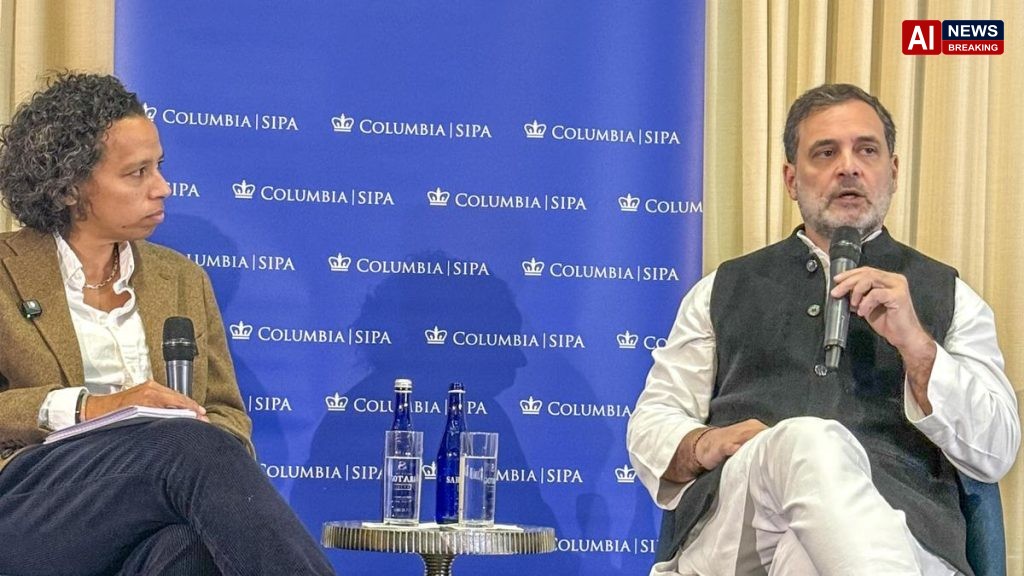
India sitting on 'economic disaster': Rahul Gandhi at Columbia University - AI News Breaking
India sitting on ‘economic disaster’: Rahul Gandhi at Columbia University In a recent lecture at Columbia University, Rahul Gandhi, the leader of the Indian National Congress, cautioned that India is poised on the brink of an economic catastrophe. The former Vice President of the country, who has spent much of his career in opposition to the ruling Bharatiya Janata Party, used the occasion to highlight the fragility of the nation’s growth engine. He argued that the small and medium enterprises (SMEs) and the agricultural sector form the backbone of the Indian economy and are crucial for job creation..
Without a robust rebuilding of the manufacturing sector, he warned, India could face a prolonged downturn. Gandhi began his address by pointing to the statistics that underscored the importance of SMEs in India. He noted that these enterprises account for almost half of the country’s gross domestic product and employ roughly 45 percent of the workforce..
Yet despite this sizeable contribution, many SMEs face crippling difficulties. The lack of access to credit, inadequate infrastructure and regulatory hurdles, he said, have stifled growth. In his view, these challenges must be tackled urgently if India is to avoid an economic collapse..
The former Vice President then turned to agriculture, emphasising its vital role in sustaining livelihoods across India’s vast rural population. He argued that the agricultural sector is not only a source of employment but also a key driver of demand for goods and services. Without a healthy agricultural base, he warned, the entire economy would struggle to generate the income necessary for industrial expansion..
Gandhi called for targeted support for farmers, including better irrigation facilities and modernised supply chains, to boost productivity and income levels. Gandhi’s critique of the current administration’s handling of the manufacturing sector was particularly pointed. He claimed that policy incoherence, excessive bureaucracy and a lack of investment incentives have left India’s industrial base lagging behind that of its neighbours..
The former Vice President stressed that manufacturing is essential for technology transfer, skill development and employment generation. He urged the government to adopt a more coherent strategy that encourages private investment and nurtures domestic innovation. In his analysis of the broader economic picture, Gandhi highlighted the between India’s demographic advantage and its current economic trajectory..
He pointed out that India’s population is ageing at a slower rate than other large economies, providing a long‑term workforce advantage. Nevertheless, he argued that without a revitalised manufacturing sector, the country’s youthful demographic could not be fully leveraged. Gandhi urged policymakers to adopt a long‑term, inclusive vision that capitalises on this demographic dividend..
The former Vice President also criticised the government’s approach to foreign direct investment (FDI). He said that while India has made strides in attracting foreign capital, many sectors remain inaccessible due to restrictive regulations. Gandhi called for a streamlined FDI policy that balances foreign participation with safeguarding national interests..
He argued that a more welcoming environment would not only boost capital inflows but also create jobs and spur technology transfer. During the Q&A session, Gandhi answered questions about his vision for a post‑pandemic recovery. He stressed the importance of creating an ecosystem that supports start‑ups and scale‑ups, particularly in technology and green energy..
He noted that India’s digital infrastructure is lagging and that the government must invest heavily in broadband connectivity to unlock the potential of its vast digital market. Gandhi also urged a focus on sustainability, arguing that economic growth must be aligned with environmental stewardship. Gandhi’s remarks came at a time when India is grappling with a host of economic challenges, including rising inflation, a sluggish services sector and a widening fiscal deficit..
He warned that these issues, if unaddressed, could lead to a significant downturn in the next few years. The former Vice President called for urgent reforms in tax policy, labour laws and industrial policy to create a conducive environment for businesses of all sizes. He suggested a more balanced approach that protects workers while encouraging entrepreneurship..
The former Vice President’s speech was met with a mixed response from the audience. Many students and scholars appreciated his emphasis on SMEs and agriculture as crucial pillars of the economy. However, some critics questioned the feasibility of his proposed reforms, citing the entrenched bureaucratic machinery and political resistance..
Nevertheless, Gandhi’s call for a comprehensive review of India’s economic policy has sparked debate among policymakers and academics alike. In closing, Rahul Gandhi reiterated that India’s economic future depends on a multifaceted strategy that includes revitalising manufacturing, supporting small businesses and strengthening the agricultural sector. He urged the government to adopt an inclusive, forward‑looking approach that harnesses India’s demographic dividend while ensuring sustainable growth..
Gandhi’s address at Columbia University has highlighted the need for a concerted effort to prevent an economic disaster and to secure a prosperous future for India’s vast population..
Updated: November 18, 2026
Rahul Gandhi warned in a Columbia lecture that India risks an economic collapse if its manufacturing base remains weak and small‑enterprise and agricultural sectors are not revitalised. He urged the government to streamline credit, reduce bureaucracy, and adopt inclusive policies that tap the nation’s demographic advantage while ensuring sustainable growth.
Insight: If India keeps shuffling its policy levers instead of locking in a clear manufacturing roadmap, the country risks turning its demographic bulge into a silent, underpaid workforce. A coherent, investment‑friendly framework that nurtures SMEs and modernises agriculture could transform the looming “economic disaster” warning into a resilient






