
 Pakistan’s leaders hail first astronaut aboard Chinese craft: ‘Proud one of us has gone into space’
 British tourist travels 29 hours from Mumbai to Amritsar for ₹5,461, rates Indian Railways 10/10 | Viral video
 The Supreme Court will decide whether assault weapons bans violate the Second Amendment
 A Critic of Beijing Falls Short in Taiwan’s Key Mayoral Election
 EPA says no rise in contamination after Army detonates lead azide stockpile in Iowa
Netanyahu Associates Acknowledge Role in Setting Off Election Day Arrests
**
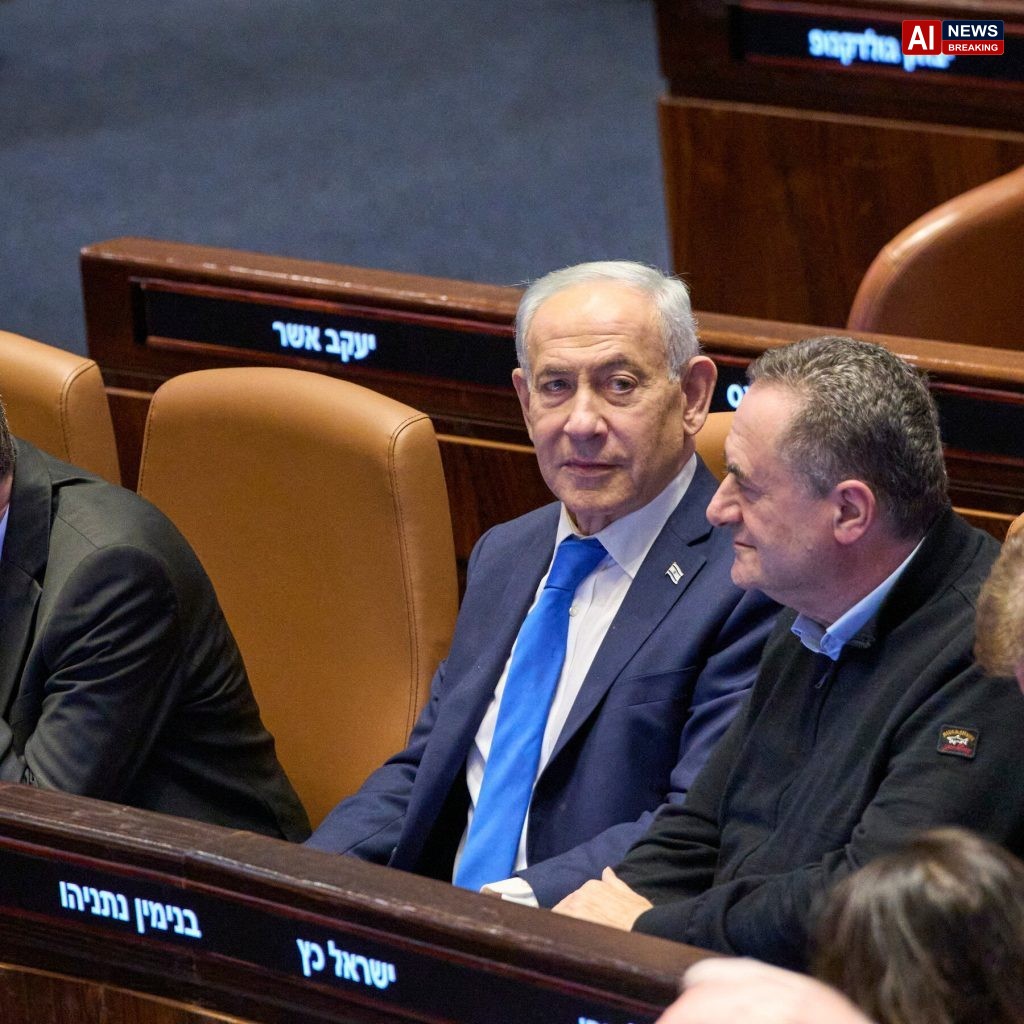
Netanyahu Associates Acknowledge Role in Setting Off Election Day Arrests - AI News Breaking
The night after Israel’s parliamentary election produced an unprecedented surge for Arab‑led parties, Prime Minister Benjamin Netanyahu took to the airwaves to denounce the result as “rigged”, citing the detention of three Arab activists on election day as evidence of a concerted effort to suppress the Arab vote. The claim, which quickly became a flashpoint in an already volatile political climate, has now been underpinned by a startling admission from Netanyahu’s own chief of staff, who confirmed that the prime minister’s office was involved in the initial contact with police that led to the arrests.The three activists – Amal Hassan, a community organizer from Nazareth; Youssef al‑Sabbagh, a university student from Umm al‑Fahm; and Fatima Saleh, a human‑rights lawyer based in Haifa – were taken into custody just before the polls opened, ostensibly on suspicion of incitement and illegal coordination with foreign entities. Their detention, which lasted less than twelve hours, sparked protests in several Arab towns and prompted a flurry of statements from opposition parties accusing the government of intimidation..
Netanyahu’s assertion that the arrests were part of a broader scheme to manipulate the vote added a new layer of controversy, prompting both domestic and international observers to demand clarity.In a televised interview on Channel 12, Netanyahu described the arrests as “the final piece in a puzzle that shows a deliberate attempt to rig the election in favour of the Arab bloc”. He argued that the timing of the arrests, combined with what he called “unprecedented interference by foreign actors”, indicated a coordinated campaign to undermine the legitimacy of the election. The prime minister’s remarks were met with a chorus of criticism from members of the Knesset, including opposition leader Yair Lapid, who called the accusations “dangerous rhetoric that threatens the fabric of our democracy”.The narrative took an unexpected turn on Tuesday when Yael Lapid, Netanyahu’s chief of staff, appeared before the Knesset Ethics Committee and acknowledged that senior officials in the prime minister’s office had reached out to the Israel Police to flag the activists’ alleged activities..
In a brief but highly publicised testimony, Lapid said: “We received credible intelligence that certain individuals were planning to disrupt the voting process. As part of our duty to safeguard the election, we shared that information with the relevant security authorities.” He stopped short of detailing the exact nature of the intelligence, citing national‑security considerations, but confirmed that the outreach occurred on the afternoon of the election.The admission has sent shockwaves through Israel’s political establishment. While it is not unusual for the government to coordinate with security forces in the run‑up to elections, critics argue that the timing and specificity of the police action suggest a level of political interference that breaches the principle of electoral neutrality..
Legal scholars at the Hebrew University’s Faculty of Law have warned that the episode could trigger a constitutional crisis, noting that Israel’s Basic Law on the Knesset requires that “elections be conducted in a free, fair, and transparent manner, free from undue influence by public officials”.Human‑rights groups have also weighed in. The Israeli Section of Amnesty International released a statement condemning the arrests as “a stark reminder of the vulnerability of Arab citizens to politically motivated legal actions”. The organisation called for an independent investigation into whether the police acted on political pressure rather than legitimate security concerns..
In a similar vein, the Association for Civil Rights in Israel (ACRI) filed a petition with the Supreme Court demanding that the court examine the legality of the police’s decision to detain the activists on election day.International reaction has been measured but pointed. The European Union’s diplomatic mission in Jerusalem issued a brief note urging Israeli authorities to “ensure that any security measures are proportionate, transparent, and do not infringe upon the democratic rights of any segment of the population”. The United States, through a spokesperson at the State Department, expressed “concern over reports of arrests that appear to be linked to political considerations” and pledged to monitor the situation closely.Within the Knesset, the matter has quickly become a partisan battleground..
The coalition bloc, which includes Netanyahu’s Likud party and several right‑wing allies, has defended the police’s actions as a necessary response to credible threats. Minister of Public Security Omer Yankelevich told reporters that “the police acted within the law, based on information that indicated a real risk to public order”. In contrast, the joint opposition, comprising centrist and left‑wing parties, has called for a parliamentary inquiry..
Yair Lapid, speaking at a press conference, demanded that “the Knesset hold the executive accountable and investigate whether the prime minister’s office overstepped its authority”.The political fallout may also have implications for the formation of the next government. Netanyahu’s party, having secured 31 seats, now faces a fragmented Knesset where Arab parties, for the first time, hold a combined 15 seats. Analysts from the Institute for National Security Studies (INSS) suggest that the controversy could complicate coalition negotiations, as potential partners weigh the risks of aligning with a government accused of electoral interference..
“If the allegations are substantiated, it could erode trust among moderate right‑wing parties that have been courting Arab voters as part of a broader strategy to broaden their appeal,” said INSS senior fellow Dr. Eliav Saban.Public opinion appears divided. A poll conducted by the Israeli Central Bureau of Statistics in the days following the election indicated that 42 percent of respondents believed the arrests were politically motivated, while 38 percent trusted the police’s justification..
Among Arab citizens, the figure rose sharply, with 67 percent expressing skepticism about the fairness of the process. In Jewish-majority areas, the sentiment was more split, reflecting the nation’s broader polarization over security versus civil liberties.The legal saga is set to unfold in the coming weeks. The Supreme Court has scheduled a hearing on the ACRI petition for early December, and the Knesset Ethics Committee is expected to issue a report on the chief of staff’s testimony by the end of the month..
Meanwhile, the detained activists have been released and are preparing to file civil suits against the state, alleging wrongful detention and violation of their constitutional rights. Their legal teams argue that the arrests were not based on concrete evidence but on “vague intelligence that was weaponised for political gain”.As Israel grapples with the aftermath of its most diverse parliamentary election to date, the episode underscores the fragile balance between security imperatives and democratic norms. The coming inquiries will test the resilience of the country’s institutions and may set a precedent for how future administrations handle the delicate interplay of politics and law enforcement during critical democratic moments..
Whether the findings will lead to substantive reforms or merely become another foot.
Netanyahu’s own chief of staff confirming the police‑kick‑off turns the “rigged‑vote” narrative into a self‑fulfilling prophecy—when the executive openly signals political intent, it normalizes the use of state apparatus for partisan ends.
If the





