
 Pakistan’s leaders hail first astronaut aboard Chinese craft: ‘Proud one of us has gone into space’
 British tourist travels 29 hours from Mumbai to Amritsar for ₹5,461, rates Indian Railways 10/10 | Viral video
 The Supreme Court will decide whether assault weapons bans violate the Second Amendment
 A Critic of Beijing Falls Short in Taiwan’s Key Mayoral Election
 EPA says no rise in contamination after Army detonates lead azide stockpile in Iowa
Time to protect eroding coastlines
**
Time to protect eroding coastlines - AI News Breaking
time protect eroding coastlines:
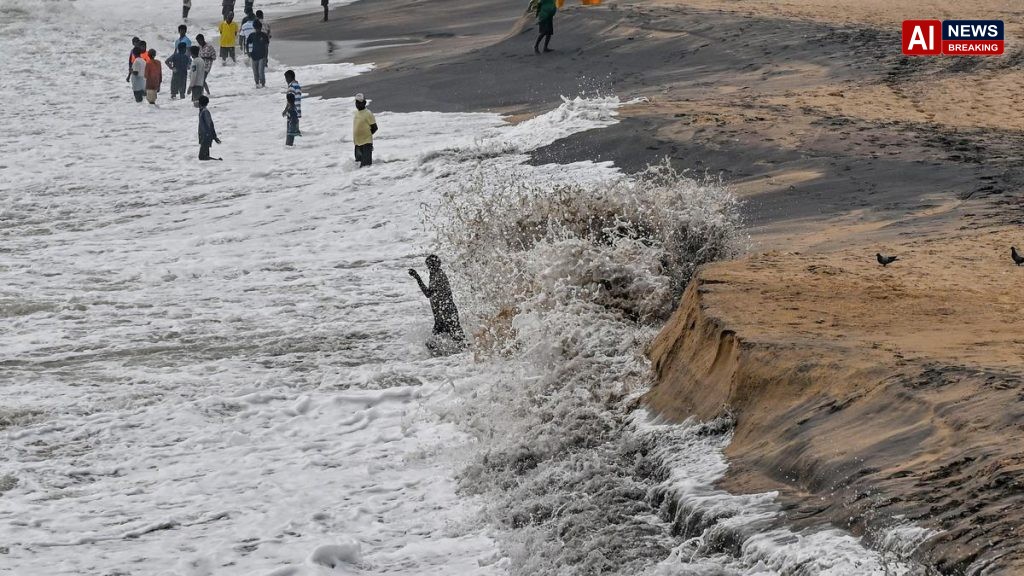
Time to protect eroding coastlines Nearly a third of Andhra Pradesh’s shoreline is disappearing under the relentless force of nature and human activity. Official surveys released this month indicate that 31 per cent of the state’s 1,025‑kilometre coast – roughly 319 kilometres – is actively eroding. Of that, 91.6 kilometres fall into the “high erosion” category, where the land loss exceeds one metre per year..
The data, compiled by the State Coastal Management Authority, paints a stark picture of a coastline that is not only retreating but doing so at a speed that threatens infrastructure, livelihoods and the region’s ecological balance. The worst‑affected zones lie in the river deltas of Kakinada, West Godavari and Krishna, where the confluence of riverine sediments and sea‑borne forces once created fertile wetlands and thriving fishing communities. In Kakinada, villages that once stood on stable sandbars now watch the sea claim homes and farmlands with each high tide..
Similar patterns are evident in the West Godavari district, where the Godavari River’s reduced sediment load has left its banks unable to replenish the shoreline, accelerating the retreat of beaches that were once natural buffers against storm surges. Visakhapatnam, the state’s flagship port and a city often dubbed the “City of Destiny”, is not immune to the trend. Although its coastline has historically been more resilient due to the presence of rocky outcrops, recent surveys show pockets of severe erosion near the harbour’s outer limits..
The port’s expansion over the past three decades, involving dredging, breakwater construction and the creation of artificial islands, has altered the natural sediment pathways. Experts warn that these interventions, while boosting trade, have inadvertently redirected wave energy toward vulnerable stretches of beach, undermining the very protection they were meant to provide. Port development is not the sole driver of the degradation..
Climate scientists point to shifting wave patterns in the Bay of Bengal, a phenomenon linked to rising sea temperatures and changing monsoon dynamics. Satellite data reveal that the dominant direction of swells has moved further north over the last twenty years, bringing larger, more powerful waves to sections of the Andhra coast that were previously sheltered. This change amplifies the erosive power of each wave, especially during the pre‑monsoon period when storm activity peaks..
Cyclones, long a seasonal menace in the region, have grown both in frequency and intensity. The 2022 Cyclone Nivar, which battered the coast just months after the monsoon, left a trail of sand displacement and mangrove loss across the Krishna delta. In the aftermath, local authorities recorded an average shoreline retreat of 3.2 metres in the hardest‑hit villages..
The pattern repeats with each subsequent storm, as the already weakened dunes are unable to recover, leading to a cumulative loss that compounds year after year. The human cost of this erosion is mounting. Fishermen, whose livelihoods depend on the proximity of the sea, are forced to travel farther offshore to find catch, increasing fuel expenses and reducing daily returns..
In Kakinada, a recent community survey indicated that 42 per cent of households have reported a decline in income directly linked to beach loss. Moreover, the erosion threatens cultural heritage sites, including centuries‑old temples perched on coastal cliffs, which now face the prospect of collapse or relocation. Government response has been a mix of reactive measures and long‑term planning..
The Andhra Pradesh Coastal Zone Management Plan, updated in 2023, earmarks ₹2.3 billion for shoreline protection projects, including the construction of sand‑fill revetments and the reinforcement of mangrove belts. However, critics argue that the allocated funds are insufficient given the scale of the problem, and that many of the proposed structures lack the flexibility needed to adapt to future sea‑level rise. Environmental NGOs have advocated for nature‑based solutions as a complement to hard engineering..
In a pilot project launched by the Coastal Ecology Trust in the West Godavari district, community volunteers planted native mangrove species along a 2‑kilometre stretch of degraded shore. Early monitoring suggests that the restored mangroves have reduced wave energy by up to 30 per cent, allowing sand to accumulate naturally and providing new habitat for fish and crustaceans. Such successes are being touted as scalable models for other vulnerable sections of the coast..
Academic research underscores the importance of integrating traditional knowledge with modern science. A study by the Indian Institute of Technology, Hyderabad, examined historical maps and oral histories from fishing families, discovering that certain sandbars re‑emerged after major cyclones in the past, only to be eroded again later. The researchers propose a dynamic management framework that anticipates cyclical changes, allowing for periodic reinforcement of protective structures rather than a one‑time build..
International attention is also focusing on the region, as the United Nations’ Climate Adaptation Fund has identified Andhra Pradesh as a priority area for coastal resilience. A recent grant of $15 million aims to bolster early warning systems, improve data collection on shoreline changes, and support community‑led relocation programmes where erosion has rendered habitation untenable. The funding, however, comes with stringent reporting requirements, prompting local officials to streamline bureaucratic processes that have previously slowed project implementation..
Looking ahead, experts warn that without decisive action, the erosion trajectory will intensify. Projections from the National Institute of Oceanography suggest that if current trends continue, the high‑erosion zones could expand by an additional 25 kilometres by 2040, engulfing more agricultural land and displacing thousands of residents. The intertwining challenges of climate change, infrastructural development and socioeconomic pressures demand a coordinated response that balances economic growth with.
Nearly a third of Andhra Pradesh’s 1,025‑km coastline is rapidly eroding, with over 90 km losing more than a metre of land each year, threatening ports, farms, homes and historic sites. While the state has pledged billions for hard defenses, experts and NGOs argue that nature‑based solutions and adaptive planning are essential to curb the tide of loss.
If Andhra’s shoreline keeps retreating at the current rate, the state risks turning its own economic engines—ports, fishing villages, and cultural sites—into liabilities, turning coastal prosperity into a perpetual fight against the sea.
Investing in adaptive, nature‑based defenses now could shift the balance from loss






