
 Pakistan’s leaders hail first astronaut aboard Chinese craft: ‘Proud one of us has gone into space’
 British tourist travels 29 hours from Mumbai to Amritsar for ₹5,461, rates Indian Railways 10/10 | Viral video
 The Supreme Court will decide whether assault weapons bans violate the Second Amendment
 A Critic of Beijing Falls Short in Taiwan’s Key Mayoral Election
 EPA says no rise in contamination after Army detonates lead azide stockpile in Iowa
In France’s Angry Autumn, TV News Channels Are Accused of Stirring the Pot
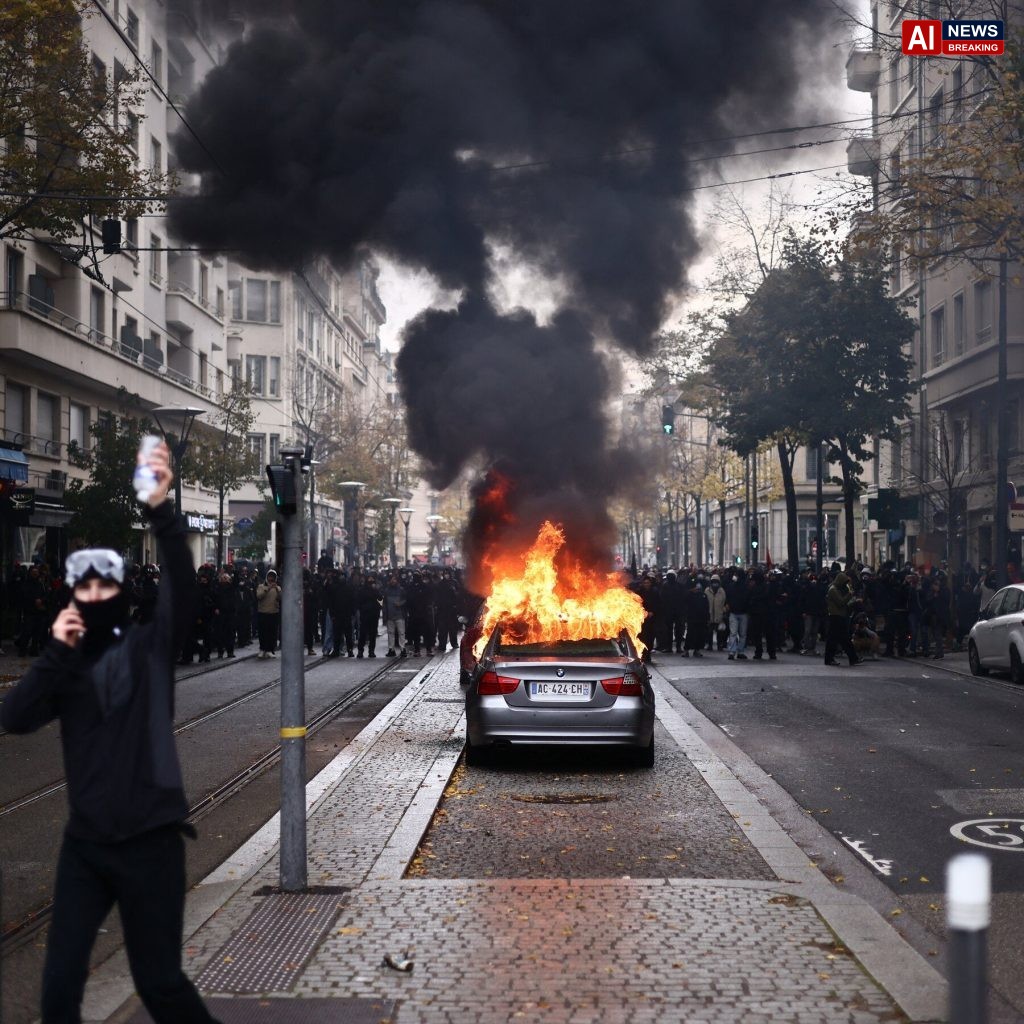
In France’s Angry Autumn, TV News Channels Are Accused of Stirring the Pot - AI News Breaking
frances angry autumn channels:
In France’s Angry Autumn, TV News Channels Are Accused of Stirring the Pot The autumn of 2023 has seen France’s public debate intensify, with a series of protests across major cities sparking controversy beyond the streets. A wave of accusations has surged against two leading news broadcasters, CNews and BFM TV, alleging that their coverage of demonstrations has employed racist language and stoked division. These claims have ignited a broader conversation about media responsibility in an era where digital amplification can turn a single statement into a national scandal..
While the broadcasters deny any deliberate misuse of language, the debate underscores the power of televised narratives to shape public perception. CNews, owned by the Bolloré Group, has long positioned itself as a go-to source for breaking news. In a recent interview, the channel’s chief correspondent defended the tone of its coverage, asserting that any perceived harshness was a response to the volatile nature of the protests..
The correspondent highlighted that the term rioters had been used by several outlets, not just CNews, and that it reflected the seriousness of the situation. Critics counter that such terminology crosses a line, especially when applied to specific ethnic communities. The channel’s statement was met with a flurry of comments on social media, where viewers debated the appropriateness of the language..
Similarly, BFM TV—part of the larger BFM Business group—has faced scrutiny over its depiction of protesters in the south of France. During a live broadcast, a reporter described participants as unlawful agitators, a phrase that many felt carried a connotation that could be interpreted as targeting a particular demographic group. BFM TV’s public relations office quickly issued a clarification, stating that the term was chosen for its neutrality and that no racial or ethnic connotation was intended..
Despite this, the broadcaster’s social media presence saw an uptick in hostile comments, with some accusing the channel of perpetuating xenophobic tropes. The backlash has not been confined to viewers alone. Several French lawmakers have called for an independent review of media coverage during the protests..
Representative Claire Dubois, of the Socialist Party, urged the Ministry of Culture and Communication to establish a panel that would evaluate whether broadcast language adhered to France’s strict anti-discrimination laws. She emphasized that the media’s role is to inform, not inflame, and that any deviation from this principle could undermine public trust. The call for oversight reflects a growing concern among civil society groups that media outlets sometimes prioritize sensationalism over accuracy..
Opponents of the accusations argue that the term rioters and similar descriptors are standard journalistic practice in situations of civil unrest. They point to the editorial guidelines of international news organisations that allow for such terminology when it is backed by evidence of violence or property damage. According to these defenders, the labels are not intended to single out any nationality or ethnicity but to describe the actions taken by participants..
In a statement released to the press, an independent media watchdog explained that context matters, and that the broadcasters in question had provided footage of individuals engaging in acts that justified the use of the term. However, a deeper analysis of the broadcasts reveals patterns that raise questions about selective language. In a clip from CNews that aired on 12 September, a commentator repeatedly referred to foreign agitators while covering a demonstration in Lyon..
The term was repeated several times over a span of ten minutes, a usage that critics say is disproportionate to the footage presented. The commentator’s tone, some observers noted, conveyed a sense of hostility rather than neutrality. When challenged in a follow‑up interview, the commentator admitted that the phrase had been chosen to emphasize the perceived threat but declined to apologise, citing editorial freedom..
BFM TV’s coverage, meanwhile, featured a segment in which a reporter described protesters as unlawful during a rally in Marseille. The segment included footage of a small group setting up barricades and confronting police. While the reporter noted the presence of non‑violent participants, the overall framing leaned heavily on the negative actions, leaving little room for nuance..
Analysts argue that this imbalance can reinforce stereotypes, especially when the group’s composition is not explicitly discussed. The segment’s conclusion—calling for increased security measures—was seen by some as a direct policy recommendation, blurring the line between news reporting and editorial opinion. The controversy has also prompted legal scrutiny..
The French High Council for Communication (Haute Autorité de la communication audiovisuelle) announced an investigation into whether the broadcasts violated the country’s anti‑discrimination statutes. Under Article 22 of the French Penal Code, the use of language that can be interpreted as hateful or discriminatory towards a protected group is prohibited. The Council’s inquiry will examine whether the terminology used by CNews and BFM TV could be construed as incitement to hatred..
Though the investigation is in its early stages, both broadcasters have pledged full cooperation, indicating that they see the matter as a procedural formality rather than a substantive allegation. Amid the legal and political scrutiny, viewers have responded with a mixed reception. A poll conducted by the French Institute of Public Opinion found that 38% of respondents believe that news outlets should refrain from using any potentially inflammatory language during protest coverage..
Conversely, 27% argue that the media’s job is to report facts as they appear, even if that includes harsh terminology. The remaining respondents were split on the issue, highlighting the complexity of public opinion in a climate of heightened sensitivity to language. The poll’s methodology, which sampled 1,200 adults across the country, suggests that a substantial segment of the populace is wary of media bias, yet many still accept that reporting on protests can be inherently confrontational.
Updated: November 21, 2026
The accusations reveal a media culture that equates “breaking news” with sensationalism, risking a slippery slope where language becomes a weapon rather than a mirror of reality.
If broadcasters continue to lean on charged labels without rigorous context, public trust may erode, turning civic discourse into a battleground for identity





