
 Pakistan’s leaders hail first astronaut aboard Chinese craft: ‘Proud one of us has gone into space’
 British tourist travels 29 hours from Mumbai to Amritsar for ₹5,461, rates Indian Railways 10/10 | Viral video
 The Supreme Court will decide whether assault weapons bans violate the Second Amendment
 A Critic of Beijing Falls Short in Taiwan’s Key Mayoral Election
 EPA says no rise in contamination after Army detonates lead azide stockpile in Iowa
Modi’s Canada visit is set to move ties in a new direction: Vina Nadjibulla
**
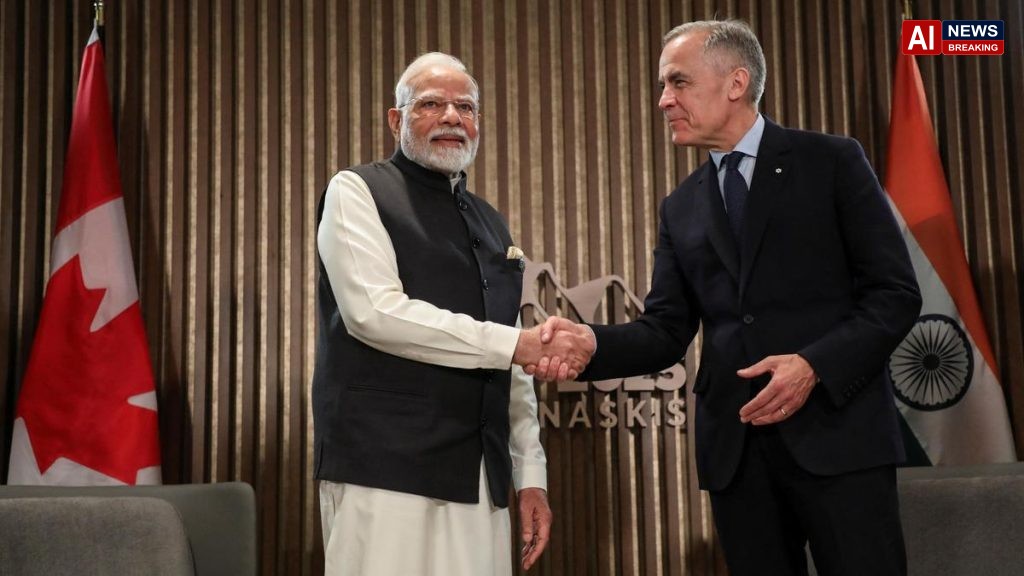
Modi’s Canada visit is set to move ties in a new direction: Vina Nadjibulla - AI News Breaking
modis canada visit move:
Modi’s Canada visit is set to move ties in a new direction: Vina Nadjibulla Prime Minister Narendra Modi’s two‑day trip to Canada this week marks a turning point in the bilateral relationship, according to Vina Nadjibulla, chief executive of Vancouver‑based think‑tank the Pacific Institute for Global Affairs. “What has changed is that both governments appear increasingly willing to approach security issues through the lens of mutual security interests, rather than allowing these differences to define the entire relationship,” she told the BBC. The shift follows months of diplomatic friction over trade, diaspora politics and competing narratives on the Indo‑Pacific, but officials on both sides say a pragmatic agenda is now taking precedence..
The visit opens with a joint press conference in Ottawa, where Modi and Canadian Prime Minister Justin Trudeau pledged to deepen cooperation on cyber‑defence, maritime surveillance and the protection of critical infrastructure. Both leaders highlighted the importance of coordinated responses to “gray‑zone” threats such as state‑backed disinformation campaigns and supply‑chain vulnerabilities. “Our shared democratic values do not preclude us from acknowledging that security challenges are increasingly transnational,” Trudeau said, echoing a sentiment that has been echoed in recent policy drafts from the Department of National Defence..
Behind the public rhetoric, senior officials have been working on a draft “Indo‑Pacific Security Framework” that would formalise intelligence sharing on maritime piracy, illegal fishing and the growing presence of the People’s Republic of China in the region. The framework, still under negotiation, proposes a quarterly summit of senior defence officers and the establishment of a joint research hub in Vancouver to analyse satellite data and oceanic traffic patterns. If ratified, it would be the first formalised security pact between Canada and India since the 1990s..
Trade negotiators have also been instructed to separate commercial disputes from security dialogues, a departure from the approach taken during the 2022 trade row over agricultural tariffs. “We cannot let one basket of issues spoil the whole produce,” said a senior Canadian trade official, who asked to remain unnamed. The two governments have agreed to restart talks on a Comprehensive Economic Partnership Agreement, with a view to addressing barriers in the technology and renewable‑energy sectors while keeping the security track separate..
The diaspora angle, long a flashpoint in Indo‑Canadian relations, received a surprisingly low profile during the visit. While community leaders were invited to a reception at Rideau Hall, the agenda avoided direct references to recent controversies surrounding alleged foreign influence operations in Canada’s political parties. “Both sides are signalling that they do not wish to let domestic politics dominate the bilateral agenda,” observed Nadjibulla..
Analysts warn, however, that the underlying tensions could resurface if public pressure mounts over issues such as the alleged funding of extremist groups. In a parallel development, the Canadian Security Intelligence Service (CSIS) announced a joint task force with India’s Research and Analysis Wing (RAW) to monitor extremist networks that operate across the Pacific Rim. The task force will focus on digital platforms that facilitate recruitment and fundraising, and will share actionable intelligence with law‑enforcement agencies in both countries..
While the collaboration has been praised as a “win‑win” by security experts, civil‑rights groups have raised concerns about potential overreach and the need for robust oversight mechanisms. India, for its part, has been keen to showcase its growing capabilities in space‑based surveillance and artificial‑intelligence‑driven threat analysis. During a visit to the Canadian Space Agency’s headquarters in Montreal, Modi toured a new satellite‑tracking facility that monitors debris and potential hostile launches..
“Technology is the great equaliser,” the prime minister said, underscoring his government’s ambition to position India as a reliable partner in the global security architecture, not merely a regional player. Trudeau, meanwhile, used the occasion to reaffirm Canada’s commitment to a free and open Indo‑Pacific, a stance that aligns with Washington’s strategy but also reflects Ottawa’s own commercial interests in the region’s trade routes. “Our partnership with India is a cornerstone of that vision,” he asserted, before turning to the question of climate security, another area where both nations see overlapping priorities..
The two leaders pledged joint investment in green‑hydrogen projects, citing the potential to reduce emissions from shipping lanes that link the two continents. The media in both countries have noted a distinct tone of optimism compared with previous visits. Indian newspapers highlighted the “new era of partnership” and the promise of “mutual growth,” while Canadian outlets have focused on the pragmatic “security‑first” narrative..
Yet, commentators caution that the enthusiasm may be tempered by domestic politics: the upcoming Indian general election and Canada’s looming federal budget debates could both reshape the momentum generated by the talks. Behind the headlines, a series of low‑key meetings have been taking place between senior bureaucrats, defence chiefs and private‑sector representatives. One such gathering, held at the Canadian International Trade Tribunal, featured CEOs from the aerospace, renewable‑energy and information‑technology sectors..
They discussed the creation of a “Canada‑India Innovation Bridge” that would fund joint start‑ups and facilitate talent exchange programmes. If successful, the bridge could channel upwards of CAD 1 billion into collaborative research over the next five years. Nadjibulla points out that the evolving relationship reflects a broader global trend where mid‑size powers are seeking to diversify security partnerships beyond traditional allies..
“Both Ottawa and New Delhi are navigating a multipolar world where reliance.
Updated: November 23, 2026
Summary: India’s Narendra Modi and Canada’s Justin Trudeau have pivoted their long‑stalled ties toward a pragmatic security partnership, pledging joint cyber‑defence, maritime surveillance and an Indo‑Pacific security framework that will formalise intelligence sharing on piracy and Chinese activity. The visit also re‑ignites trade talks and green‑hydrogen projects, while keeping domestic disputes and diaspora politics low on the agenda.
By treating security and trade as distinct lanes, Modi’s Canadian stop signals a pragmatic shift that could sidestep the electoral volatility each side faces, yet the real test will be whether domestic politics will keep the new framework from stalling once the election and budget deadlines loom. The move also hints at a growing trend where rising powers craft bilateral pacts to punch above their weight, but only if they can embed transparent oversight and maintain trust against the backdrop of rising cyber‑espionage concerns.






