The Supreme Court will decide whether assault weapons bans violate the Second Amendment
 A Critic of Beijing Falls Short in Taiwan’s Key Mayoral Election
 EPA says no rise in contamination after Army detonates lead azide stockpile in Iowa
 Israeli Strike Kills 2 Workers at Gaza Clinic, Doctors Without Borders Says
 McQueen Pre-Fall 2027
Trump’s Nvidia Push Shows Companies’ Importance in Global Economic War
President Donald Trump’s unique focus on Nvidia has turned the United States’ economic strategy into a geopolitical battlefield, linking tax incentives, regulatory easements, and public endorsements to a trillion‑dollar chip empire and a worldwide contest for AI dominance.
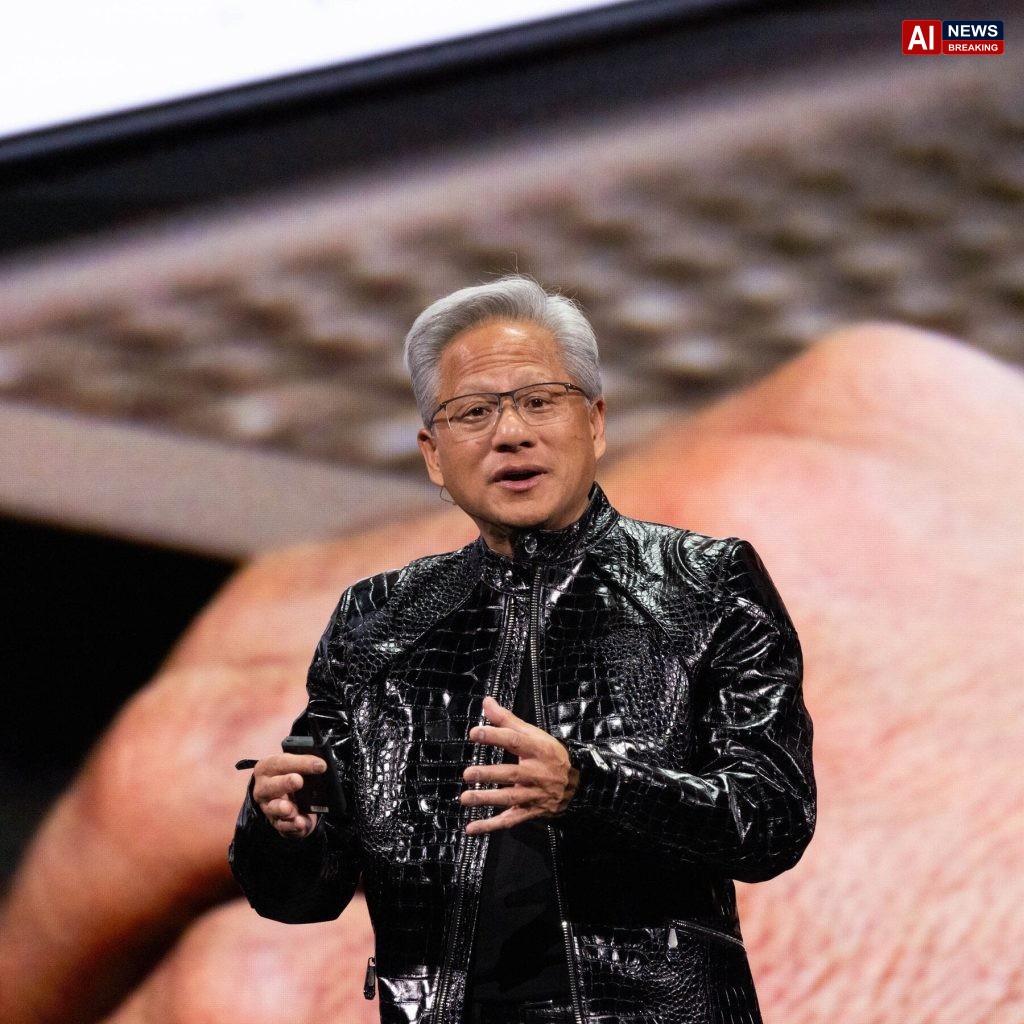
Trump’s Nvidia Push Shows Companies’ Importance in Global Economic War - AI News Breaking
trumps nvidia push shows:
President Donald Trump’s unprecedented focus on a single technology firm has turned the United States’ economic strategy into a contest of corporate fortunes. While earlier presidents intervened in the private sector to stabilise the economy during wars or crises, the former president went a step further, intertwining his political legacy with the success of Nvidia Corp, the chipmaker that now stands at the centre of a broader geopolitical struggle for technological dominance. The partnership between Trump and Nvidia, forged through a series of policy moves, tax incentives and public endorsements, has reshaped the narrative of how national power is projected in an era where silicon chips are as strategically valuable as oil or steel.The roots of the alliance can be traced back to 2020, when Nvidia announced its intention to acquire Arm Holdings, a British semiconductor design firm critical to the architecture of many processors worldwide..
The deal, valued at $40 billion, raised alarms in Washington about the concentration of design capability in a single American company. Trump’s administration responded not by blocking the transaction, but by offering a suite of regulatory easements and tax credits designed to accelerate Nvidia’s research and development pipeline. In return, the president frequently highlighted Nvidia’s role in American innovation, positioning the firm as a bulwark against Chinese technological encroachment.Trump’s public rhetoric amplified the commercial stakes..
In speeches and town‑hall meetings, he praised Nvidia’s CEO, Jensen Huang, as a “great American entrepreneur” and a “defender of our way of life.” The president’s language framed the company’s growth as a patriotic mission, a message that resonated with a constituency increasingly aware of supply‑chain vulnerabilities revealed by the pandemic and the war in Ukraine. This narrative helped secure bipartisan support for legislative measures that expanded the Defense Production Act to include advanced semiconductor manufacturing, effectively granting the government priority access to Nvidia’s output in times of national emergency.The policy environment created by the Trump administration also opened doors for private investment. Following the president’s endorsement, Wall Street poured capital into Nvidia, driving its market capitalisation from under $300 billion in early 2021 to more than $1 trillion by the end of 2023..
The surge attracted sovereign wealth funds and state‑backed investors from allied nations, all keen to secure a share of the AI boom that Nvidia’s graphics processing units now power. This influx of foreign capital, however, prompted concerns among U.S. security agencies that critical technology could be inadvertently transferred to potential adversaries through complex investment structures.In response, the Treasury Department, under Trump’s direction, tightened the Committee on Foreign Investment in the United States (CFIUS) review process for semiconductor firms..
The revised guidelines required foreign investors to disclose not only ownership stakes but also any strategic partnerships that could grant them access to Nvidia’s proprietary AI models. While the measures were praised by some national‑security experts as necessary safeguards, critics argued that they risked discouraging the very foreign capital that had helped fuel Nvidia’s rapid expansion. The tension between openness and protectionism became a defining feature of the administration’s broader economic doctrine.The implications of Trump’s Nvidia strategy extend beyond the United States..
In Europe, Brussels has launched its own “Digital Sovereignty” initiative, aiming to reduce reliance on American chipmakers by investing in domestic design houses and encouraging joint ventures with Asian partners. Meanwhile, Beijing has accelerated its “Made in China 2025” program, seeking to develop indigenous alternatives to Nvidia’s GPUs and to capture a larger share of the burgeoning AI market. The resulting triangular competition has turned semiconductor policy into a proxy battlefield, with each bloc vying for control over the supply chain that underpins everything from autonomous vehicles to military drones.Analysts note that the Trump‑Nvidia alignment has also reshaped domestic labour markets..
The company’s rapid hiring spree, spurred by government incentives, has created a surge in demand for highly specialised engineers, pushing wages in the sector to record highs. While this benefits workers with niche skills, it has intensified shortages in related industries, prompting calls for expanded STEM education and immigration reforms to broaden the talent pool. The administration’s push for “tech‑focused” visas, though initially stalled by congressional opposition, eventually passed as part of a broader trade package, further linking corporate growth to legislative action.The financial markets have reflected the heightened stakes..
Nvidia’s stock volatility has become a barometer for broader geopolitical risk, with analysts warning that any disruption to the U.S.–China technology truce could cause sharp price swings. Hedge funds now incorporate geopolitical scenario analysis into their valuation models for semiconductor firms, a practice once reserved for commodities like oil. This new paradigm underscores how closely intertwined corporate fortunes have become with national security assessments, a reality that the Trump era helped to cement.Looking ahead, the legacy of Trump’s approach will likely influence how future administrations engage with the private sector..
The Biden administration, while distancing itself from overt political endorsements of individual CEOs, has retained many of the policy tools introduced during Trump’s tenure, such as expanded CFIUS authority and targeted tax credits for chip manufacturing. Congressional hearings this year have scrutinised whether the United States has become overly dependent on a single company for its AI capabilities, prompting proposals for a diversified “chip resilience” strategy that spreads risk across multiple domestic and allied firms.The convergence of politics, economics and technology that defines the Trump‑Nvidia saga illustrates a broader shift in how global power is contested. In the 20th century, military hardware and natural resources were the primary levers of influence; in the 21st century, the design and production of semiconductor chips have taken centre stage..
By placing his political capital behind Nvidia, Trump transformed a corporate success story into a symbol of national strength, a move that has both rallied support and raised questions about the appropriate balance between state intervention and market freedom. As the world watches the next chapter of this high‑tech rivalry unfold, the outcomes will shape not only the fortunes of a single company but also the architecture of global economic security for years to come..
Updated: November 24, 2026