The Supreme Court will decide whether assault weapons bans violate the Second Amendment
 A Critic of Beijing Falls Short in Taiwan’s Key Mayoral Election
 EPA says no rise in contamination after Army detonates lead azide stockpile in Iowa
 Israeli Strike Kills 2 Workers at Gaza Clinic, Doctors Without Borders Says
 McQueen Pre-Fall 2027
Hyderabad must make room for buses, rein in private vehicles, says Bogotá’s former mayor
**
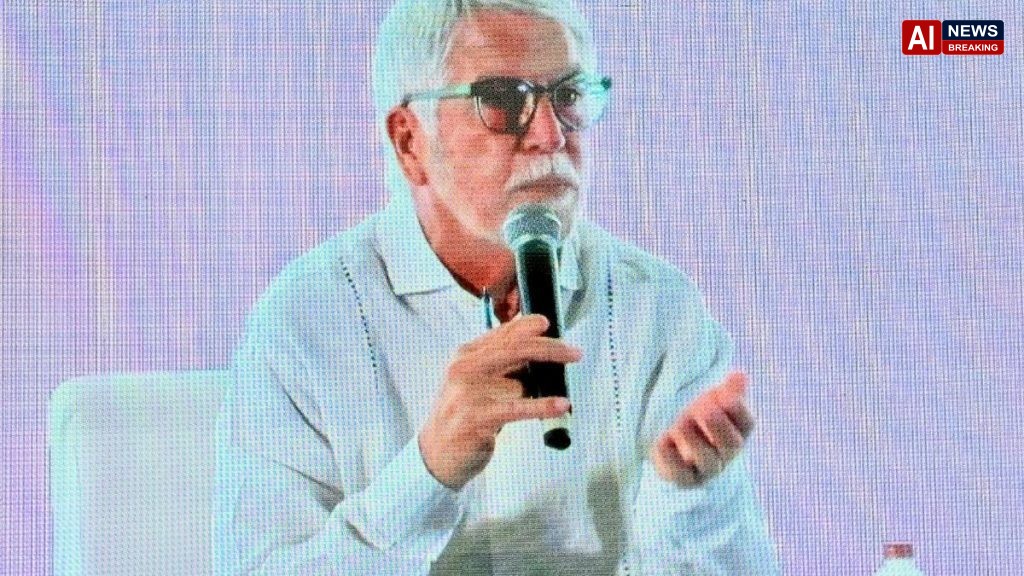
Hyderabad must make room for buses, rein in private vehicles, says Bogotá’s former mayor - AI News Breaking
Hyderabad must make room for buses, rein in private vehicles, says Bogotá’s former mayor Former Bogotá mayor Enrique Peñalosa visited Hyderabad last week and warned the rapidly expanding Indian metropolis that its transport future hinges on a decisive shift toward mass transit and pedestrian‑friendly streets. Speaking at a conference organised by the Indian Institute of Technology Hyderabad, Peñalosa argued that the city cannot afford to keep prioritising private cars while ignoring the potential of bus rapid transit (BRT) and walkable neighbourhoods. “You have to decide what kind of city you want to be before you keep spending billions on roads that only serve a minority,” he told an audience of planners, policymakers and journalists..
Peñalosa, who transformed Bogotá in the 1990s by introducing a world‑renowned BRT system and extensive bike lanes, pointed out that Hyderabad’s current transport strategy mirrors a car‑centric model that many global cities are beginning to abandon. He cited the example of Bogotá’s TransMilenio, which now carries over two million passengers daily and has dramatically reduced travel times, congestion and air pollution. “We built a city for people, not for cars..
Hyderabad can do the same if it changes its priorities,” he said, urging local officials to adopt a similar vision. The former mayor highlighted that Hyderabad’s rapid population growth – now estimated at over 10 million in the metropolitan area – has outstripped the capacity of its existing road network. Daily traffic snarls on arterial roads such as the Outer Ring Road and the newly expanded NH‑44 have become routine, costing commuters hours and businesses billions in lost productivity..
Peñalosa warned that without a decisive policy shift, the city will face escalating congestion, higher emissions and a deteriorating quality of life for its residents. In his view, the key to breaking this cycle lies in reallocating road space from private vehicles to high‑capacity buses and safe pedestrian corridors. He cited successful case studies from Latin America, where cities that removed lanes for cars and introduced dedicated BRT lanes saw immediate improvements in traffic flow and public health..
“The evidence is clear: when you give priority to buses, you free up space for everyone else,” he said, emphasizing that such changes do not require massive new construction but rather a re‑thinking of existing infrastructure. Peñalosa also warned against the temptation to simply expand highways or build more flyovers, a strategy he described as “the old‑fashioned, short‑term fix that only fuels more car use.” He argued that each new lane tends to induce additional traffic, a phenomenon known as induced demand, which ultimately nullifies any temporary relief. Instead, he advocated for a comprehensive master plan that integrates BRT corridors, feeder services, and walkable streets into a coherent network, supported by robust land‑use policies that discourage sprawl..
The former mayor’s critique came at a time when Hyderabad’s municipal authorities are pushing forward with the Hyderabad Metro expansion and a series of ring‑road projects. While these initiatives have been praised for modernising the city’s transport backbone, Peñalosa cautioned that they must be complemented by a strong bus network that can serve the suburbs and low‑income neighbourhoods not covered by rail. “Metro is a premium service; buses are the workhorse that reaches the doorsteps of the majority,” he explained..
Peñalosa’s remarks resonated with several Indian transport experts present at the event, who echoed concerns that Hyderabad’s current policies risk replicating the same car‑dominant pattern seen in many Indian cities. Ramesh Kumar, a senior fellow at the Centre for Urban Policy Research, noted that the city’s fiscal resources could be better allocated to expanding BRT lanes and improving bus frequency rather than funding costly flyovers that often become underutilised. He added that a shift toward public transport would also align with India’s climate commitments under the Paris Agreement..
In response, Hyderabad’s Commissioner of Urban Development, Ms. Anjali Rao, acknowledged the value of Peñalosa’s perspective and promised a “thorough review” of the city’s transport hierarchy. Rao said the municipal corporation is already piloting a BRT corridor along the Outer Ring Road and that plans are underway to introduce dedicated bus lanes on major thoroughfares such as the NH‑65..
She stressed that the city’s approach will be “balanced,” aiming to improve mobility for all users while respecting the needs of private vehicle owners. Local residents, however, remain divided. While commuters in densely populated areas such as Secunderabad and Charminar have welcomed the promise of faster, cheaper bus services, motorists in affluent suburbs expressed apprehension about possible lane reductions and increased parking fees..
A recent survey conducted by the Hyderabad Residents’ Association showed that 58 % of respondents support greater bus priority, while 42 % fear that their daily commutes could be disrupted by aggressive reallocation of road space. The debate also touches on broader urban planning issues, including land‑use density, housing affordability and the need for mixed‑use developments that reduce the distance between homes, workplaces and amenities. Peñalosa argued that without integrating transport planning with zoning reforms, any investment in buses or metros would be undermined by sprawling, car‑dependent development patterns..
He cited Bogotá’s “urban growth boundaries” as an example of how policy can guide compact, transit‑oriented growth. As Hyderabad moves toward its 2030 development vision, the city’s choices will likely shape its trajectory for decades. If it follows Peñalosa’s prescription, the next decade could see a network of high‑frequency BRT lines, expanded pedestrian zones and a gradual curbing of private car use, positioning Hyderabad as a model for.
Updated: November 27, 2026
Former Bogotá mayor Enrique Peñalosa urged Hyderabad to curb car‑centric planning and invest in high‑capacity bus corridors and pedestrian‑friendly streets, warning that continued road expansion will only deepen congestion and pollution. City officials say they will review the proposal, with pilots for BRT lanes already under way as the metropolis debates how to balance private‑vehicle interests with a shift toward mass transit.
Hyderabad’s pivot to BRT is a litmus test: if the city reallocates lanes and funds to buses rather than highways, it could reverse induced‑demand paralysis and set a precedent for other Indian metros; if it stalls, the same car‑centric trap will deepen congestion and erode its climate commitments.