
 US cop who killed one-year-old resigns hours after release of shooting footage
  North Korea’s Kim Jong-un Arrives in China, South Korea Says
  El Gouna Takeaways: ‘Safe Exit’ Wins Top Prize, Arab TV Seeks New Talent and Egyptian Filmmakers Push Boundaries
  Phillies Legend Chase Utley Breaks Silence On Don Mattingly Replacement Report
  Courts cannot be unmindful when precious water bodies remain unprotected: SC
 FCRA Amendment Bill 2026 Sent to 31-Member JPC: Why India’s Foreign Funding Law Has Become a Political, Federal and Global Flashpoint
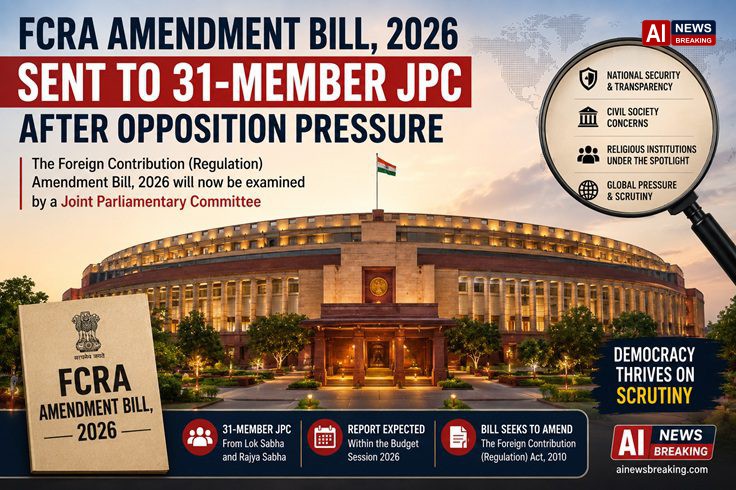
The Foreign Contribution (Regulation) Amendment Bill, 2026 has been referred by the Lok Sabha to a 31-member Joint Parliamentary Committee (JPC) after sustained Opposition protests and demands for its withdrawal. The move gives Parliament additional time to examine the Bill’s controversial provisions, particularly those concerning foreign-funded assets, NGO registration, religious institutions and government-appointed oversight.
The legislation is no longer simply an administrative reform of India’s foreign-funding regime. It has become a wider debate over national security, sovereignty, minority institutions, civil-society space, federalism and India’s relations with Western governments and international rights organisations. The governments of several northeastern states, including Mizoram and Nagaland, have welcomed the JPC route, while the Union government argues that stronger rules are necessary to prevent misuse of foreign funds and bring legal clarity to thousands of crores worth of assets.
FCRA Bill 2026: Parliament Chooses Scrutiny Over a Straight Vote
The most significant development in the controversy over India’s foreign-funding regime came on Wednesday, August 12, when the Lok Sabha referred the Foreign Contribution (Regulation) Amendment Bill, 2026 to a 31-member Joint Parliamentary Committee.
The decision followed intense Opposition resistance in Parliament. Opposition parties had demanded that the legislation be withdrawn, arguing that several provisions could give the executive excessive powers over foreign-funded non-governmental organisations, religious institutions and charitable bodies.
Rather than proceeding immediately toward passage, the government opted for the JPC route.
That decision changes the political character of the controversy.
The Bill was introduced in the Lok Sabha on March 25, 2026, by Minister of State for Home Affairs Nityanand Rai. It seeks to amend the Foreign Contribution (Regulation) Act, 2010, the principal law governing the acceptance and utilisation of foreign contributions in India. The 2010 law itself replaced the earlier FCRA enacted in 1976 during the Emergency.
The JPC will now become the central arena in which the government’s national-security argument, Opposition concerns, state-level objections, civil-society criticism and international scrutiny will collide.
For the government, the Bill is about closing loopholes.
For its critics, it is about the concentration of regulatory and property powers in the hands of the Central government.
For several northeastern states, it is also a question of whether Delhi fully understands the operational realities of institutions that rely on foreign assistance for education, healthcare, social welfare and religious activities.
And for foreign governments and international organisations watching India, the issue has acquired an additional dimension: whether regulation of foreign funding can be strengthened without creating disproportionate restrictions on independent civil society.
What Is the FCRA and Why Does It Matter?
The Foreign Contribution (Regulation) Act is not a new mechanism.
India has regulated foreign funding for decades because successive governments have viewed overseas money as a potential source of both legitimate development assistance and foreign influence.
The first FCRA was enacted in 1976, during the Emergency, amid concerns that foreign powers could influence Indian political and social affairs through funding to individuals and organisations.
The present framework dates from 2010, when the UPA government enacted a new FCRA to consolidate regulation of foreign contributions and prevent their use for activities considered detrimental to national interest. The law has subsequently been amended, including significant changes in 2016, 2018 and 2020. The 2020 amendment tightened financial controls, including restrictions on transfers of foreign contributions and administrative expenditure.
The basic principle is straightforward:
Foreign money can enter India for legitimate purposes, but organisations receiving it must operate within a regulatory framework designed to protect transparency, accountability and national interests.
Foreign contribution can support activities in areas such as:
- education,
- healthcare,
- social welfare,
- disaster relief,
- rural development,
- cultural activities,
- religious activities,
- poverty alleviation and
- humanitarian assistance.
The government does not argue that foreign funding itself is illegitimate.
Indeed, official figures show that foreign contributions continue to flow into India on a substantial scale.
The debate is therefore not about whether India should permit foreign donations.
It is about how much regulatory power the government should have over organisations receiving them, what should happen to assets created from such funds when registration ends, and how safeguards against misuse should be balanced against institutional autonomy.
The Numbers Behind the Debate
The scale of the system explains why the proposed amendments matter.
The government says there are currently around 14,500 active FCRA organisations in India. The new FCRA 2.0 digital portal processes a very large volume of applications, renewals and annual returns, with approximately 15,000–20,000 applications and around 17,000 annual returns received each year.
The government has also highlighted the enormous administrative problem created by organisations whose FCRA registrations have been cancelled, surrendered or allowed to lapse.
According to a recent government factsheet, approximately 22,000 registrations have been cancelled over the last decade, while around 15,000 have ceased to be valid. These cases involve foreign contributions and assets worth thousands of crores of rupees.
The government’s argument is that the existing legal framework does not adequately explain what should happen to these assets.
That is one of the most important arguments behind the Bill.
At present, Section 15 of the FCRA deals with the management of foreign contribution and assets following cancellation or cessation of registration. The government says states have often struggled to take possession of, maintain and manage such assets because the existing provision does not provide a comprehensive operational mechanism.
The proposed legislation therefore attempts to create a more detailed system.
That system is also the source of the controversy.
The Most Controversial Proposal: The Designated Authority
The centerpiece of the 2026 Bill is the proposed Designated Authority.
Under the proposed framework, when an organisation’s FCRA registration is cancelled, surrendered or ceases to exist because it is not renewed, foreign contribution and assets created from that contribution could be placed under the control of the designated authority.
The government describes this as a mechanism for solving an existing administrative problem.
Critics see something much more consequential: a shift from regulatory oversight to potential government control over physical assets belonging to organisations.
The Bill provides for provisional vesting of foreign contributions and assets in the designated authority in specified circumstances.
If the organisation subsequently obtains fresh registration or renewal within the prescribed period, the assets and funds can be restored.
But where registration is not restored within the prescribed period, the Bill allows permanent vesting and eventual transfer or disposal in accordance with the proposed framework.
That distinction is crucial.
The government’s case is essentially:
The state already has a legal interest in foreign-funded assets when an FCRA registration ends; the Bill merely creates a clear mechanism for managing that situation.
The critics’ response is:
The proposed mechanism gives the executive a much stronger ability to control property and institutional operations, potentially before the underlying dispute is finally resolved.
That is precisely the type of issue a parliamentary committee can examine clause by clause.
Why Places of Worship Have Become Central to the Controversy
The debate became particularly sensitive because the proposed framework also deals with assets that may have religious significance.
The Indian Express’s examination of the Bill noted that the proposed provisions include specific treatment for places of worship. In such cases, the designated authority would have to preserve their religious character while exercising the powers contemplated under the legislation.
This provision has become a major point of concern among Christian organisations.
The concern is particularly strong in parts of northeastern India and Kerala, where churches and Christian institutions have historically played significant roles in education, healthcare and social welfare.
Critics fear that an organisation could lose FCRA registration and consequently face government intervention in assets that have been constructed or developed using foreign contributions.
The government’s position is different.
Its argument is that the proposed law does not target any particular religion and that the same legal principles apply to all organisations covered by the FCRA.
That distinction will be important during the JPC process.
The committee will have to determine whether the proposed safeguards are sufficient to prevent arbitrary action and whether the law clearly distinguishes between legitimate regulatory action and government interference in institutional autonomy.
The ₹10-Lakh Question and the Renewal Debate
Another issue attracting attention is the proposed framework governing the continuation and renewal of FCRA registration.
The 2026 changes come against the backdrop of new FCRA Rules notified in June.
The amended rules introduced additional compliance requirements, including greater specificity regarding activities and geographical areas for which organisations seek registration. Organisations can face additional approval requirements if they want to expand beyond the purposes or locations specified under their registration framework.
This creates a broader regulatory architecture.
The Bill is therefore not operating in isolation.
The government has simultaneously been strengthening the digital infrastructure and compliance system through FCRA 2.0.
The new portal has made applications, renewals and annual returns increasingly digital and integrates information with government databases. The government says this will improve transparency, reduce paperwork and strengthen monitoring.
Supporters of reform argue that such digitisation is essential because the system deals with tens of thousands of applications and returns.
Critics counter that digitisation does not solve the central question of discretion.
The critical issue is not simply whether applications are processed electronically.
It is who decides whether an organisation remains eligible, on what evidence, with what safeguards and what happens to its assets if the decision is adverse.
That is where the JPC becomes important.
Why the Opposition Wanted the Bill Withdrawn
The Opposition’s objections have several layers.
First is the issue of executive discretion.
Opposition parties argue that the proposed designated authority could acquire significant powers over assets associated with foreign-funded organisations.
Second is the concern over minority institutions.
Christian organisations in particular have argued that the proposed framework could disproportionately affect churches, educational institutions, hospitals and charitable organisations that depend partly on overseas contributions.
Third is civil society.
Critics argue that India’s NGO sector includes organisations working on health, education, poverty, tribal development, environmental protection, humanitarian relief and human rights. They fear that an increasingly restrictive regulatory framework could discourage legitimate international collaboration.
Fourth is the constitutional question.
At the heart of the debate are questions involving the right to form associations, property rights, religious freedom and administrative fairness.
The government, however, rejects the characterisation of the Bill as anti-minority or anti-NGO.
Its position is that foreign funding creates a legitimate national-security and transparency concern and that regulation is consistent with India’s sovereign right to determine how foreign money is received and used inside the country.
The government has also emphasised that the existing FCRA framework already places restrictions on several categories of recipients, including political parties and certain public officials.
The argument is that foreign funding has always been treated as a sensitive category because of its potential connection to external influence.
Why Mizoram, Nagaland and the Northeast Matter
The northeastern states have given the FCRA controversy a particularly important federal dimension.
The region has a large network of churches, educational institutions, charitable organisations and community-based organisations. Many such institutions have historically been involved in public services and community development.
Mizoram is especially significant because Christian institutions occupy a prominent place in social life.
Political opposition to the Bill has therefore crossed party lines in parts of the Northeast.
In Mizoram, for example, the opposition Mizo National Front has urged MPs to oppose the amendments, arguing that the changes could affect churches, NGOs, educational institutions and charitable organisations dependent on foreign assistance.
Earlier, Meghalaya’s church organisations and political groups had also expressed concerns about the proposed legislation.
The latest decision to refer the Bill to a JPC has consequently been welcomed in the region.
This is politically significant.
The FCRA debate is no longer confined to Delhi’s ideological contest between the BJP and Opposition parties.
It has become an issue in the federal relationship between the Union government and states whose social institutions are heavily connected with foreign-funded charitable networks.
The JPC will therefore have an opportunity to hear state governments and institutions directly.
That could prove particularly important.
The Political Background: From Kerala to the Northeast
The political history of the Bill is also important.
The legislation was introduced during the Budget Session in March, but the government faced resistance almost immediately.
Its first major political challenge emerged in Kerala.
The Bill came before Parliament close to the state’s Assembly election, and Christian organisations and political parties raised strong objections.
The controversy became sufficiently intense that the government deferred consideration of the Bill in April. The Indian Express reported at the time that Opposition parties and Christian organisations had objected strongly, while the issue also created unease among sections of the BJP’s political base in Kerala.
The political calculation surrounding Kerala was obvious.
Kerala has a substantial Christian population, and Christian institutions have historically played a significant role in education and healthcare.
Any legislation perceived as affecting church-funded institutions was therefore bound to become politically sensitive.
But the controversy did not end after the election cycle.
It expanded.
By July, opposition from Meghalaya and other northeastern states had intensified.
Church organisations, civil-society groups and political parties continued to raise objections.
Then came the Monsoon Session.
The government once again prepared to move the legislation.
But the Opposition resistance remained.
And on August 12, the government ultimately agreed to send the Bill to a JPC.
What Is a JPC and Why Is It Important?
A Joint Parliamentary Committee is an ad hoc parliamentary body consisting of MPs from both the Lok Sabha and Rajya Sabha.
Unlike a permanent standing committee, a JPC is created for a specific purpose.
Its function is to examine a particular Bill or issue in greater detail, hear stakeholders where appropriate, examine evidence and prepare a report with recommendations.
A 31-member committee is a familiar parliamentary model, generally involving representation from both Houses.
For example, other 31-member JPCs constituted in 2026 have consisted of 21 Lok Sabha MPs and 10 Rajya Sabha MPs.
The FCRA JPC now has an opportunity to examine the legislation beyond the immediate confrontation of the Lok Sabha floor.
That matters because the controversy is technically complex.
It involves:
- constitutional law,
- property law,
- NGO regulation,
- national security,
- religious freedom,
- federal relations,
- foreign policy,
- financial transparency,
- administrative discretion and
- international human-rights standards.
A parliamentary debate may establish political positions.
A JPC can conduct a more detailed examination.
The committee can hear the government.
It can hear Opposition MPs.
It can hear state governments.
It can hear NGOs.
It can hear religious organisations.
It can hear legal experts.
It can examine government data.
And it can determine whether safeguards should be added to the proposed provisions.
The JPC Is Not a Veto on the Government
There is, however, an important point that should not be lost in the political excitement.
Referral to a JPC does not mean that the Bill has been rejected.
It does not mean that the government has abandoned the legislation.
It does not automatically mean that controversial provisions will disappear.
The JPC will examine the Bill and submit recommendations.
The government can then decide how to proceed with the legislative process.
The committee’s report can recommend changes, deletions, safeguards or retention of provisions.
Parliament ultimately decides whether the legislation is passed.
Therefore, the August 12 decision should be understood as a delay and scrutiny mechanism, not a defeat of the Bill.
That distinction is critical.
The government still has a strong interest in reforming the FCRA framework.
The question is what form the final legislation will take.
The Government’s National Security Argument
The government has repeatedly framed FCRA regulation around three words:
transparency, accountability and national security.
This is not merely political rhetoric.
Foreign funding can potentially create channels through which overseas actors influence domestic institutions.
That is why most countries have some form of foreign-agent, foreign-donation, charity or nonprofit financial regulation.
India is not unique in believing that foreign money requires transparency.
The government’s broader argument is that legitimate foreign-funded development work has nothing to fear from a transparent regulatory regime.
From this perspective, the problem is not the existence of foreign contributions.
The problem is undisclosed influence, financial irregularities, diversion of funds or activities inconsistent with Indian law.
The government has also argued that existing provisions have created an administrative vacuum when organisations lose registration.
If an organisation has received foreign money and constructed assets using that money, what should happen if the organisation ceases to exist?
Who maintains the building?
Who safeguards the funds?
Who manages a school, hospital or other facility?
What happens if the organisation simply allows its registration to lapse?
The government’s answer is that the current system does not adequately answer these questions.
The Bill seeks to provide that answer.
The Critics’ Counterargument: Regulation Must Not Become Control
The opposing argument is not necessarily that foreign funding should be unregulated.
Many critics accept the need for financial transparency.
Their concern is the boundary between regulation and control.
This is the central philosophical issue that the JPC must confront.
A government can require:
- annual financial statements,
- donor disclosure,
- audited accounts,
- bank-account transparency,
- reporting of activities,
- compliance with tax laws,
- prevention of money laundering,
- restrictions on political financing and
- penalties for misuse.
But what happens when the state acquires the power to take control of physical assets because an organisation’s registration has ended?
That is where the legal controversy begins.
Critics argue that the law needs stronger procedural safeguards.
For example:
What evidence must be produced before action is taken?
How quickly must the organisation receive notice?
Can it challenge the action before an independent authority?
What happens if renewal is delayed by the government itself?
What happens to assets created with mixed domestic and foreign funding?
Who determines what proportion of an asset was financed by foreign contribution?
What happens to schools, hospitals and places of worship?
Can the government manage them?
Can they be transferred?
Can they be sold?
Who receives the proceeds?
What judicial remedy is available?
These are not merely ideological questions.
They are questions of legislative drafting.
And they are precisely the questions that the JPC can address.
The Global Pressure Begins With Washington
The FCRA debate has also moved beyond India’s borders.
The United States has become one of the most visible international critics of the proposed changes.
US Congressman Riley Moore publicly criticised the proposed legislation, describing it as a serious concern for Christians and warning that it could have implications for India-US relations.
India rejected that criticism.
The Ministry of External Affairs said the legislation is an internal Indian matter and defended the country’s right to regulate foreign contributions.
The Indian government’s response was unequivocal: foreign governments and legislators should not dictate Indian domestic legislation.
India’s Ambassador to the United States, Vinay Mohan Kwatra, also defended the proposed changes and argued that several countries, including the United States, maintain their own systems for regulating foreign funding.
This exchange is important because India-US relations have expanded dramatically in recent years.
The two countries cooperate in:
- defence,
- technology,
- semiconductors,
- critical minerals,
- Indo-Pacific strategy,
- counterterrorism,
- trade and investment.
Against that backdrop, neither side wants a relatively narrow NGO regulation dispute to become a larger bilateral political problem.
India’s position is therefore clear:
Foreign funding regulation is a matter of Indian sovereignty.
Washington’s concern, at least from the critics who have spoken publicly, is that legitimate religious and civil-society activity should not be unnecessarily restricted.
Is There a Real Global Conflict Over NGO Regulation?
Yes — but it is more complicated than the India-versus-West narrative sometimes suggests.
Around the world, governments have become increasingly concerned about foreign-funded organisations.
The reasons differ.
Some governments cite:
- national security,
- foreign interference,
- terrorism financing,
- money laundering,
- election interference,
- political lobbying,
- religious extremism,
- strategic influence operations.
Other governments and civil-society groups warn that these arguments can be used to suppress legitimate dissent.
That tension exists in many democracies.
India’s debate therefore sits inside a much larger global conversation.
The European Union, the United States and other democracies have their own transparency and foreign-funding mechanisms.
But the important question is not simply whether regulation exists.
It is how broad the government’s powers are, how transparent the enforcement process is and whether independent organisations have effective remedies against arbitrary decisions.
That is likely to become one of the most important themes during the JPC hearings.
European Concerns and the Civil-Society Question
European diplomatic representatives have also reportedly raised concerns about the legislation.
The Financial Times reported that diplomats had lobbied against the Bill, while civil-society organisations have argued that the proposed changes could make it more difficult for independent organisations to operate.
International civil-society monitoring organisations have similarly raised concerns.
The International Center for Not-for-Profit Law said India’s 2026 regulatory changes introduced additional compliance obligations and restrictions affecting foreign-funded civil-society organisations. It also noted that the June 2026 rules did not incorporate some of the more controversial asset-vesting provisions contained in the March Bill.
This distinction matters.
The Rules and the Bill are not the same thing.
The government has already changed the regulatory environment through the 2026 Rules.
The Bill goes further in relation to asset management.
That means the JPC is not examining FCRA regulation in a vacuum.
It is examining the next stage of a broader transformation of India’s foreign-funding regulatory architecture.
The Human Rights Dimension
International scrutiny also introduces human-rights considerations.
India is a signatory to international human-rights instruments, including the International Covenant on Civil and Political Rights.
A recent submission to the UN Human Rights Committee urged reforms to FCRA licensing procedures, arguing that foreign-funding regulation should be consistent with human-rights standards and should not disproportionately affect marginalised communities.
This does not mean that international bodies have the power to dictate India’s legislation.
They do not.
But it does mean that India’s FCRA policy is increasingly being examined through an international human-rights lens.
For New Delhi, this creates a diplomatic challenge.
India wants to defend its sovereign regulatory authority while also maintaining its image as a major democratic power.
The answer cannot simply be:
“This is an internal matter.”
That may be legally and politically defensible.
But international perceptions can still affect India’s diplomatic environment.
India’s challenge is therefore to demonstrate that stronger foreign-funding regulation can coexist with:
- constitutional freedoms,
- judicial review,
- religious freedom,
- civil-society independence and
- transparent administrative procedures.
The FCRA and India’s NGO Ecosystem
India has one of the world’s largest nonprofit ecosystems.
The FCRA applies only to the subset of organisations that receive foreign contributions.
That distinction is essential.
Not every Indian NGO is governed by the FCRA.
An organisation can operate domestically without receiving foreign contribution.
But once it wants to receive foreign money, additional regulatory obligations apply.
The government says the framework is designed precisely because foreign funding creates an additional layer of sensitivity.
The scale of the wider NGO sector also means that changes to FCRA rules can have indirect consequences.
A foreign-funded NGO may run:
- schools,
- hospitals,
- clinics,
- livelihood projects,
- rural development programmes,
- women’s welfare initiatives,
- environmental projects,
- disaster-relief operations,
- educational institutions,
- community programmes.
Therefore, the question of what happens to an organisation’s assets after registration ends is not abstract.
It could involve real buildings and services used by thousands of people.
This is why the JPC should focus not merely on the legal status of the organisations but also on the public-service consequences of any regulatory action.
The Asset Question Is More Complicated Than “Government Seizes NGO Property”
Political slogans have reduced the controversy to a simple phrase: “government seizure of NGO assets.”
The actual legal framework is more complicated.
The proposed legislation creates a process involving provisional vesting, possible restoration and, in specified circumstances, permanent vesting and disposal.
The government says this is necessary because assets created using foreign contributions cannot remain in legal limbo indefinitely.
The critics argue that the process can still result in government control and potentially permanent loss of assets if registration is not restored.
Both sides therefore have legitimate questions to answer.
The government needs to demonstrate that:
- asset control cannot be triggered arbitrarily;
- organisations receive adequate notice;
- renewal delays caused by the government do not unfairly prejudice organisations;
- judicial remedies remain effective;
- mixed-source assets are treated fairly;
- places of worship receive special protection;
- legitimate charitable services continue without disruption.
Critics, meanwhile, need to explain how the government should practically manage thousands of assets where organisations have ceased to exist.
This is where a parliamentary compromise may be possible.
What the JPC Should Examine
The JPC now has an opportunity to move the debate beyond political accusations.
There are at least ten questions that deserve detailed scrutiny.
1. What exactly triggers asset vesting?
The legislation should establish objective conditions.
2. What happens when renewal is delayed?
An NGO should not lose its assets because of administrative delay for which it is not responsible.
3. What is the appeals mechanism?
The law should establish clear and effective remedies.
4. How will mixed-funded assets be treated?
Many institutions may be built through a combination of domestic donations, foreign contributions, loans and institutional resources.
5. Who appoints the Designated Authority?
The independence and accountability of this authority will be central.
6. Who supervises the authority?
Parliamentary, judicial or administrative oversight may need to be clarified.
7. What happens to places of worship?
Religious character is one issue.
Management and ownership are another.
8. How will state governments participate?
The federal implications of the legislation cannot be ignored.
9. What constitutes a “public interest” concern?
Broad terms can create uncertainty unless properly defined.
10. What protection exists against arbitrary enforcement?
This may ultimately determine whether the Bill survives constitutional scrutiny.
The Federalism Question
The Northeast has brought another issue into focus: federalism.
The FCRA is a central law administered by the Union government, but the organisations affected by it operate inside states.
Their buildings are located in states.
Their schools are in states.
Their hospitals are in states.
Their churches and community institutions are in states.
Their beneficiaries are citizens of states.
Therefore, state governments have an obvious interest in what happens to those assets.
The government says existing Section 15 arrangements have already placed responsibility on state authorities, but states have faced difficulties in managing assets.
The proposed system would therefore need to answer an important federal question:
Should control become more centralised because state governments cannot effectively manage these assets, or should states receive a stronger role in determining their future?
This question could become particularly important for Mizoram, Nagaland, Meghalaya and other states where religious and community institutions are deeply integrated into public life.
Why the JPC Referral May Actually Help the Government
Politically, the referral is not necessarily a setback for the Modi government.
It could provide the government with an opportunity to strengthen the Bill.
If the legislation were passed amid Opposition protests, the government could face prolonged litigation and continued international criticism.
A JPC gives the government a way to say:
We are willing to listen, but we are not abandoning the reform.
That is a politically useful position.
The government can retain its core arguments on national security and transparency while allowing Parliament to modify provisions that create legitimate concerns.
The committee could recommend additional safeguards without abandoning the central concept of stronger foreign-funding regulation.
Such a process could produce a Bill that is more legally durable and politically defensible.
Why the Opposition May Also Benefit
The Opposition gains something equally important.
It gets time.
The Opposition can now place its legal and political objections before a formal parliamentary committee.
Instead of simply protesting in the House, it can demand clause-by-clause scrutiny.
Congress, Left parties and regional parties can call witnesses.
State governments can submit memoranda.
Church organisations can present their legal concerns.
NGOs can provide evidence.
Constitutional experts can analyse the asset provisions.
This transforms the controversy from:
“Government versus Opposition”
into:
“Parliament examining the future of India’s foreign-funding framework.”
That is healthier for legislative legitimacy.
The Bigger Political Question: Who Controls Civil Society?
There is a deeper political argument underneath the FCRA controversy.
It concerns the relationship between the Indian state and civil society.
Governments need NGOs.
NGOs often provide services that governments cannot deliver efficiently at the local level.
But governments also worry that organisations receiving foreign funding can become channels for external influence.
The resulting tension is unavoidable.
A sovereign government cannot simply ignore foreign funding.
But a democratic government must also recognise the importance of independent civil society.
The challenge is to establish a regulatory system that can distinguish between:
foreign influence and international cooperation;
financial fraud and legitimate fundraising;
political manipulation and lawful advocacy;
security threats and criticism of government policy.
That distinction will determine the credibility of FCRA 2.0.
Amnesty, Greenpeace and the Legacy of Earlier FCRA Enforcement
The current debate is also shaped by earlier controversies.
Over the last decade, prominent organisations including Greenpeace, Amnesty International India and the Centre for Policy Research have faced serious FCRA-related difficulties.
These cases became international symbols of India’s increasingly restrictive approach to foreign-funded civil society.
The government has consistently maintained that enforcement action is based on legal compliance and national interest rather than political ideology.
Critics have argued that FCRA enforcement has contributed to shrinking civic space.
This disagreement is not new.
What is new in 2026 is the proposed asset-management mechanism.
That is why the current Bill could represent a significant next stage in the evolution of India’s FCRA regime.
The Government’s Strongest Data Point
One of the strongest arguments available to the government is that foreign contributions have not disappeared despite tighter regulation.
India’s Ambassador to the United States recently cited data showing foreign contributions to registered organisations rising to about $2.67 billion in 2024-25, compared with approximately $1.2 billion in 2010-11.
That statistic is politically important.
It challenges the argument that India’s FCRA system has simply shut the door on international funding.
Foreign money continues to enter India on a substantial scale.
The government can therefore argue that its objective is not to prohibit foreign funding but to ensure that the system operates transparently.
Critics, however, can respond that aggregate inflows do not answer the question of whether individual organisations are being treated fairly.
Both arguments can be true simultaneously.
Foreign contributions can increase while certain organisations experience severe regulatory pressure.
That is precisely why a more sophisticated policy debate is necessary.
Why “Foreign Influence” Is Such a Sensitive Issue in 2026
The global environment has changed significantly since the original FCRA was enacted.
Foreign interference is no longer limited to traditional intelligence operations.
It can involve:
- digital platforms,
- social media campaigns,
- foreign-funded advocacy,
- political consulting,
- data operations,
- strategic philanthropy,
- disinformation,
- cyber networks,
- transnational activist organisations.
Governments across the world are therefore becoming more interested in foreign funding transparency.
India’s argument is that it cannot afford to be an exception.
But the same technological transformation creates a challenge for governments.
Not every international connection is foreign interference.
Universities collaborate internationally.
Hospitals receive overseas assistance.
Disaster-relief organisations cooperate across borders.
Climate organisations operate internationally.
Humanitarian agencies depend on global donations.
Therefore, the modern regulatory model must be capable of distinguishing between legitimate international cooperation and covert foreign influence.
A law that is too weak can expose national interests.
A law that is too broad can damage legitimate international cooperation.
The JPC must find the middle ground.
India-US Relations: Will FCRA Become a Bilateral Issue?
India has strongly resisted attempts to turn the FCRA controversy into a bilateral dispute.
That position is understandable.
India would not accept Washington telling New Delhi how to write domestic legislation.
But diplomacy does not operate only through formal government instructions.
Congressional statements, religious organisations, rights groups, media coverage and diplomatic representations can all shape the political environment.
The United States has significant religious and civil-society constituencies that follow developments affecting Christian organisations abroad.
India’s large and increasingly strategic relationship with Washington makes this issue more politically visible.
However, it would be premature to suggest that FCRA has become a major bilateral crisis.
There is no evidence that the United States has imposed sanctions on India specifically because of the proposed FCRA amendments.
The current pressure is primarily political and diplomatic.
That distinction matters.
India’s response has so far been to defend its sovereign legislative authority while explaining the government’s position.
The JPC could provide another opportunity to reduce international criticism by demonstrating that the legislation is being subjected to parliamentary scrutiny.
The European Dimension Is Different
European governments tend to frame these issues more through civil-society space, human rights and institutional independence.
The EU and European governments also have their own regulatory frameworks for charities and foreign funding.
But European diplomats and organisations have raised concerns about the direction of Indian FCRA policy.
The issue therefore intersects with India’s broader relationship with Europe.
India wants stronger economic and strategic ties with European countries.
European companies and institutions increasingly operate in India.
European governments also view civil-society freedoms and rule-of-law standards as important aspects of their external relations.
The FCRA controversy will therefore not determine India-Europe relations by itself.
But it contributes to the broader debate about India’s democratic institutions.
The JPC Could Become a Test of Parliamentary Consensus
The real significance of the JPC will be visible not in its creation but in its recommendations.
If the committee produces a consensus-based report, it could give the Bill much greater legitimacy.
If the government accepts substantial safeguards, the final legislation could emerge stronger.
If Opposition members reject the report entirely, the controversy could continue into the next session.
The committee could therefore become a test of whether Parliament can find common ground on an issue that combines national security and civil liberties.
That will not be easy.
The political incentives favour confrontation.
But the policy incentives favour compromise.
Three Possible Outcomes
There are broadly three possible paths from here.
Scenario One: The Bill Returns Largely Unchanged
The JPC could endorse the government’s core proposals with limited modifications.
The government would then seek passage.
This would preserve the strong asset-management framework.
The Opposition would likely continue its legal and political challenge.
Scenario Two: Significant Safeguards Are Added
The JPC could support stronger FCRA regulation but recommend:
- greater judicial oversight,
- clearer definitions,
- stronger appeal mechanisms,
- protection against administrative delays,
- safeguards for places of worship,
- clearer treatment of mixed-funded assets,
- greater state-government participation.
This would represent a middle path.
Scenario Three: Major Provisions Are Rewritten
The committee could conclude that the proposed asset-vesting mechanism is too broad and recommend substantial restructuring.
The government could still pursue the Bill, but the final legislation could look significantly different from the March draft.
Of the three possibilities, the second may offer the greatest chance of creating durable legislation.
The Real Test: Can India Protect Security Without Choking Civil Society?
This is ultimately the central question.
India has a legitimate interest in knowing where foreign money comes from.
It has a legitimate interest in knowing how that money is spent.
It has a legitimate interest in preventing foreign influence over political processes.
It has a legitimate interest in preventing money laundering and illegal activity.
But the state also has a responsibility to protect legitimate associations, charities, religious institutions and humanitarian organisations.
The strongest regulatory framework is not necessarily the one with the greatest number of restrictions.
It is the one in which rules are clear, enforcement is predictable, decisions are reviewable and legitimate organisations can operate without fear of arbitrary intervention.
That should be the standard against which the 2026 Bill is judged.
Editor’s View: The JPC Is an Opportunity, Not a Retreat
The referral of the FCRA Amendment Bill to a 31-member JPC should not be interpreted simply as a victory for the Opposition or a retreat by the government.
It is better understood as an acknowledgement that the legislation has consequences beyond financial compliance.
It touches the relationship between the state and civil society.
It touches religious institutions.
It touches property rights.
It touches federalism.
It touches India’s national-security framework.
And, increasingly, it touches India’s international reputation.
The government’s argument about foreign influence deserves serious consideration.
India is a sovereign country and has every right to regulate foreign funding.
The Opposition’s concerns also deserve serious consideration.
Regulatory authority cannot become unlimited executive discretion.
The interests of churches and minority institutions deserve examination without assuming that every criticism of the Bill is politically motivated.
At the same time, legitimate concerns about foreign-funded influence should not be dismissed merely because they are raised by the government.
The JPC therefore has a difficult responsibility.
Its job should not be to choose between the government’s narrative and the Opposition’s narrative.
Its job should be to determine what law India actually needs.
What Should a Balanced FCRA 2.0 Look Like?
A credible final law should ideally achieve five objectives.
First, national security.
Foreign funding must remain transparent, traceable and subject to effective oversight.
Second, accountability.
Organisations that misuse foreign funds should face meaningful penalties.
Third, due process.
Registration cancellation or non-renewal should be governed by clear, objective and reviewable procedures.
Fourth, institutional autonomy.
Legitimate charities, religious bodies, educational institutions and humanitarian organisations should not face disproportionate government interference.
Fifth, federal cooperation.
State governments should have an appropriate role where assets and institutions located within their territories are affected.
If these five principles can be reconciled, India could emerge with a stronger FCRA framework without unnecessarily shrinking legitimate civic space.
The Road Ahead
The immediate next phase will be the constitution and functioning of the JPC.
The committee will have to examine the Bill, hear stakeholders and eventually submit its recommendations.
The most important hearings are likely to involve:
- Union Home Ministry officials,
- state governments,
- constitutional lawyers,
- NGOs,
- religious institutions,
- civil-society organisations,
- financial experts,
- security specialists and
- representatives of affected communities.
The committee’s eventual report could become one of the most important documents in the evolution of India’s NGO regulatory regime.
The final legislation could then return to Parliament.
But by then, the debate is likely to be much wider than it was in March.
The question will no longer simply be whether foreign contributions should be regulated.
It will be:
How should the world’s largest democracy regulate foreign money without allowing either foreign influence or excessive state power to undermine democratic institutions?
That is the real FCRA debate.
Conclusion: India’s Foreign Funding Debate Has Entered Its Most Important Phase
The referral of the Foreign Contribution (Regulation) Amendment Bill, 2026 to a 31-member JPC is a significant political development because it temporarily moves the legislation away from a confrontational floor battle and into detailed parliamentary scrutiny.
The government has a strong case that India needs a modern, transparent and enforceable framework for foreign funding. The scale of the system is enormous: around 14,500 active FCRA organisations, tens of thousands of annual applications and returns, and thousands of crores associated with foreign-funded assets. The government also argues that the existing legal framework leaves serious gaps when organisations lose registration.
But the critics raise an equally important question: who should control the assets and institutions created with foreign contributions when registration is cancelled or not renewed?
That question cannot be answered through slogans.
It requires legislation with clear definitions, procedural safeguards, independent review and protection against arbitrary action.
The political background makes the issue even more complicated.
The Bill has already triggered opposition in Kerala, concerns in the Northeast, criticism from Christian organisations and civil-society groups, and international attention from the United States and Europe.
Yet India has also made clear that it will not surrender its sovereign right to regulate foreign funding.
That position is unlikely to change.
The real challenge, therefore, is not whether India should regulate foreign contributions.
It is whether India can build a foreign-funding regime strong enough to protect national security while restrained enough to protect constitutional freedoms and legitimate civil society.
The JPC now has the opportunity to answer that question.
If it succeeds, the committee could transform a politically divisive Bill into a more durable national framework.
If it fails, the FCRA debate could move from Parliament to the courts, from domestic politics to international diplomacy, and from an argument over foreign funding into a much larger confrontation over the future of civil society in India.
For the Modi government, the JPC is therefore not merely a delay.
For the Opposition, it is not merely a victory.
For India’s civil society, religious institutions and NGOs, it is a crucial opportunity to put their concerns on the parliamentary record.
And for India’s international partners, it will be an important test of how New Delhi balances sovereignty, security, democracy and openness in an increasingly interconnected world.
Insight: The FCRA controversy is likely to become one of India’s most consequential governance debates because it sits at the intersection of national security and democratic openness. The government is responding to a genuine modern problem: foreign money can create legitimate humanitarian partnerships, but it can also become a channel for opaque influence. At the same time, a regulatory framework that gives the executive broad control over assets can create a different risk — the possibility that legitimate civil-society institutions become excessively dependent on government discretion. The most sustainable policy is therefore unlikely to be either unrestricted foreign funding or maximum state control. India’s long-term interest lies in a risk-based regulatory model: transparent donor disclosure, strict financial auditing, intelligence-led investigation of genuine security threats, time-bound decisions on registration, independent appeals, judicial oversight and strong protection for legitimate humanitarian and religious activity. The JPC’s most important contribution would be to convert the current political confrontation into that kind of rules-based framework. The global dimension makes this even more important. As India becomes a larger geopolitical and economic power, its domestic regulatory decisions increasingly influence how partners, investors, international organisations and democratic institutions view the country. A transparent and proportionate FCRA 2.0 could strengthen India’s sovereignty while simultaneously strengthening its international credibility.