
 Major UK air traffic control failure disrupts flights: Heathrow, Manchester hit; EasyJet, British Airways warn of delays
  UK Imposes Sanctions on Israeli Settlements in West Bank, Accuses Settlers of Ethnic Cleansing
  Four arrested in connection with theft of earth movers in custody in Keralam’s Idukki
  Canadian Jet Maker Is Target in Trump’s Trade War
 US Diesel Prices Hit Record $5.85 a Gallon as Iran War, Supply Crunch Push Fuel Costs to New High
U.S. diesel prices have surged to a record $5.85 per gallon, surpassing the previous 2022 high as the Iran conflict, global fuel-supply disruptions and historically tight diesel inventories drive prices sharply higher. The latest surge is putting growing pressure on trucking, agriculture, businesses and American consumers.
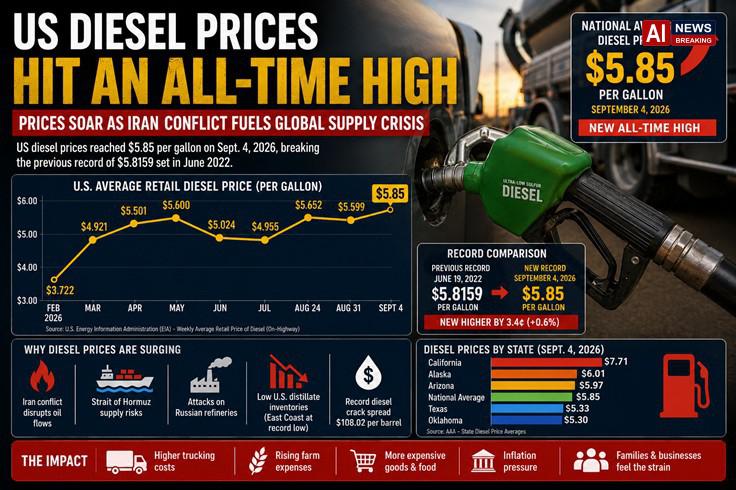
US Diesel Prices Hit Record $5.85 a Gallon as Iran War, Supply Crunch Push Fuel Costs to New High - AI News Breaking
diesel prices record gallon:
U.S. diesel prices have reached a new all-time nominal record of about $5.85 per gallon, surpassing the previous record of $5.8159 set in June 2022. The latest surge comes after months of disruption linked to the U.S.-Israel war with Iran, reduced fuel flows through the Strait of Hormuz and attacks affecting Russian refining capacity.
The increase is particularly significant because diesel was already under pressure before the latest escalation. EIA data show the national average at $3.722 a gallon in February 2026, compared with approximately $5.85 now — an increase of more than $2 a gallon, or roughly 57%.
US Diesel Prices Hit New All-Time High
U.S. diesel prices have climbed to an unprecedented nominal level, adding another major inflationary shock to an economy heavily dependent on diesel-powered transportation, agriculture, construction and industrial activity.
The national average price for diesel reached approximately $5.85 per gallon on September 4, 2026, according to the latest market data reported by major U.S. fuel-price trackers. That exceeds the previous national record of $5.8159 per gallon recorded by AAA on June 19, 2022, during the energy shock that followed Russia’s invasion of Ukraine.
The difference between the two records may look small at first glance — only around 3.4 cents per gallon — but the significance is much larger. The 2026 record comes after months of extreme volatility in global refined-fuel markets, with the Iran conflict, disruption around the Strait of Hormuz and damage to Russian refineries tightening the supply of diesel and other middle distillates.
Reuters reported on September 3 that U.S. diesel had already reached $5.820 per gallon, with prices having risen roughly 55% since the U.S.-Israel war with Iran began in late February. By September 4, AAA’s national average had moved higher still, to around $5.85.
The record is therefore not simply a one-day spike. It represents the culmination of a sustained deterioration in the diesel market.
Diesel Price Comparison: February to September 2026
The scale of the increase becomes clearer when the latest price is compared with the market before the Iran conflict.
According to the U.S. Energy Information Administration, the national average retail price for on-highway diesel was approximately $3.722 per gallon in February 2026. By March, the monthly average had jumped to $4.921, followed by $5.501 in April and $5.600 in May.
EIA’s subsequent monthly data show some moderation during early summer, with the average falling to approximately $5.024 in June and $4.955 in July. But the decline did not last. Weekly prices began moving higher again in August, reaching $5.652 on August 24 and remaining at $5.599 on August 31.
The latest AAA figure of roughly $5.85 therefore represents a dramatic reversal from the lower summer prices.
U.S. diesel price comparison
| Period | Average/Reported diesel price | Change from Feb. 2026 |
|---|---|---|
| February 2026 | $3.722/gal | — |
| March 2026 | $4.921/gal | +$1.199 |
| April 2026 | $5.501/gal | +$1.779 |
| May 2026 | $5.600/gal | +$1.878 |
| June 2026 | $5.024/gal | +$1.302 |
| July 2026 | $4.955/gal | +$1.233 |
| August 24, 2026 | $5.652/gal | +$1.930 |
| August 31, 2026 | $5.599/gal | +$1.877 |
| September 4, 2026 | ~$5.85/gal | ~+$2.13 |
| Previous record, June 19, 2022 | $5.8159/gal | — |
Sources: U.S. EIA and AAA. Monthly EIA figures are not directly equivalent to the daily AAA figure, but together they show the direction and magnitude of the market move.
From February’s EIA average of $3.722 to the latest $5.85 level, diesel has increased by roughly $2.13 per gallon, equivalent to about 57%.
That means a truck with a 150-gallon fuel tank would pay roughly $319 more to fill the tank at today’s price than it would have at the February average, before accounting for differences between individual stations and regions.
For fleets operating hundreds of trucks, the financial impact can quickly reach tens or hundreds of thousands of dollars.
How the 2026 Record Compares With the 2022 Record
The previous U.S. diesel record was established during the enormous energy-market disruption triggered by Russia’s invasion of Ukraine.
AAA’s historical data put the previous record national average at $5.8159 per gallon on June 19, 2022. The latest $5.85 level therefore exceeds the 2022 record by roughly 3.4 cents per gallon, or approximately 0.6%.
The numerical difference is small, but the circumstances are different.
In 2022, crude oil and refined products were disrupted following Russia’s invasion of Ukraine and the subsequent restructuring of global energy trade.
In 2026, the market is confronting another geopolitical shock — but this time the pressure is concentrated heavily in refined products such as diesel.
The current crisis involves several overlapping factors:
- The U.S.-Israel conflict with Iran
- Disruption around the Strait of Hormuz
- Reduced Middle Eastern refined-fuel exports
- Damage or disruptions involving Russian refineries
- Ukrainian attacks on Russian energy infrastructure
- Low U.S. distillate inventories
- High refinery margins
- Seasonal agricultural demand
- Expectations of increased heating-fuel demand heading into winter
The combination has produced an unusually severe squeeze in the diesel market.
Why Diesel Is Rising Faster Than Gasoline
Diesel and gasoline do not respond identically to changes in crude oil prices.
Diesel is a middle distillate, alongside products such as heating oil and jet fuel. Refiners must allocate crude oil and refinery capacity among several products, meaning that a disruption to refining capacity can have an especially powerful effect on diesel availability.
That is exactly what the current market is showing.
Reuters reported that the U.S. diesel crack spread — a measure of the difference between refined diesel prices and crude oil prices — reached a record $108.02 per barrel. Such an exceptionally wide spread indicates that refined diesel is commanding a very large premium relative to crude oil.
In other words, the problem is no longer simply that crude oil has become more expensive.
There is also a shortage of refining capacity and readily available diesel.
That distinction is important.
If crude oil rises but refineries have ample capacity and inventories are comfortable, retail fuel prices can rise relatively gradually.
When crude becomes expensive at the same time that refineries, inventories, shipping routes and international trade flows are under pressure, refined products can become dramatically more expensive.
That is what appears to be happening with diesel.
Strait of Hormuz Adds to the Supply Problem
The Strait of Hormuz has become one of the most important variables in the global energy market.
The narrow waterway between Iran and Oman is a critical route for crude oil, condensate and petroleum products moving out of the Persian Gulf.
Before the conflict, enormous quantities of energy products moved through the region every day.
Reuters reported that the Gulf previously transported roughly 900,000 barrels per day of diesel, equivalent to about 10% of global diesel supply. Disruptions to those flows therefore have consequences far beyond the Middle East.
The conflict has caused shipping companies, refiners and traders to reassess the risks of transporting fuel through the region.
Even when cargoes are not physically destroyed, increased insurance costs, longer shipping routes, delays and uncertainty can raise the effective cost of moving petroleum products.
Energy markets price those risks rapidly.
A refinery or fuel trader does not necessarily need to experience an immediate physical shortage before prices rise.
The possibility of future shortages can be enough.
Russia Is Another Major Part of the Diesel Story
The Middle East is not the only source of pressure.
Russia remains a major participant in global refined-product markets, and disruptions to its refining sector have further tightened diesel availability.
Ukraine’s attacks on Russian energy infrastructure have affected refinery operations and fuel exports.
The resulting supply loss matters because diesel markets are globally interconnected.
A shortage in one region can cause buyers elsewhere to compete for the same cargoes.
That competition raises prices internationally, which can then feed into U.S. wholesale markets.
Reuters said the current U.S. diesel surge was being driven by global supply disruptions associated with both the U.S.-Iran conflict and Ukrainian attacks on Russian refineries.
This creates a difficult situation for policymakers.
Even if U.S. domestic refinery production increases, American consumers can remain exposed to global diesel prices.
Oil and refined products are traded internationally, and the United States is part of that global market.
U.S. Diesel Inventories Are a Major Warning Signal
Perhaps the most concerning feature of the current market is the condition of diesel inventories.
EIA data show U.S. distillate fuel inventories at approximately 104.2 million barrels for the week ending August 28, up modestly from the previous week. But the regional picture is considerably more worrying.
East Coast distillate stocks stood at roughly 19.3 million barrels, according to EIA data, a record-low level for that measure. Reuters also highlighted the East Coast inventory squeeze as a major factor behind the current price surge.
That is particularly important because the East Coast is a major fuel-consuming region.
It also faces increasing heating-fuel demand as winter approaches.
Diesel and heating oil are closely related products. Consequently, refiners and fuel traders must prepare for competition between transportation demand and heating demand.
If inventories enter the winter season at unusually low levels, the market becomes much more sensitive to any additional disruption.
A refinery outage, severe storm, shipping interruption or unexpected increase in demand could produce another price spike.
The Numbers Show a Rapid Spring Shock
The EIA price history provides a clear picture of how quickly the market reacted after the conflict began.
The February 2026 monthly average was $3.722 per gallon.
By March, the average had climbed to $4.921.
That represents an increase of about $1.20 per gallon in a single month, or more than 32%.
The April average reached $5.501, taking the increase from February to nearly 48%.
May reached $5.600, while the market then eased during June and July.
The important point is that the market never returned to its pre-conflict pricing structure.
Even July’s $4.955 monthly average remained more than $1 per gallon above February’s level.
The subsequent August rebound pushed prices back toward the 2022 record.
By September, the record had been broken.
Diesel Prices Compared With a Year Ago
The year-on-year comparison is equally striking.
AAA’s September 3 data showed the national diesel average at $5.7832 per gallon, compared with $3.7047 a year earlier.
That represented an increase of approximately $2.08 per gallon, or more than 56%.
The September 4 record of roughly $5.85 makes the year-on-year increase even larger.
For consumers, this means the current diesel shock is not simply a temporary movement from already-high prices.
It is a major change from the fuel-price environment Americans faced one year earlier.
Gasoline Is Also Expensive — But Diesel Is the Bigger Problem for Industry
Gasoline prices have risen as well.
AAA reported a national regular gasoline average of approximately $4.14 per gallon on September 3, while diesel was approximately $5.78.
The difference is significant.
Diesel was therefore roughly $1.64 per gallon more expensive than regular gasoline at that point.
That spread matters because diesel is disproportionately important to commercial activity.
A gasoline driver can reduce consumption by driving less, using public transportation or switching to a more fuel-efficient vehicle.
A trucking company has far fewer options.
A long-haul truck must consume large quantities of diesel to move freight.
Farm equipment requires diesel.
Construction machinery requires diesel.
Heavy-duty generators and industrial equipment frequently rely on diesel.
Rail freight and maritime operations also depend heavily on diesel and related distillate fuels.
That means diesel inflation can pass through the economy even when households themselves do not purchase large quantities of diesel directly.
Trucking Industry Faces Another Cost Shock
The trucking industry is one of the first sectors to feel the impact of a diesel-price spike.
Fuel represents one of the largest operating costs for trucking companies.
The impact is particularly severe for smaller carriers and independent owner-operators.
Reuters reported earlier this year that diesel prices had already reached $5.38 per gallon by March 27, creating substantial pressure on an industry that was already dealing with weak freight conditions.
At that time, California diesel prices had reached roughly $7.17 per gallon, while Washington state was around $6.55.
The latest national record means the problem has now moved beyond isolated high-price states.
Fuel surcharges can help large carriers recover some of the additional expense from customers, but they do not eliminate the underlying cost.
Smaller trucking companies often have less negotiating power and less financial capacity to absorb sudden fuel-price increases.
That can result in:
- Higher freight rates
- Reduced margins
- Delayed vehicle purchases
- Lower investment
- Pressure on independent drivers
- Increased bankruptcies among financially weak operators
- Higher transportation costs for manufacturers and retailers
Ultimately, those costs can reach consumers.
Food Prices Could Feel the Impact
Diesel is deeply embedded in the food supply chain.
A typical agricultural supply chain can involve diesel consumption at multiple stages.
Farmers use diesel-powered tractors and harvesting machinery.
Fuel is required to transport grain, vegetables, livestock and other agricultural products.
Trucks move food from farms to processing facilities.
Refrigerated trucks then move finished products to distribution centers.
Additional trucks transport products from warehouses to supermarkets and restaurants.
When diesel prices rise by more than $2 per gallon compared with the February average, the additional cost is spread throughout this system.
The result is not necessarily an immediate one-for-one increase in grocery prices.
Food companies may absorb some costs.
Retailers may reduce margins.
Transport companies may apply fuel surcharges.
But if elevated diesel prices persist for months, a portion of the additional cost is likely to reach consumers.
The timing is especially problematic because the U.S. agricultural sector is entering the harvest period.
That creates additional seasonal demand for diesel precisely when inventories are under pressure.
Harvest Season Could Keep Diesel Demand High
The arrival of harvest season adds another layer to the market.
Farmers require large quantities of diesel to operate combines, tractors, trucks and other equipment.
Higher fuel costs therefore arrive at a particularly sensitive point in the agricultural calendar.
The combination of expensive fuel and expensive fertilizer can put significant pressure on farm profitability.
The Guardian reported that U.S. farmers were already confronting higher fuel and fertilizer costs as diesel prices approached record territory.
This creates a potential feedback mechanism.
Higher fuel costs increase the cost of producing and transporting crops.
Higher crop-production costs can increase food prices.
Higher food prices contribute to inflation.
Persistent inflation can complicate monetary-policy decisions.
Therefore, a diesel-price record can become an economic story far beyond the gasoline station.
Construction and Manufacturing Also Face Pressure
Diesel is essential to construction.
Excavators, bulldozers, loaders, cranes, generators and heavy trucks frequently rely on diesel.
When fuel costs rise, contractors must decide whether to absorb the increase or pass it on through higher project costs.
Large infrastructure projects can involve enormous quantities of fuel.
A sustained diesel shock can therefore increase the cost of:
- Roads
- Bridges
- Housing construction
- Commercial buildings
- Mining operations
- Infrastructure maintenance
- Excavation
- Industrial projects
Manufacturing can also be affected indirectly.
Factories depend on truck deliveries of raw materials and components, while finished products need transportation to customers.
Higher freight costs therefore increase the cost of moving goods throughout the economy.
California Is Far Above the National Average
The national average also hides significant regional differences.
AAA’s September 4 data show California with diesel prices around $7.71 per gallon, dramatically above the national average of approximately $5.85.
That means California diesel was roughly $1.86 per gallon more expensive than the national average.
The difference demonstrates why national averages should be treated cautiously.
A trucking company operating primarily in the Midwest may face a substantially different fuel bill from a carrier operating on the West Coast.
AAA’s data also show significant differences among other states.
For example, diesel in Alaska was around $6.01 per gallon, Arizona approximately $5.97, Connecticut about $5.86, and Colorado approximately $5.55 on September 4.
At the lower end, some states remained considerably below the national average.
The regional differences are influenced by refinery access, transportation infrastructure, state taxes, environmental regulations, supply patterns and proximity to major fuel markets.
Regional Price Snapshot
Selected diesel prices on September 4, 2026
| State | Diesel price per gallon |
|---|---|
| California | $7.7094 |
| Alaska | $6.0121 |
| Arizona | $5.9703 |
| Connecticut | $5.8611 |
| Colorado | $5.5466 |
| Alabama | $5.5665 |
| Arkansas | $5.5080 |
| Oklahoma | $5.3033 |
| National AAA average | ~$5.85 |
California’s figure is particularly notable because it places diesel almost $2 per gallon above the national average.
For a commercial truck purchasing 150 gallons, that difference alone represents nearly $279 per fill-up compared with the national average.
Why Refinery Margins Have Exploded
Another important feature of the current market is the extraordinarily high profitability of refining diesel.
The diesel crack spread exceeding $108 per barrel indicates that refiners can command a very large premium for converting crude into diesel.
Normally, a high crack spread encourages refiners to increase production.
That is already happening.
Reuters reported that U.S. refinery utilization reached approximately 98% in the week ending August 28, the highest level since August 2018. Refinery runs increased by about 103,000 barrels per day.
This is an important counterpoint to the record price.
The United States is not simply failing to refine enough crude.
Refiners are running extremely hard.
The problem is that supply disruptions and global competition are putting enormous pressure on the market at the same time.
U.S. Crude Inventories Are Not the Main Problem
U.S. crude inventories actually declined sharply during the latest reporting week.
EIA data cited by Reuters showed U.S. crude stocks falling by approximately 4.5 million barrels to 424.5 million barrels for the week ending August 28. Refinery utilization was around 98%, while U.S. crude exports increased significantly.
This illustrates the difference between crude availability and refined-product availability.
There can be substantial crude oil in the United States while diesel prices still surge.
The bottleneck can occur further down the supply chain.
Refineries must convert crude into products.
Those products must then be transported to consumers.
International supply disruptions can alter the balance between domestic production, imports and exports.
Consequently, looking only at crude inventories does not provide a complete picture of the diesel market.
The EIA Data Tell a More Complicated Story
The EIA’s weekly diesel data provide evidence that the market had already become expensive before the September record.
The U.S. average was:
- $5.313 on July 27
- $5.348 on August 3
- $5.257 on August 10
- $5.454 on August 17
- $5.652 on August 24
- $5.599 on August 31
The movement is important.
Diesel prices did not jump directly from $3.72 to $5.85.
Instead, the market moved through several stages:
February: pre-conflict pricing
March: immediate geopolitical shock
April-May: sustained high prices
June-July: partial correction
August: renewed tightening
September: record-breaking price
This pattern suggests that the current record is the result of cumulative supply stress rather than a single market event.
Why Prices Could Remain High
The biggest question now is whether diesel prices will retreat quickly or remain elevated.
Several factors point toward continued pressure.
1. Conflict risk remains high
As long as the conflict involving Iran continues to threaten oil and refined-product transportation, traders will maintain a geopolitical risk premium.
2. Hormuz remains critical
Any significant deterioration in shipping conditions through the Strait of Hormuz could trigger another surge.
3. Russian refinery disruptions continue to matter
Further attacks or outages could reduce global availability of diesel and other refined products.
4. East Coast inventories are exceptionally low
Low inventories leave the market vulnerable to unexpected disruptions.
5. Harvest demand is increasing
Agricultural fuel demand is seasonal and is rising at precisely the wrong time for the supply market.
6. Winter heating demand is approaching
Heating oil demand will increase as temperatures fall, creating additional competition for distillate production.
7. Refining capacity cannot expand instantly
Even with refineries operating at high utilization, increasing production substantially requires operational flexibility and adequate crude and feedstock availability.
What Could Bring Prices Back Down?
There are also several factors that could eventually ease the market.
A sustained reduction in geopolitical tensions would remove part of the risk premium.
Improved shipping through the Strait of Hormuz could restore international fuel flows.
Russian refinery operations could recover.
Higher U.S. refinery production could rebuild domestic inventories.
Lower seasonal demand later in the year could also help.
And if global crude prices decline, the reduction could eventually feed into wholesale and retail diesel markets.
However, the response would not necessarily be immediate.
Fuel prices can remain elevated even after a geopolitical shock begins to fade because inventories, contracts and supply chains take time to normalize.
That is one reason analysts remain cautious about predicting a rapid return to February price levels.
The Inflation Problem Is Bigger Than the Pump
The economic significance of the diesel record extends well beyond the transportation sector.
Diesel functions as an input into the production and movement of goods.
If fuel becomes more expensive, companies face higher operating costs.
Those costs can appear in:
- Freight rates
- Food transportation
- Agricultural production
- Construction
- Manufacturing
- Warehousing
- Delivery services
- Public transportation
- Heating expenses
- Industrial production
That makes diesel an important inflation transmission mechanism.
The Federal Reserve monitors inflation across the economy rather than simply watching fuel prices, but persistent energy-price increases can complicate the inflation outlook.
The latest surge therefore creates an additional challenge for policymakers attempting to balance inflation control against economic growth.
Diesel Is Now Nearly $2 Above Gasoline in Some Markets
The national price gap between gasoline and diesel is already unusually large.
AAA’s September 3 national averages were approximately:
Regular gasoline: $4.1436
Diesel: $5.7832
That represents a diesel premium of approximately $1.64 per gallon.
In California, the difference can be even more striking.
AAA reported regular gasoline at about $5.8078 per gallon and diesel at approximately $7.7094 on September 4.
That is a diesel premium of approximately $1.90 per gallon.
The disparity highlights the severity of the refined-distillate shortage.
The 2026 Diesel Shock Is Different From 2022
The 2022 record provides a useful benchmark, but today’s market has its own characteristics.
The Russia-Ukraine energy shock produced a massive rise in both crude and refined-product prices.
The 2026 market is being affected by several simultaneous disruptions.
The conflict with Iran has created a major geopolitical threat around one of the world’s most important energy corridors.
At the same time, Russian refining infrastructure has faced attacks.
Global refined-product inventories are under pressure.
And the seasonal cycle is moving toward higher diesel consumption.
The combination means that diesel prices are not simply following crude oil higher.
They are reflecting a shortage of available refined products.
What the Record Means for American Consumers
For the average consumer, the most visible impact may not be the price of diesel itself.
It is the cost of everything that moves by truck.
A supermarket does not purchase all of its products directly from farms.
Food moves through multiple transportation stages.
A refrigerator, washing machine, television or piece of furniture may travel hundreds or thousands of miles before reaching a customer.
Construction materials also travel.
Fuel is therefore embedded in the cost structure of the economy.
When diesel rises from around $3.72 to $5.85, the additional cost does not remain confined to fuel stations.
It moves through supply chains.
That is why diesel prices are closely watched by economists, transportation companies, farmers, retailers and manufacturers.
A $2 Increase Is Enormous for Heavy Users
Consider a hypothetical heavy-duty truck consuming 100 gallons during a particular operating cycle.
At $3.72 per gallon, the fuel cost would be approximately $372.
At $5.85 per gallon, the same fuel purchase costs approximately $585.
The difference is $213.
For a truck consuming 500 gallons over several operating cycles, the additional cost would be more than $1,000.
For a fleet consuming hundreds of thousands of gallons, the increase becomes a major operating expense.
That is why fuel surcharges have become increasingly important in freight contracts.
But surcharges generally shift the cost rather than eliminate it.
Ultimately, another company — and often eventually the consumer — pays.
The Critical Winter Test Is Still Ahead
Perhaps the biggest concern is that the market is entering another period of seasonal pressure.
Diesel demand does not disappear after the harvest.
Heating-oil demand begins to rise as winter approaches, especially in the Northeast.
The East Coast already has exceptionally low distillate stocks.
EIA data showed PADD 1 distillate inventories at approximately 19.318 million barrels at the end of August, a record-low level for that series.
That creates a particularly uncomfortable scenario.
The region needs to rebuild inventories while simultaneously competing for global supplies.
If international refined-product markets remain tight, rebuilding those stocks could require higher prices.
If another supply disruption occurs, prices could move even higher.
Could Diesel Reach $6 a Gallon?
The national average is already around $5.85.
That means the psychological $6-per-gallon threshold is extremely close.
Whether the national average crosses $6 will depend on crude prices, refinery margins, inventories, international shipping and geopolitical developments.
It is important not to treat $6 as a guaranteed outcome.
But the distance between the current record and $6 is now only around 15 cents per gallon.
Given the volatility seen since February, such a move cannot be dismissed.
The more important question is not simply whether diesel briefly crosses $6.
It is whether prices remain near that level long enough to affect inflation expectations, freight contracts, farm profitability and consumer prices.
The Bigger Economic Picture
The new diesel record is a warning about the vulnerability of modern supply chains to energy shocks.
The United States has substantial domestic energy production and significant refining capacity.
Yet global energy markets mean that domestic consumers remain exposed to events thousands of miles away.
A disruption in the Middle East can raise U.S. fuel prices.
An attack on a Russian refinery can affect American diesel costs.
Shipping problems in a narrow maritime corridor can influence the price paid by a farmer in the Midwest.
This interconnectedness is one of the defining features of the modern energy economy.
It also means that solving a domestic fuel-price problem can require more than increasing domestic oil production.
Refining capacity, transportation infrastructure, inventories, international trade and geopolitical stability all matter.
What to Watch Next
Several indicators will determine whether the diesel record becomes a short-lived spike or the beginning of a prolonged energy-price crisis.
Oil prices
Brent and WTI crude prices remain the foundation of the fuel market. Reuters reported Brent around the mid-$90s during the latest escalation, with renewed fighting pushing crude higher.
Diesel crack spreads
A persistently extreme crack spread would indicate that refined diesel remains unusually scarce relative to crude.
East Coast inventories
The 19.3-million-barrel level is a critical warning sign. A sustained rebuilding of inventories would be positive; further declines would raise concern.
Refinery utilization
U.S. refineries were already operating near 98% utilization. That leaves relatively limited room for further increases without additional capacity or operational changes.
Hormuz shipping
Any improvement in shipping through the Strait could reduce supply pressure. Further disruption could have the opposite effect.
Russian refinery output
Recovery of Russian refining operations could provide additional international supply.
Agricultural demand
The harvest season could maintain strong diesel consumption in the coming weeks.
Heating demand
The arrival of colder weather could add another major demand source.
Conclusion: A New Diesel Record With Broader Economic Consequences
The United States has entered a new era of diesel-price pressure.
The national average has reached approximately $5.85 per gallon, breaking the previous nominal record of $5.8159 set in June 2022.
Compared with the EIA’s $3.722 February 2026 average, the latest price represents an increase of roughly $2.13 per gallon, or about 57%.
The surge has been driven by a combination of geopolitical conflict, disrupted oil and refined-product flows, pressure on Russian refining capacity, exceptionally high diesel refining margins and depleted inventories.
The most worrying part of the story may be that the market is entering a period when diesel demand could increase further.
Farmers are moving through harvest season.
The Northeast is preparing for winter heating demand.
East Coast inventories are already at exceptionally low levels.
And global shipping remains vulnerable to geopolitical disruption.
The result is a fuel market with little room for error.
If geopolitical tensions ease and international fuel flows normalize, diesel prices could eventually retreat.
But if disruptions persist, the current $5.85 record may prove to be a milestone rather than a ceiling.
For American consumers, the consequences will extend far beyond the diesel pump. Higher diesel costs mean higher costs for trucking, farming, construction and industrial transportation — and those costs can eventually appear in the prices of food, goods and services.
The new diesel record is therefore not merely a story about fuel.
It is a story about the cost of moving the American economy.
AI Insight: The latest diesel record shows how quickly a geopolitical crisis can move from an overseas energy disruption into the everyday economics of American businesses and households. The most important signal is not simply that diesel has crossed $5.85 per gallon, but that the price is being supported by a combination of low inventories, exceptionally high refining margins, constrained international supplies and seasonal demand. The EIA data suggest the market entered the Iran conflict at roughly $3.72 per gallon and has never sustainably returned to that level. With East Coast distillate stocks at a record-low 19.3 million barrels and refineries already operating near maximum utilization, additional supply disruptions could have an outsized effect. The key economic risk is therefore not a temporary record at the pump, but a prolonged period of elevated diesel prices that feeds into freight, food, agriculture and inflation. If geopolitical tensions ease, the market has room to correct; if they intensify while winter demand rises, the United States could face a much broader diesel-driven inflation shock.