
 Revival Rugs Birthday Sale: 20 Percent Off Sitewide Through Sunday
  Ohio mayor says employee error caused chemical leak, lifts evacuation orders
  Nabi, Rashid and quicks lead Afghanistan to tri-series title
  How a U.K. Official’s Wife Set Off a Debate Over Free Speech and Palestinians
  IIT Bombay scholar builds low cost air purifier starting at ₹2,000, can bring down AQI by 85% – How he did it? Details
 India Replaces Indonesia as Asia’s Least-Preferred Stock Market in BofA Survey as Investors Flag AI Gap, Growth Concerns
India has replaced Indonesia as Asia’s least-preferred stock market in Bank of America’s latest fund manager survey, with investors raising concerns over limited AI exposure, economic growth, high valuations and reforms despite strong corporate earnings and renewed foreign investment.
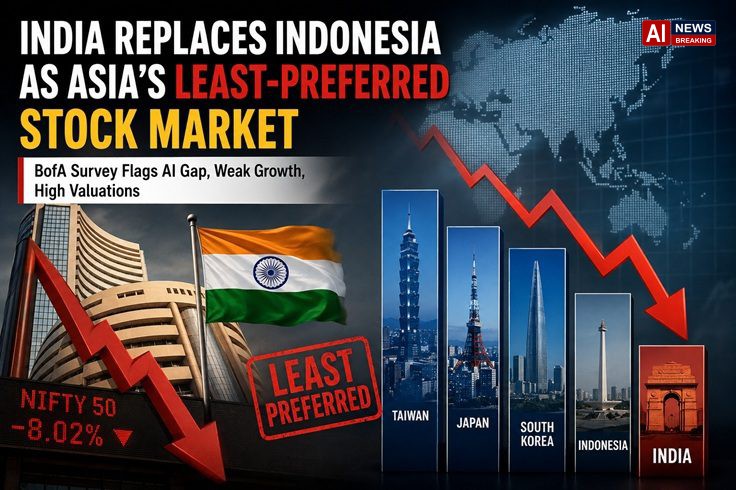
India Replaces Indonesia as Asia's Least-Preferred Stock Market in BofA Survey as Investors Flag AI Gap, Growth Concerns - AI News Breaking
india replaces indonesia asias:
New Delhi, August 19, 2026: Indian equities have slipped to the bottom of global fund managers’ preference list in Asia, with Bank of America’s latest fund manager survey showing growing caution over the country’s stock market despite improving corporate earnings and renewed foreign investment.
According to the August Bank of America survey, 32 per cent of respondents were net underweight on Indian equities, making India the least-preferred stock market in Asia and replacing Indonesia at the bottom of the ranking. The survey covered 98 fund managers overseeing $272 billion in assets, with responses collected between August 7 and August 13.
The shift in investor sentiment highlights a growing disconnect between the performance of Indian companies and the way international portfolio managers are assessing the Indian market. While corporate earnings have shown signs of resilience and foreign investors have returned to Indian shares in recent months, concerns over valuations, economic growth, structural reforms and India’s relatively limited exposure to the global artificial-intelligence investment cycle are weighing on sentiment.
Key Points
- India has replaced Indonesia as Asia’s least-preferred stock market in Bank of America’s latest fund manager survey.
- 32% of fund managers were net underweight on Indian equities, with AI exposure, economic growth and valuations among the key concerns.
- Lack of clear AI exposure has emerged as the biggest concern for investors compared with markets such as Taiwan and Japan.
- Despite weak sentiment, Nifty 50 companies recorded around 18% year-on-year earnings growth, while foreign investors have bought more than $4 billion of Indian stocks this quarter.
- Indonesia has regained investor favour, while Taiwan and Japan remain among Asia’s preferred markets, highlighting the increasingly competitive environment for Indian equities.
Lack of AI exposure emerges as biggest concern
The most significant concern identified by fund managers was the lack of clear artificial-intelligence exposure in Indian equities.
The AI investment boom has become one of the dominant themes in global equity markets, particularly in the United States and parts of Asia. Investors have increasingly focused on semiconductor manufacturers, data-centre operators, cloud-computing companies and other businesses positioned to benefit directly from rising AI-related capital expenditure.
India has a large technology-services industry, but its stock-market exposure to the AI infrastructure theme is viewed as less direct than that of markets such as Taiwan, Japan and South Korea. This has become increasingly important as global investors compare markets not only on traditional measures such as earnings growth and valuations, but also on their exposure to the next phase of technological investment.
For international fund managers, the question is therefore not simply whether Indian companies can deliver earnings growth, but whether the Indian equity market provides sufficient exposure to the investment themes currently driving global capital allocation.
Weak growth and high valuations add to investor caution
After AI exposure, weak economic growth emerged as another major concern for investors. High valuations and a perceived lack of reforms were also cited as reasons for maintaining a bearish stance on Indian equities.
India’s stock market has faced a difficult year. The Nifty 50 has declined by roughly 8 per cent in 2026, making it one of the weaker-performing major equity markets in Asia. The benchmark has nevertheless recovered around 8 per cent from its March low, indicating that the market has not remained under uninterrupted selling pressure.
The combination of relatively expensive valuations and slower-than-expected growth has created a difficult equation for global investors. When valuations are high, investors generally demand stronger earnings growth or clearer structural catalysts to justify maintaining large allocations.
The latest BofA survey suggests that some international investors are currently not convinced that Indian equities offer that combination.
India’s fall contrasts sharply with Indonesia’s recovery
India’s position at the bottom of the Asian preference table is particularly notable because Indonesia has moved up from the least-preferred position.
In the latest survey, around 27 per cent of fund managers were net underweight on Indonesian equities, compared with 32 per cent in July. The improvement in sentiment has coincided with a strong rebound in Indonesia’s benchmark stock index, which has gained more than 20 per cent from its June low.
The change means that India is now carrying the weakest relative positioning among the Asian markets tracked by the survey, while Indonesia has benefited from improving investor sentiment.
Taiwan and Japan remain among the most-preferred markets in the region, reflecting investors’ continued interest in markets with stronger exposure to technology, manufacturing, artificial intelligence and other global investment themes.
Foreign investors are returning despite the negative sentiment
One of the most striking aspects of the BofA survey is that the negative investor positioning comes at a time when foreign capital has begun returning to Indian equities.
Global investors have purchased more than $4 billion of Indian stocks during the current quarter, according to data cited in recent coverage. That represents a significant change after heavy foreign selling earlier in the year.
The return of foreign buying suggests that the BofA survey should not be interpreted as evidence that international investors have completely abandoned India.
Instead, the results point toward a more selective approach. Some investors may be willing to deploy capital into individual Indian companies or sectors while remaining cautious about the broader market because of valuation concerns and the relative attractiveness of other Asian markets.
This distinction is important. A market can experience substantial foreign inflows while still being ranked as the least preferred market in a relative allocation survey.
Corporate earnings provide a counterpoint
India’s corporate earnings picture also offers a counterargument to the pessimistic market ranking.
Earnings for companies in the Nifty 50 rose about 18 per cent year-on-year in the latest three-month period, significantly exceeding an earlier estimate of around 10 per cent, according to data cited in reports on the BofA survey.
That improvement suggests that the underlying corporate sector is not necessarily experiencing the deterioration implied by the market’s weak relative performance.
Instead, investors appear to be demanding more from Indian equities. Strong earnings alone may not be sufficient to attract large portfolio allocations when competing markets offer more attractive valuations, stronger technological exposure or clearer near-term catalysts.
The divergence between earnings and investor preference therefore remains one of the most important features of the current Indian equity-market environment.
Energy prices and geopolitical risks remain an additional challenge
Indian equities are also vulnerable to developments in global energy markets because India remains heavily dependent on imported crude oil.
Higher oil prices can increase India’s import bill, put pressure on the current account and inflation outlook, and potentially reduce corporate margins and consumer purchasing power.
Recent geopolitical tensions and disruptions involving the Middle East have added another layer of uncertainty for investors. Indian stocks were previously identified as the least-preferred market in the BofA survey in May when rising energy costs were putting pressure on the country’s growth outlook.
A sustained rise in crude prices could therefore make it more difficult for India to overcome the concerns already identified by international investors.
A dramatic reversal in investor sentiment
The latest survey also represents a striking change from the perception of India among global investors in previous periods.
In May 2025, India was the most-preferred Asia-Pacific equity market in a BofA survey, with a net 42 per cent of fund managers favouring Indian equities over other major markets.
The subsequent deterioration demonstrates how quickly international portfolio preferences can change when valuations, global trade conditions, currency movements, economic growth expectations and geopolitical risks shift.
India’s current position should therefore be viewed as a measure of relative investor preference rather than a definitive verdict on the long-term health of the Indian economy.
What the BofA survey means for Indian investors
For domestic investors, the survey does not automatically signal that Indian stocks are headed for a prolonged decline.
Foreign fund managers are only one part of India’s equity market, which has increasingly been supported by domestic institutional investors and retail participation. Moreover, improving corporate earnings and renewed foreign buying indicate that there are still investors willing to take positions in Indian companies.
However, the survey does highlight several risks that could influence the market in the months ahead.
The first is valuation. If earnings growth fails to accelerate sufficiently, elevated valuations could continue to limit the upside for major benchmarks.
The second is global technology exposure. As artificial intelligence increasingly influences international capital flows, Indian companies and policymakers may face greater pressure to demonstrate that the country’s technology ecosystem can capture a meaningful share of the AI investment cycle.
The third is economic growth. Stronger domestic demand, private investment and productivity growth would help address one of the principal concerns highlighted by global fund managers.
Finally, investors will continue to watch the pace of structural reforms and developments in energy prices, both of which can materially influence India’s attractiveness relative to competing Asian markets.
India’s challenge is relative, not simply absolute
The latest BofA survey ultimately tells a more complicated story than the headline suggests.
India has not suddenly become an unattractive economy. Corporate earnings are improving, foreign investors have begun returning and the benchmark indices have recovered from their lows.
But international investors are comparing India with alternatives.
Taiwan offers direct semiconductor exposure. Japan has benefited from corporate reforms and strong investor interest. Other Asian markets are increasingly positioned around technology, manufacturing, commodities or other global investment themes.
Against that backdrop, India’s combination of relatively high valuations, concerns about growth, limited direct AI exposure and questions over the pace of reforms has made it harder for the market to retain its previous position among global investors’ favourites.
For Indian equities, the next test will be whether stronger earnings and renewed foreign inflows can eventually overcome those concerns.
For now, however, Bank of America’s latest survey sends a clear message: global fund managers have become significantly more cautious about Indian stocks, and India has replaced Indonesia as Asia’s least-preferred equity market.