 Tao Tokyo Spring 2027
  Karnataka SIR: Teaching on the back burner
  Trump administration offers mixed messages on limits to Ukraine’s Starshield access
  US Treasury proposes a rule to crack down on high-tech investments in China, other adversaries
  Calley Means, a key MAHA advocate, resigns as a top RFK Jr. adviser
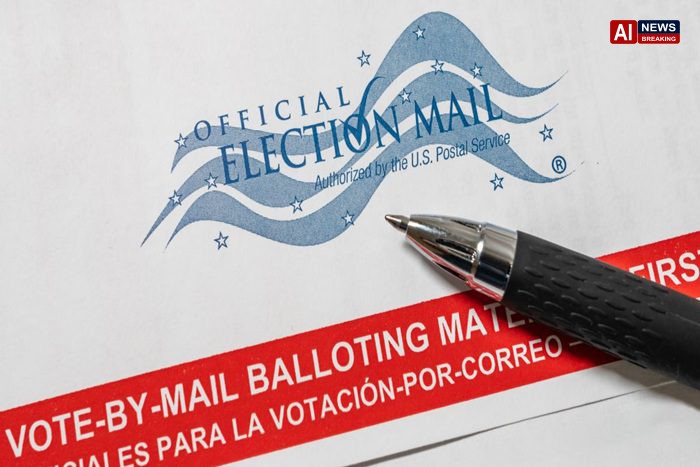
 US Supreme Court Lifts Key Block on Trump’s Mail-In Voting Order Ahead of 2026 Midterms
US Supreme Court Lifts Key Block on Trump's Mail-In Voting Order Ahead of 2026 Midterms - AI News Breaking
supreme court lifts block:
The United States Supreme Court on Tuesday issued a temporary order that allows the administration of President Donald J. Trump to enforce a set of restrictions on mail‑in voting that had been challenged in lower courts. The decision, delivered without a full briefing or oral argument, grants the executive branch a narrow window to implement the rules while the Court’s full docket continues to consider the broader legal questions surrounding the order.The order stems from an executive directive issued in February that sought to tighten the standards for accepting absentee ballots..
Among the provisions are new requirements that states verify a voter’s identity before a ballot is mailed, that election officials retain a paper copy of every absentee ballot, and that ballot drop boxes be supervised at all times. The administration argues that these measures are necessary to safeguard the integrity of elections and to prevent what it describes as “widespread fraud” in the mail‑in voting process.Opponents of the directive, including the Democratic National Committee, a coalition of state election officials, and several civil‑rights groups, contend that the rules amount to an unconstitutional intrusion into state‑run election administration. They argue that the federal government lacks the authority to dictate procedural details that have traditionally been left to the states, and that the measures would disproportionately disenfranchise voters who rely on absentee voting, particularly seniors, people with disabilities, and minority communities.In its brief order, the Supreme Court did not address the merits of the case but instead granted a stay of the lower‑court injunctions that had blocked the rule’s implementation..
The justices indicated that the stay was granted “pending further briefing and oral argument,” a phrase that signals the Court’s willingness to review the issue in depth at a later date. The decision, however, effectively restores the Trump administration’s ability to enforce the new standards for the upcoming 2026 mid‑term elections, a cycle that will see thousands of voters casting ballots by mail across the country.Legal analysts note that the Court’s move is consistent with its recent pattern of allowing executive actions to proceed while substantive challenges are litigated. “The justices are giving the administration a chance to test the rules on the ground,” said Professor Elena Ramirez, a constitutional law scholar at Georgetown University..
“If the rules are applied, the lower courts will have a concrete record to evaluate, which could shape the Court’s eventual ruling.”The decision arrives at a moment of heightened political tension over voting rights. Since the 2020 presidential election, which saw an unprecedented surge in mail‑in ballots due to the COVID‑19 pandemic, lawmakers and activists have been locked in a series of battles over the balance between election security and voter access. Republican‑led legislatures in several states have passed laws tightening absentee voting requirements, while Democrats have pursued measures to expand mail‑in voting and early‑voting windows..
The Supreme Court’s temporary order adds a federal dimension to a debate that has largely been fought at the state level.Critics of the ruling argue that the Court’s intervention undermines the principle of federalism that underpins the Constitution’s allocation of election administration to the states. “This is an unprecedented federal intrusion into a domain that has been, for centuries, the preserve of state law,” said Marisol Ortega, director of the voting‑rights organization Fair Vote USA. “By allowing the executive branch to impose nationwide standards, the Court is effectively rewriting the rules of the game without congressional approval.”Supporters, however, contend that the federal government has a vested interest in ensuring uniform standards for a process that has become increasingly national in scope..
“Mail‑in voting is no longer a local curiosity; it is a critical component of our democratic infrastructure,” said Senator James Whitmore (R‑OH), a vocal advocate of the administration’s policy. “The Court’s decision recognizes the need for a consistent, secure framework that can be applied across all states.”The temporary nature of the order means that the policy could be altered or rescinded pending the Supreme Court’s final determination. In the meantime, state election officials are expected to begin revising their procedures to comply with the new requirements..
Some states have already announced plans to adjust their absentee ballot handling processes. In Arizona, for example, the ary of State’s office has indicated that it will adopt the identity‑verification protocol for mailed ballots starting next month. In contrast, Colorado, which has long championed no‑excuse mail voting, has signaled its intention to challenge the federal directive in state court.The ruling also about the practical impact on voter turnout..
Historically, mail‑in voting has been associated with higher participation rates, especially among demographic groups that face barriers to in‑person voting. A study by the Pew Research Center found that in the 2020 election, about 46 percent of all votes were cast by mail, a figure that contributed to a record‑high voter turnout. Critics fear that tightening the process could reverse these gains and lead to a decline in overall participation.Election officials are now tasked with navigating a complex legal landscape as they prepare for the 2026 cycle..
The Department of Justice has issued guidance to states, emphasizing that the new rules are intended to be “reasonable, narrowly tailored, and minimally burdensome.” Yet the guidance also warns that failure to comply could result in federal enforcement actions, including the potential withholding of federal election‑aid funds.In Washington, the political fallout is already evident. Senate Majority Leader Chuck Schumer (D‑NY) denounced the Supreme Court’s decision as “a step backward for democracy,” calling for congressional legislation to protect the right to vote by mail. Conversely, House Minority Leader Kevin McCarthy (R‑CA) praised the ruling as a “common‑sense measure” that will restore confidence in the electoral system.The case is expected to return to the Supreme Court for full argument later this year, with both sides preparing extensive briefs..
The administration’s legal team, led by Solicitor General Elizabeth Hooper, is expected to argue that the Constitution grants the federal government the authority to enact reasonable standards to protect the electoral process. The plaintiffs, represented by civil‑rights attorney Maya Patel, will likely contend that the order violates the Elections Clause of the Constitution and the Fourteenth Amendment’s guarantee of equal protection under the law.As the legal battle unfolds, the immediate practical effect of the Court’s temporary order is clear: the Trump administration can move forward with its mail‑in voting restrictions, and state officials must adapt quickly to avoid federal penalties. Whether the policy will stand after full judicial review remains uncertain, but the decision marks a significant moment in the ongoing national conversation about how best to balance election security with the fundamental right to vote..
The Supreme Court has issued a temporary stay, allowing the Trump administration to enforce new mail‑in voting restrictions while the case returns for full review. The ruling enables the federal government to impose identity‑verification, paper‑copy retention and supervised drop‑box requirements nationwide, prompting state officials to adjust procedures amid a broader debate over election security and voter access.
By letting these rules take effect before ruling, the Court is essentially baking in logistical inertia that will be hard to unwind.
This creates a de facto standard that states must adopt, shifting the burden of proof away from voters and onto the system’s flexibility.